
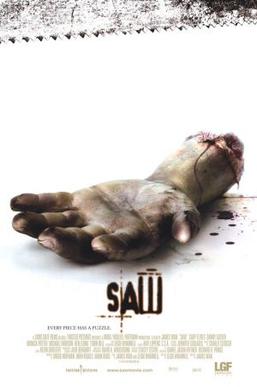
Behind the film
- Year
- 2004
- Director
- James Wan
- Writers
- Leigh Whannell, James Wan
- Genres
- Gore, Horror, Crime
- Production
- Evolution Entertainment, Twisted Pictures
- Country
- United States
- Cast
- Leigh Whannell, Cary Elwes, Danny Glover, Monica Potter, Michael Emerson, Tobin Bell, Shawnee Smith, Ken Leung
About the film
Contains story spoilers.
Saw begins with two men who have to discover the shape of their captivity before they can begin to argue about it. Adam wakes in a filthy bathtub, while Dr. Lawrence Gordon is chained on the opposite side of the room. Between them lies a body with a gun and a recorder. They cannot comfortably reach one another, and the objects they find have meanings that depend on information somebody else has chosen to provide. The bathroom is both a physical prison and an incomplete set of instructions. Its stained surfaces and hard lighting make it feel abandoned, but the arrangement of the men and objects suggests that someone has prepared it with precise intentions.
The recorded messages give their situation a deadline and make their interests unequal. Adam is told to survive; Lawrence is ordered to kill him before six o'clock or lose his wife and daughter. A possibility of cooperation immediately becomes entangled with a reason for betrayal. The men search for clues and discover tools that cannot simply release their chains, realizing that the proposed escape demands a terrible bodily cost. Lawrence recognizes the methods associated with Jigsaw, a killer whose traps force victims into desperate decisions. His knowledge offers Adam an explanation, but it also gives him a reason to question how a doctor could be so familiar with the person who imprisoned them.
Flashbacks bring a police investigation into the room. Detectives David Tapp and Steven Sing had questioned Lawrence after finding his penlight at the scene of an earlier crime, although an alibi cleared him. Lawrence also heard the account of Amanda, a survivor whose ordeal appeared to confirm Jigsaw's claim that terror could change somebody's attitude toward life. The killer treats that survival as justification for his methods; the film shows the coercion on which the supposed lesson depends. Tapp and Sing followed a lead to a warehouse and almost caught their suspect, but the encounter left Sing dead and Tapp injured. Tapp's later obsession continues beyond the investigation that first gave him authority.
Adam and Lawrence are connected before they ever enter the bathroom. Adam had been paid by Tapp to photograph the doctor, bringing Lawrence's private conduct into a case the detective could not let go. Lawrence had concealed an affair, while Adam concealed the surveillance that put him outside the doctor's movements. Their discoveries make the room feel less like a random abduction and more like the closing point of several lives watched from a distance. Neither has enough information to know which confession will improve the situation. The camera observing them adds another layer: they are trying to interpret each other while somebody outside can see a performance they cannot fully control.
Lawrence's wife Alison and their daughter Diana are also captive, held by Zep Hindle, an orderly the doctor knows from the hospital. Alison has to act while Lawrence hears fragments of what is happening through a telephone. Tapp watches the house, convinced that it remains connected to the man he suspects. When Alison frees herself and fights Zep, Tapp intervenes and follows him away, but is shot during the pursuit. The doctor cannot see that his family has gained an opening. Gunshots and cries reach the bathroom without the context that would let him understand them, making the difference between knowing and hearing central to his panic.
Lawrence finally harms himself to escape the chain and shoots Adam in a desperate attempt to satisfy the demand. Adam survives, and when Zep enters the bathroom, he attacks and kills him. Lawrence crawls away seeking help, promising to return for Adam. His departure gives one prisoner a route out without making the room's history clear. Searching Zep's body appears to offer Adam a final answer, but another recording reveals that the orderly was also being forced to participate. Poisoned and seeking an antidote, Zep had been following a set of instructions rather than designing the ordeal. The apparent controller becomes another person caught inside a wider arrangement.
The body in the middle of the bathroom then stands up. John Kramer, the hospital patient seen in the earlier scenes, has been present throughout the men's struggle and is the real Jigsaw. The position that looked like evidence of a previous victim has concealed the person watching them most closely. Adam learns that an escape key was lost down the bathtub drain when he woke, giving his first confused movements a consequence he could not understand at the time. John leaves and shuts the door, abandoning him in darkness. The ending resolves the identity behind the arrangement while refusing the reassurance of a successful police rescue or a promised return.
James Wan and writer Leigh Whannell build the suspense through competing accounts of the same events. The bathroom conversations, police flashbacks and scenes at Lawrence's home interrupt one another, so a new piece of information can change the significance of something already shown. The restricted room makes distances matter: a phone, a body or a hidden clue can be visible without being conveniently available. Beyond it, investigators and captives also act on incomplete knowledge. The final revelation turns the room's most passive-looking object into its central presence, but the tension has already depended on how readily certainty can be manufactured. Jigsaw supplies the rules and claims the right to judge; everyone else is left to discover how little those rules actually allow them to choose.