
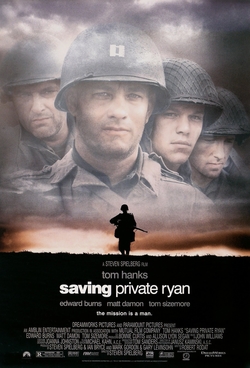
Behind the film
- Year
- 1998
- Director
- Steven Spielberg
- Writers
- Robert Rodat
- Runtime
- 2h 49m
- Genres
- War, Drama, Action
- Production
- Amblin Entertainment, Mutual Film Corporation, Paramount Pictures
- Country
- United States
- Cast
- Tom Hanks, Matt Damon, Tom Sizemore, Edward Burns, Barry Pepper, Adam Goldberg, Giovanni Ribisi, Jeremy Davies
About the film
Contains story spoilers.
Steven Spielberg’s Saving Private Ryan begins with an elderly veteran visiting the American cemetery at Normandy, then moves into the D-Day landing through Captain John Miller and the soldiers around him. The Omaha Beach sequence follows the confusion of men coming ashore under German fire: orders are hard to hear, equipment is lost in the surf, and survival depends on moving forward through immediate danger. Once Miller’s group secures a position, the discovery that one fallen soldier’s name is Ryan connects the landing to a separate military decision. The central mission grows out of one family’s losses and becomes a test of what one life is worth to a unit.
Army leaders learn that three Ryan brothers have been killed in action and order the remaining son, Private James Ryan, to be found and sent home. Miller is chosen to lead the search, taking a small team away from the front line and into territory where information is unreliable. His men include Sergeant Horvath, the steady second-in-command; Reiben, who questions the purpose of the assignment; and Upham, a translator with little combat experience. The mix gives the mission arguments as well as obstacles. Miller is not free to ignore his orders, but his authority is strained by the knowledge that every mile toward Ryan exposes his own soldiers to new risk.
The search takes the group through villages and units whose members may know where Ryan has gone. After losing Caparzo, they find another soldier named James Ryan and discover that he is not the man they need. The detour makes the task feel less like a straightforward rescue than an information problem unfolding in the middle of a war. Caparzo’s attempt to help a French child ends in his death, leaving the men with a fresh example of how compassion can collide with orders and danger. Miller keeps the group moving, but each loss adds weight to Reiben’s question: why should this squad risk itself for one soldier when other men are also trapped in combat?
The mission nearly breaks the group before they reach Ryan. Medic Wade dies during an attack on a German gun position, and Miller’s decision to release a prisoner brings their anger to the surface. He calms the confrontation by revealing the civilian life he has kept private: he was a teacher. At Ramelle, the real Ryan refuses to abandon the men defending a vital bridge. Miller chooses to stay and help hold it, giving the search a new purpose without removing the danger. The team prepares positions and improvised defences for an approaching German force. Ryan is now a person arguing for his comrades, rather than a name on an order the squad has resented for miles.
The battle at Ramelle brings the mission’s arguments into action. Jackson’s position as a sniper and the team’s improvised defences slow the German force, but the fight takes a severe toll. Upham, assigned to carry ammunition between positions, freezes when Mellish is attacked and cannot bring himself to intervene. The moment becomes a lasting fracture in how he sees himself and the other men. Miller is shot as reinforcements arrive; the German prisoner the squad had earlier released returns among the attackers, and Upham later confronts and kills him. The bridge is held, but survival does not make the decisions leading to it feel simple or fair.
As Miller dies, he tells Ryan to earn the sacrifices made to bring him home. The line travels forward to the cemetery framing scene, where the elderly Ryan stands at Miller’s grave with his family. He tells his wife that he has tried to live a good life and asks whether he has been a good man. The film does not give that question a neat public answer. It places the ordinary span of Ryan’s life beside the brief service of the men who died around him, making remembrance a responsibility that continues after the battle. The opening and closing cemetery scenes also give the military story a personal frame rather than presenting it as a detached campaign history.
Spielberg and cinematographer Janusz Kaminski keep the camera close to the soldiers’ bodies and limited sightlines, especially during the landing and final defence. Muddy water, obstructed views and abrupt shifts between noise and quiet make combat feel disorienting rather than neatly choreographed. The search scenes change that rhythm: conversations in villages and units create room for the squad’s disagreements to surface before the next confrontation. Miller’s hand tremor and reluctance to explain his civilian past add strain to his command without making him a distant symbol. The central tension stays specific: an order meant to spare one family further loss may demand that another group accept losses of its own. The squad’s arguments keep the abstract order attached to actual faces, particularly when the men compare Ryan’s family loss with the danger facing their own group. That ethical dispute never removes the military facts of the journey: they still have to locate Ryan, reach him before the battle shifts, and decide what to do when he refuses extraction. The film’s scenes of ordinary conversation give those decisions room to breathe before the action closes around them again.