
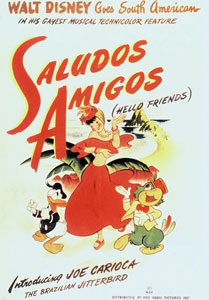
Behind the film
- Year
- 1942
- Director
- Norm Ferguson, Wilfred Jackson, Jack Kinney, Hamilton Luske, Bill Roberts
- Writers
- Homer Brightman, William Cottrell, Richard Huemer, Joe Grant, Harold Reeves, Ted Sears
- Runtime
- 42m
- Genres
- Musical, Fantasy, Live-action/animated, Documentary
- Production
- The Walt Disney Company, Walt Disney Animation Studios
- Country
- United States
- Cast
- Clarence Nash, Pinto Colvig, José Oliveira, Walt Disney
About the film
Contains story spoilers.
Saludos Amigos is a short hybrid film rather than a feature with one continuous story. It joins travel footage of South America with four animated episodes, presenting the Disney artists’ journey as the frame for the cartoons. The structure moves between the people sketching and the characters they create, so observation turns into caricature, music and comedy. The film emerged from a 1941 goodwill trip by Walt Disney and a group of studio artists through parts of South America. That context is part of its shape: the movie introduces its landscapes and characters as an exchange, though it reflects the perspective of American visitors making an entertainment for a broad audience.
The first animated stop is Lake Titicaca, where Donald Duck travels through the Andes and tries to navigate unfamiliar terrain. The comedy comes from the mismatch between Donald’s impatient confidence and a landscape that does not cooperate with his expectations. He is drawn into an encounter with a local boy and a llama, and his journey becomes a sequence of mishaps rather than a conquest of the place. The live-action material around the segment shows artists observing the region, then turns those impressions into simplified animated action. Donald’s familiar temper gives viewers an entry point, while the setting supplies the surprises that keep his reactions changing.
Pedro shifts the focus from a famous duck to a tiny airplane carrying mail across the Andes. Pedro is a young plane who has to take over the route while his father is sick, and the trip becomes a small adventure built around altitude, weather and the importance of completing a delivery. The danger is scaled to his size: the mountains loom over the aircraft, and the mail run feels like a test of courage and responsibility. It is one of the film’s gentler pieces, shaped like a children’s fable. The short, clean premise also makes it distinct from the character-driven Donald and Goofy episodes. Returning safely is the achievement, but the mailbag supplies a comic anticlimax: the dangerous journey has delivered a single postcard. Pedro has treated a small everyday service as an enormous responsibility, and the ending lets those two scales exist together.
El Gaucho Goofy places the American cowboy in a South American setting. Goofy is shown as a gaucho, learning how to ride and handle the equipment and customs of the countryside. The humor comes from watching him adapt, with the narration guiding viewers through each part of the routine. The segment shifts the style from Donald’s frantic comic resistance to a more explanatory demonstration, while still keeping Goofy’s physical awkwardness central. It is also a moment where the film’s travelogue impulse is clearest: the animated sequence translates a set of observed practices into a quick, approachable lesson for audiences unlikely to know them.
The final segment, Aquarela do Brasil, takes Donald to Rio de Janeiro and introduces José Carioca, a smooth-talking Brazilian parrot. José welcomes Donald, shows him around, and introduces him to samba through music and dance. The episode’s rhythm is different from the earlier travel challenges; it is organized around movement, musical performance and the pleasure of a new friendship. The live-action views and animated city scenes merge the real and invented South America, so the film can move from a glimpse of a place to a stylized version of it in the same breath. José’s easy sociability also gives the film a character designed to continue beyond this one short.
The frame of artists drawing and discussing what they see ties these episodes together, but the anthology format means each short has its own pace and tone. The movie’s geography travels from the Andes to Brazil, and its mix of documentary glimpses, narration, music and cartoon gags makes the journey itself the organizing idea. Its storyworld is not a neutral record of South America; it is a mid-century American studio’s interpretation of places and customs encountered by visiting artists. That perspective matters when watching the jokes and visual shorthand. As a compact collection, the film is most specific when it lets each character’s encounter with a landscape or musical form shape the action, rather than trying to force all four sections into a single plot.
Music is particularly important to the final change in mood. Earlier episodes depend on a character struggling against a difficult landscape or a narrated set of instructions; the Brazilian sequence welcomes Donald into a rhythm he can join. José Carioca is the host rather than an obstacle, and teaching Donald samba makes friendship something expressed through movement. The surrounding painted landscapes do not have to obey the camera’s recording of an actual street. Animation can change colour, pace and scale as the music develops. That difference explains why the ending feels more like a celebration than the completion of Pedro’s dangerous route. The title song also addresses the viewer through a greeting, reinforcing the film’s invitation to travel with familiar characters rather than introducing one hero with a quest to finish.
The film first reached audiences in Rio de Janeiro in August 1942, before its American release in February 1943. Its short running time sits between a conventional cartoon programme and a longer animated feature. The live-action frame gives it a reason to change form, because the visit itself is the connective story. It also makes the limitations of that viewpoint visible: selected sketches and jokes can introduce a place without representing all of its people or history. The four episodes offer different kinds of encounter, from Donald’s tourist frustration to Pedro’s duty, Goofy’s narrated lesson and José’s musical welcome. Taken together, they reveal how a studio translated a journey into entertainment while keeping the familiar personalities that viewers already knew.