
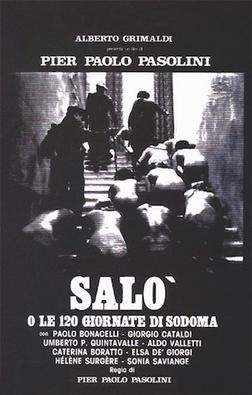
Behind the film
- Year
- 1975
- Director
- Pier Paolo Pasolini
- Writers
- Pier Paolo Pasolini, Sergio Citti, Pupi Avati
- Runtime
- 1h 57m
- Genres
- Drama, Art, Lgbtq-related, Exploitation
- Production
- United Artists
- Country
- France, Italy
- Cast
- Paolo Bonacelli, Caterina Boratto, Aldo Valletti, Giorgio Cataldi, Uberto Paolo Quintavalle, Elsa De Giorgi, Antonio Orlando, Franco Merli
About the film
Contains story spoilers and discussion of sexual violence, torture and murder.
Salò, or the 120 Days of Sodom relocates the Marquis de Sade's account of absolute domination to fascist northern Italy. Four men representing aristocratic, religious, judicial and financial authority arrange the abduction and selection of young captives. They withdraw into a guarded villa, where their commands replace any protection the prisoners might otherwise expect from law or society. The opening establishes agreements between the rulers and a classification of everyone beneath them: victims, soldiers, collaborators and servants. Regulations are announced with the precision of an administrative system, including the threat of death for disobedience. The imprisonment is therefore organized from the outset as a closed social order whose rules belong entirely to those who exercise power.
The film divides this regime into an entrance to hell and successive circles, drawing a structural analogy with Dante. Narrators recount experiences that the rulers use as prompts for further degradation, while a pianist accompanies the proceedings. Repeated ceremonies and assemblies gradually lead toward a selection of people for lethal punishment. Serafino Murri's Treccani account identifies denunciation among the captives as part of the final machinery of control. John Powers's Criterion essay likewise describes an escalation from abuse through degrading communal rituals to killing. The development follows the administrators' changing demands rather than a prisoner's successful plan of escape, so the organization of daily life itself becomes the means by which the violence advances.
In the closing movement, victims are tortured and killed in the courtyard while the rulers observe through binoculars. The distance between the viewing room and the courtyard becomes part of the presentation of violence. Powers describes this arrangement as an attack on spectatorship: the visual apparatus separates watching from the immediate experience of suffering. The film then turns to two young guards who dance together and speak about a girlfriend, an ordinary exchange beside the atrocity. That ending offers no rescue that could undo what has happened. Its change in scale, from organized murder to casual conversation, preserves the coexistence of routine behavior and extreme violence within the same enclosed world, rather than supplying a restorative aftermath.
Pasolini discussed his intentions with Gideon Bachmann during production, in reporting preserved by Sight and Sound. He treated the fascist setting as a way to make the exercise of power historically concrete while addressing the modern exploitation of bodies. His discussion connected apparently new freedoms in consumer society with a continued loss of autonomy. The form was deliberately resistant to easy emotional explanation: he did not want the presentation reduced to pity for individualized victims. Bachmann observed even lighting, ritualized procedures and perpetrators taking notes in books, as if inventing and administering a legal code. For the final courtyard material, Dante Ferretti reproduced a location courtyard at Cinecittà, constructing the view that the rulers supposedly see from the villa's window.
The film's visual order has received different critical explanations. In his discussion for the British Film Institute, Gilbert Adair describes ritual tableaux surrounded by Bauhaus furniture, modern paintings, dance music and the voice of Ezra Pound on radio. Those cultural objects cannot be separated comfortably from the violence staged beside them. Adair argues that the decoration prevents the kind of selective nostalgia that might otherwise attach to an elegant historical interior. His account also questions the relationship between the production's material conditions and what its images ask an audience to witness. The meticulous setting is consequently part of the film's difficulty, rather than a neutral background that can be admired independently of the acts presented within it.
Sam Rohdie's Criterion essay approaches the same density through Pasolini's idea of cinematic poetry. He identifies several times held together in the film: de Sade's eighteenth-century writing, Dante's medieval poem, the last phase of the fascist republic, and the contemporary moment in which Pasolini made the adaptation. References to painting, literature and music allow these periods to interact instead of remaining separate historical illustrations. Rohdie also distinguishes the rulers' demand for uniformity from the film's variety of languages and artistic references. In this reading, the represented world destroys difference while the construction of the images keeps multiple meanings active. That distinction gives a specific basis for discussing formal complexity without treating the director's political allegory as a single proposition that settles every scene.
The work also belongs to a sharp turn in Pasolini's career. Powers contrasts it with the preceding Trilogy of Life and describes an artist increasingly doubtful that his earlier celebrations of bodily freedom could resist consumer culture. The later film's controlled presentation became inseparable from arguments about its purpose and ethics. Murri similarly stresses the quantity of artistic and philosophical references embedded in its apparent realism, identifying an allegorical construction rather than an unmediated historical reconstruction. The preserved production credits name Tonino Delli Colli as cinematographer, Nino Baragli as editor, Danilo Donati for costumes and Ferretti for art direction. Together, those records situate the film's calculated appearance within a collaborative production, alongside the unresolved debates over how its political intentions relate to the suffering it represents.