
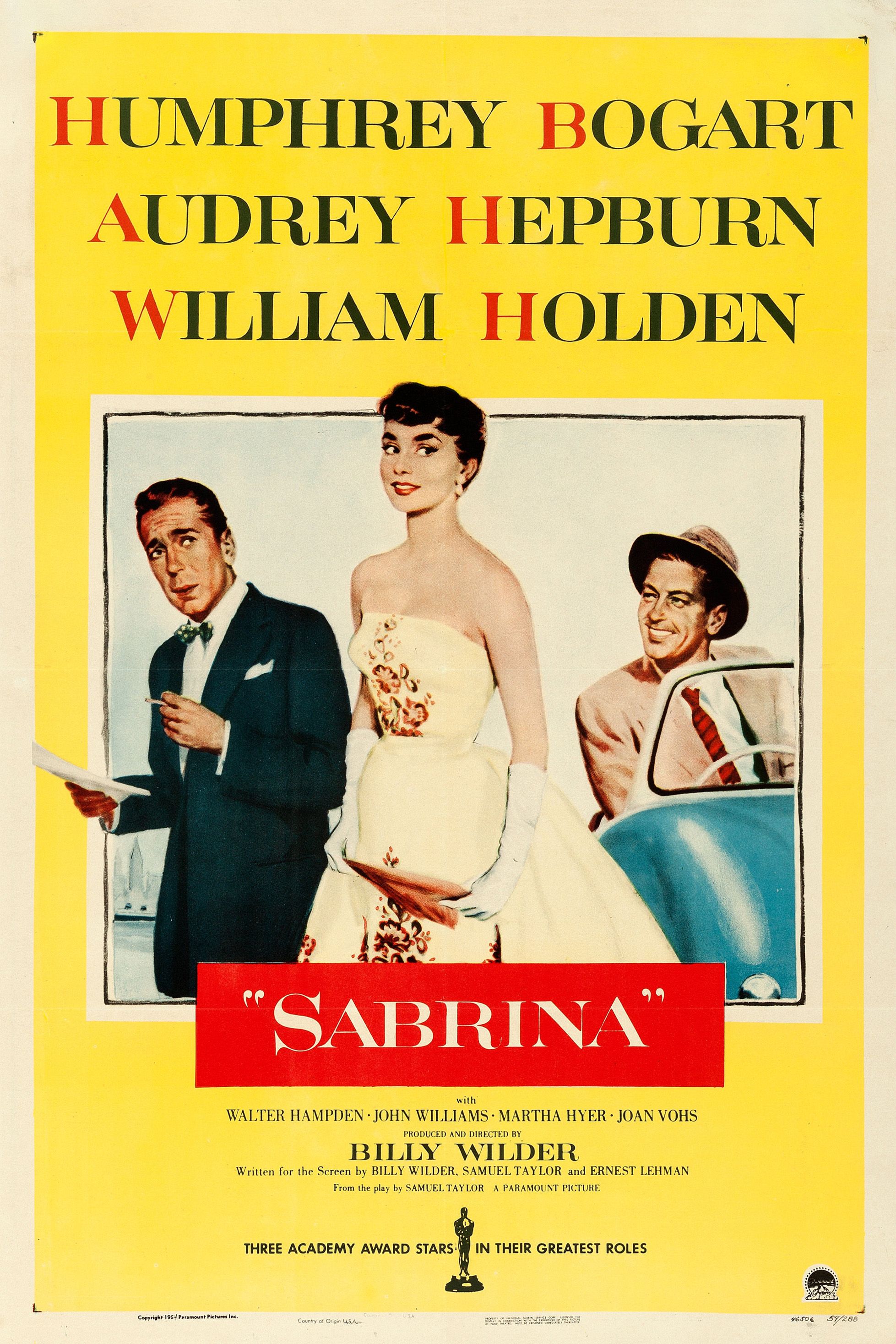
Behind the film
- Year
- 1954
- Director
- Billy Wilder
- Writers
- Billy Wilder, Samuel Taylor, Ernest Lehman
- Genres
- Romantic comedy, Comedy drama
- Production
- Paramount Pictures
- Country
- United States
- Cast
- Humphrey Bogart, Audrey Hepburn, William Holden, Walter Hampden, Martha Hyer, John Williams, Marcel Dalio, Nella Walker
About the film
Contains story spoilers.
Sabrina Fairchild grows up on the Larrabee estate, in love with wealthy playboy David, who barely notices her. After a desperate night and rescue by his older brother Linus, she leaves for cooking school in Paris. She returns transformed, attracting David despite his engagement to Elizabeth Tyson. That marriage serves a corporate merger, so Linus diverts David and begins courting Sabrina himself. His plan is to send her back to Paris without following, but his feelings become real. He confesses the deception; hurt, Sabrina chooses to leave without his financial inducements. Linus then prepares to sacrifice the business arrangement, only for David to recognize whom Sabrina now loves. With David's help, Linus reaches her departing ship. The calculating brother finally steps outside the future he had arranged for everyone else.
The estate is a small world with a very clear division between proximity and belonging. Sabrina has spent her life close enough to observe its pleasures while remaining outside the social position that makes those pleasures seem natural. Knowing a household intimately is not the same thing as being invited to participate on equal terms. Her father's work sustains a connection without dissolving that distance. The setting makes romantic longing inseparable from class imagination: David represents a person she desires and a life she has watched from the edge. The comedy develops when the familiar arrangement no longer tells its wealthy inhabitants how to respond to her. Someone they believed they understood becomes harder to place.
Paris gives Sabrina room to develop beyond the role assigned by her surroundings. The transformation has a glamorous surface, but its more interesting effect is a change in how she can inhabit a conversation. She has acquired experiences that do not depend on David's attention. That makes the return emotionally complicated. Wanting the same person after changing yourself can conceal a wish to have your old self finally recognized. It can also reveal that the original fantasy has ceased to fit. The film lets appearance begin that disturbance without making appearance a complete explanation of maturity. A different dress can attract a gaze; it cannot guarantee that the person looking has become capable of seeing you accurately.
David's ease rests on being protected from the consequences of his appetite. The charm that makes him attractive is connected to the freedom to move on before a choice becomes an obligation. Linus appears to be his opposite because he values control, work and planning, yet the contrast is less comfortable than it first looks. One brother treats romance as pleasure, the other as a problem requiring management. Both can overlook the person whose future they are discussing. Sabrina's position exposes the limitation in each attitude. Freedom without responsibility and responsibility without emotional honesty both leave someone else carrying the cost. The romantic triangle becomes more interesting once neither man's customary way of living is sufficient.
Linus's business habits give the courtship its distinctive tension. He knows how to identify an objective, arrange incentives and reduce an obstacle, but those skills become suspect when applied to another person's trust. A persuasive gesture can be sincere in its immediate feeling while still belonging to a deceptive larger plan. The film asks how far affection can develop before the plan behind it has to be acknowledged. Linus's restraint makes him difficult to read, which gives small changes in attention unusual significance. His difficulty is not simply learning to express a feeling. It is accepting that a feeling may require him to abandon the arrangement that made expressing it useful in the first place.
The comedy of money is particularly clear in the family's approach to marriage. A socially approved match can look like the responsible choice while being valued mainly for the transaction it enables. That makes decorum a poor guide to motive. A relationship regarded as inappropriate may be emotionally serious, while a respectable engagement may function as another entry in a business strategy. The film does not offer a broad solution to inequality; its glamorous romance still depends on a highly privileged world. Within that world, however, the mismatch between public respectability and private purpose supplies a sharp source of humor. Nobody needs to announce that feeling has been subordinated to money when the practical conversations have already made the hierarchy visible.
Hepburn's poise gives Sabrina's self-presentation a lightness that contrasts with the effort required to acquire it. Bogart's guarded presence makes Linus's change less obvious than an immediately expansive romantic performance would, while Holden gives David the ease of someone accustomed to being liked. The ensemble's different rhythms allow the triangle to work through interruptions, hesitations and small adjustments of attention. Formal rooms and carefully arranged appearances become places where a supposedly manageable conversation can wander beyond its intended purpose. Wilder's black-and-white presentation keeps the glamour connected to social observation. The image can invite enjoyment of elegant surfaces while the dialogue exposes the calculations operating beneath them, leaving attraction and suspicion active together.
Sabrina's refusal of an arranged reward is important because it preserves a choice beyond accepting whichever brother offers her a future. Recognizing deception does not make her earlier feelings meaningless, but it changes what she can reasonably ask of the relationship. Linus has to follow through in a way that cannot be reduced to sending her somewhere convenient. The ending's romantic movement therefore carries a practical change in his conduct. It is possible to enjoy the fairy-tale departure while recognizing that the larger social world remains intact. The immediate promise is smaller: someone who habitually manages other people's lives has become willing to risk uncertainty in his own. Sabrina can travel toward a shared future without accepting the original terms on which it was offered.