
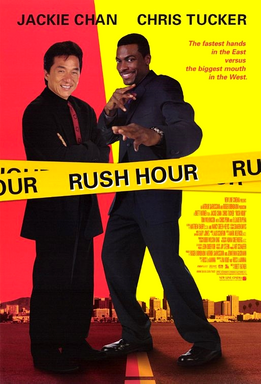
Behind the film
- Year
- 1998
- Director
- Brett Ratner
- Writers
- Jim Kouf, Ross LaManna
- Genres
- Action, Buddy cop, Martial arts
- Production
- New Line Cinema
- Country
- United States
- Cast
- Jackie Chan, Chris Tucker, Tom Wilkinson, Ken Leung, Elizabeth Peña, Chris Penn, Tzi Ma, Julia Hsu
About the film
Contains story spoilers.
Inspector Lee recovers stolen Chinese treasures during a Hong Kong raid, but the criminals escape. Later, Consul Han's daughter Soo Yung is kidnapped in Los Angeles. Han calls Lee, while the FBI assigns LAPD detective Carter to keep the visitor occupied. The pair instead investigates together, tracing an explosive device and uncovering a link to crime boss Juntao. Former British police commander Griffin proves to be the hidden criminal, using the kidnapping to reclaim the value of the recovered art. At an exhibition, Soo Yung is held in an explosive vest. Carter retrieves her, and bomb specialist Johnson removes it. Lee pursues Griffin, who falls to his death; Carter catches Lee when he falls too. The girl reunites with her father, and the partners receive a trip to Hong Kong.
The partnership begins with a task designed to prevent one of its members from doing useful work. That gives the comedy a clear institutional pressure before either man discovers what the other can contribute. Carter believes he has received a prestigious opportunity, while Lee understands his visit through an obligation to the family asking for help. Their expectations clash because the arrangement has supplied neither with an honest account of its purpose. The story turns that misleading assignment into a reason to cooperate. Discovering that somebody has underestimated you can be a source of wounded pride, but it can also reveal that the supposed rival beside you faces a related obstacle.
Lee and Carter bring different ways of making themselves heard. Carter uses speech to establish momentum and status, while Lee's confidence is more readily expressed through precise action. The contrast gives the film two comic rhythms that can interrupt and then complement each other. Neither method alone is a complete substitute for understanding a situation. Talking can keep an exchange moving without uncovering the truth; acting decisively can solve a physical problem while creating another social one. Their developing trust involves recognising those limits. A partner becomes valuable when his response supplies something your own habits leave out, rather than when he begins behaving like a copy of you.
The investigation's personal centre is important to that development. A kidnapped child cannot be reduced to an opportunity for professional advancement without distorting what the work is for. Lee's connection to Han's family supplies an immediate reason to resist that distortion, while Carter's involvement gains weight as he looks beyond the status he initially imagined. The story lets a broad action-comedy structure carry a concrete responsibility. Success means returning a person to safety, not merely demonstrating that the protagonists can embarrass an institution which dismissed them. That distinction gives their pride somewhere useful to go and makes cooperation more consequential than winning an argument.
The Hong Kong and Los Angeles connection also gives the case a history that crosses the boundaries of the assignment. Objects recovered in one place become part of a struggle continuing elsewhere, and an apparently respectable position can conceal a criminal interest. That makes appearances a recurring investigative problem. Authority, familiarity and professional standing can all encourage trust without supplying proof. Lee and Carter have to recognise a relationship between events which the official division of responsibilities does not readily make visible. Their outsider status is inconvenient, but it can also keep them from accepting every established account simply because a well-placed person offers it.
Chan's martial-arts presence makes physical ingenuity central to the action premise. A body moving through obstacles can communicate judgement, vulnerability and persistence without a long explanation. The comic possibility lies in treating an environment as something a fighter must continually interpret, rather than a neutral surface for displaying power. Carter's different energy prevents that physical mode from becoming the only way a scene works. The film's appeal as a buddy story depends on the exchange between them: confidence shifts, help changes hands and a moment of apparent command can become a moment of dependence. Their competence is most interesting when it has to respond to another person.
Johnson's contribution is useful for the same reason. The central duo may supply the film's name and comic focus, but their success does not make every other form of expertise unnecessary. Some dangers require patient, specialised work which cannot be replaced by an impressive confrontation. That broadens the idea of a successful police partnership beyond the two most visible performers. It asks who creates the conditions in which they can act, and who solves the problem their preferred methods cannot. An action-comedy can celebrate its leads while still making space for that dependence. The case becomes a shared practical effort rather than proof that charisma makes assistance redundant.
The conclusion rewards a change in how the men understand their place in that effort. Being recognised by an institution is less important when its approval has ceased to define the value of the work. Friendship also gains meaning through the risk of depending on someone whose habits once seemed intolerable. Rush Hour builds its satisfaction around those adjustments. The pair does not need to erase its differences to become effective; the differences need to stop functioning only as barriers. That is the deeper purpose of the reluctant partnership. Two people who have been placed together as a diversion make the arrangement useful by deciding that another person's abilities deserve serious attention.