
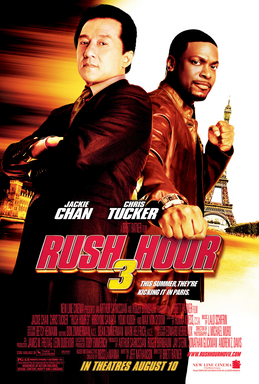
Behind the film
- Year
- 2007
- Director
- Brett Ratner
- Writers
- Jeff Nathanson
- Genres
- Action, Buddy cop, Martial arts, Comedy
- Production
- New Line Cinema
- Country
- United States, France, Germany
- Cast
- Jackie Chan, Chris Tucker, Hiroyuki Sanada, Max von Sydow, Noémie Lenoir, Yvan Attal, Zhang Jingchu, Youki Kudoh
About the film
Contains story spoilers.
Rush Hour 3 puts an established partnership into a case that tests what its familiarity can withstand. Lee and Carter have different habits of speech, observation and action, but those differences are also part of how they work together. The comedy depends on friction; the investigation depends on cooperation. That relationship becomes more vulnerable when another connection pulls Lee towards a private conflict. The story sends the pair into unfamiliar surroundings while asking a familiar question about them: whether their shared experience can keep them functioning as partners when one person's past makes the immediate problem harder to see clearly.
Brett Ratner directs the 2007 film, with Jackie Chan as Lee and Chris Tucker as Carter. Jeff Nathanson wrote the screenplay, and Hiroyuki Sanada plays Kenji. The action moves from Los Angeles to Paris, expanding the partners' investigation beyond the institutions and routines they know. This is the third entry in a continuing action-comedy series, so its central attraction is a relationship already shaped by previous encounters. The new setting does not make the pair agree more easily. It gives their differences new circumstances in which to become useful, embarrassing or dangerous, depending on how successfully they adapt to what is happening.
An attack on Ambassador Han leads Lee to Kenji, his childhood foster brother. Lee hesitates, allowing him to escape. The investigation takes Lee and Carter to Paris, where Geneviève carries information identifying Triad leaders. The apparently helpful Reynard is part of the conspiracy. Kenji captures Han's daughter Soo Yung and demands an exchange at the Eiffel Tower. The partners intervene; Lee tries to save Kenji during their confrontation, but Kenji lets go and falls to his death. Carter rescues Soo Yung, and taxi driver George kills Reynard when he threatens the survivors. The immediate case ends, but Lee's personal loss remains.
Kenji gives the question of brotherhood a difficult form. A shared upbringing can explain attachment without guaranteeing that two people will continue to choose the same loyalties. Lee cannot make the past disappear simply because professional responsibility would be easier without it. Nor can that past erase the danger presented by a person's current actions. The conflict asks him to hold those realities together rather than resolve them through a convenient change of feeling. Affection becomes painful because recognition persists across disagreement. The emotional stakes come from understanding an opponent as somebody whose life once occupied a different place within one's own.
Carter's role gains importance beside that conflict. A partner can offer a perspective that an old relationship makes difficult to maintain, even when the partner's manner initially seems less disciplined. The contrast between the two detectives is therefore more than a division between serious work and comic distraction. Their different ways of approaching people can widen what an investigation notices. Cooperation requires them to tolerate the irritation those differences produce. The film lets banter express that ongoing negotiation, making their relationship something repeatedly practised rather than a fact that can simply be announced at the beginning and left untouched until the ending.
Paris changes the meaning of being an outsider. Moving through an unfamiliar city means needing help, judging strangers and recognising that apparent authority does not necessarily amount to protection. The partners cannot rely on their usual expectations to tell them which situations are trustworthy. That uncertainty also makes the city useful to the comedy: confidence can outrun understanding, and somebody who feels competent in one setting can become conspicuously ill-prepared in another. The travel is part of the investigation's pressure. It introduces distance from familiar support while giving the pair a larger physical world in which their practical and interpersonal habits have to function.
The conspiracy links information to the safety of the person carrying it. Knowledge is valuable because of what it can expose, but the individual associated with that knowledge can become expendable to those seeking control. Protecting a witness therefore involves more than obtaining a clue. It means recognising a person's right to survive after their usefulness to an investigation has been established. That distinction helps connect the larger case to the partnership's concerns about loyalty. People cannot honestly be reduced to what they know or what they can provide, even when an institution or criminal network has a strong reason to do exactly that.
The film combines investigation, physical action and comic misunderstanding around those competing attachments. The partners' rhythm gives it continuity while the case changes their surroundings and personal stakes. Its conclusion can return to their shared comic ease without making Lee's history uncomplicated or pretending every relationship has been repaired. That contrast distinguishes the central friendship from the connection that has become untenable. Lee and Carter remain able to act together because partnership involves present choices as well as remembered experience. The adventure's resolution restores their working relationship while leaving the cost of the case inside the story rather than completely outside its final celebration.