
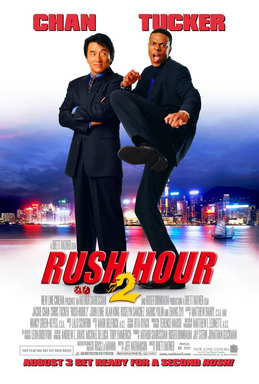
Behind the film
- Year
- 2001
- Director
- Brett Ratner
- Writers
- Jeff Nathanson
- Genres
- Action, Buddy cop, Martial arts, Comedy
- Production
- New Line Cinema
- Country
- United States
- Cast
- Jackie Chan, Chris Tucker, John Lone, Zhang Ziyi, Roselyn Sánchez, Alan King, Harris Yulin, Don Cheadle
About the film
Contains story spoilers.
Rush Hour 2 begins with a partnership familiar enough for disagreement to become part of its working method. Lee and Carter do not need to discover that they are different; they already know it and keep making that knowledge audible. The comedy comes from the gap between how each man imagines an encounter should unfold and what the other man does to it. Their effectiveness is consequently difficult to separate from their irritation. A smooth partnership might be easier to manage, but this one finds its energy in interruptions, misread expectations and the necessity of responding to the trouble those interruptions create.
Brett Ratner directs the 2001 sequel, with Jeff Nathanson writing the screenplay. Jackie Chan plays Lee and Chris Tucker plays Carter, while John Lone plays Ricky Tan and Zhang Ziyi plays Hu Li. The story moves between Hong Kong and the United States, making the partners alternate between familiarity and unfamiliarity. A location can supply one man with confidence and leave the other searching for his footing. That shifting advantage helps prevent the pairing from settling into a fixed arrangement in which the same person always knows how the world works and the other simply follows.
A consulate bombing draws Lee and Carter into a counterfeiting scheme involving Tan and hotelier Steven Reign. Isabella Molina is revealed as an undercover agent. The investigation reaches a Las Vegas casino, where Tan's apparent death proves false and he admits killing Lee's father. Reign, Tan and Hu Li die during the confrontation, while the partners escape. Carter's gambling winnings prompt another trip together. The crime plot supplies personal stakes for Lee without replacing the film's comic momentum. The concluding journey keeps the partnership open after the particular investigation has reached its end.
The counterfeit-money premise gives the action a useful relationship to appearances. Something designed to look ordinary can move through a system precisely because its surface attracts no immediate suspicion. Detecting the difference requires knowledge of how that system operates. The broader plot repeatedly asks the partners to distinguish a convincing role from an actual allegiance, so the financial fraud belongs to a world in which first impressions can be professionally dangerous. That does not make the comedy a technical guide to counterfeiting. The false currency is a story mechanism that connects plausible surfaces, hidden operations and the risk of trusting the wrong appearance.
Lee's personal connection changes the weight attached to that uncertainty. An investigation can demand evidence about somebody whose place in a family history already seems established. New information then threatens more than the case's previous direction; it threatens an account of the past that a person has lived with. The film uses that pressure to give its action a motive beyond finishing an assignment. Loyalty to the dead can make a detective want an answer urgently, yet urgency does not guarantee that the people invoking a shared history deserve belief. The personal stake makes interpretation more necessary rather than less.
Carter supplies a different kind of disruption because his social confidence can outrun his understanding of a situation. The comedy does not always treat confidence as competence, though the capacity to act without perfect comfort can still become useful. Lee's greater restraint and Carter's willingness to push into an encounter offer contrasting responses to uncertainty. Either can fail in isolation. Together, their habits create possibilities neither would have generated alone, alongside problems neither would have chosen. The buddy-film structure turns that uneven exchange into the practical basis of affection: surviving someone's irritating decisions can reveal why their presence is still wanted.
Physical action and verbal comedy give the disagreement different forms. An argument can continue while the situation demands movement, so the partners' relationship is carried through danger rather than paused whenever a fight begins. That integration is central to understanding the film's tone. The crime must remain serious enough to generate pursuit and peril, but the audience is also invited to enjoy characters who keep responding to that peril in recognisably contrasting ways. The story does not ask them to become identical professionals. Their shared success depends on cooperation that preserves the friction rather than eliminating it. Each response reveals character while also creating the next practical problem the pair must solve.
The ending's willingness to keep travelling together expresses that idea more clearly than a formal declaration of compatibility would. Lee and Carter have reasons to separate once the investigation is over, yet their companionship produces another destination. Rush Hour 2 treats the case as a test and the partnership as something capable of continuing beyond the test. Its world is an exaggerated action-comedy environment, where investigations generate spectacular danger and personalities remain larger than procedure. Beneath that exaggeration sits the familiar pleasure of a friendship that can accommodate disagreement because the disagreement has become part of how the friends recognise one another.