
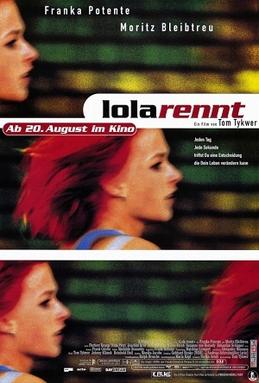
Behind the film
- Year
- 1998
- Director
- Tom Tykwer
- Writers
- Tom Tykwer
- Genres
- Drama, Thriller, Crime, Experimental
- Production
- X-Filme Creative Pool, Westdeutscher Rundfunk, Arte
- Country
- Germany
- Cast
- Franka Potente, Moritz Bleibtreu, Herbert Knaup, Nina Petri, Armin Rohde, Joachim Król, Ludger Pistor
About the film
Contains story spoilers.
Manni has lost a bag of money belonging to his criminal employer and calls Lola in a panic. He has twenty minutes to find the sum before his boss arrives. Lola runs through Berlin seeking help, first from her father, a bank manager, and then from whatever opportunity appears along the way. The film repeats this predicament in three variations. A collision, a delay, or a changed decision sends each attempt toward a different consequence: one ends with Lola shot, another with Manni struck by an ambulance, and the last with both finding the money and surviving. Its plot is a countdown transformed into a study of alternative outcomes.
Run Lola Run’s formal idea is simple but generative. The deadline is easy to understand, yet the repeated attempts keep the story from becoming a straightforward race. Each version travels through familiar spaces while changing the chain of consequences. The film asks viewers to remember a corner, staircase, or passerby, then recognize how one altered encounter redirects events. This is not a puzzle with one hidden solution. It is a form built to make contingency visible, showing how the same intention can meet a different world on each pass.
The running is the film’s organizing rhythm. Lola’s body carries the story through streets, stairwells, and institutional interiors while the electronic score propels her forward. Tykwer combines live action, animation, freeze frames, and quick inserts, so movement becomes an editing grammar as much as a plot device. The shifts in medium are not decorative pauses; they make each run feel like another telling of a fable. Berlin remains recognizable, but the presentation keeps it from settling into a stable visual reality. Form mirrors the instability of outcomes.
Rapid photographic glimpses imagine possible futures for people Lola barely notices. A brief collision can launch a sequence of still images showing a life redirected by their encounter. These flashes make her emergency coexist with many stories she cannot see. They also challenge her centrality: the world is not simply a track laid out for her. Other people carry their own histories, and a few seconds in her path can alter their direction. The film turns chance meetings into invitations to imagine lives beyond the frame.
The bank brings another kind of time into a film driven by an emergency. Institutions work through appointments, permissions and expectations about whose interruption deserves attention. Lola has no spare minutes for those habits, and her urgency does not automatically make her persuasive. That friction gives the setting more purpose than simply offering a possible source of cash. It places the frantic energy of a young person beside an adult world that expects to control the terms of conversation. Family authority adds another complication: asking for help also means confronting assumptions about what a daughter owes and what a father should provide. The film makes the encounter feel unstable without suggesting that one forceful appeal can settle every pressure beneath it.
Manni and Lola’s relationship comes through urgency and the way they address one another over the phone. Manni’s predicament is dangerous, but his first response assumes Lola can solve it. Her decision to run is loyalty and an assertion of agency. The film gives her more physical motion, yet does not portray her as controlling every variable. She can act decisively and remain vulnerable to traffic, other people’s choices, and luck. This friction keeps the repetitions emotionally grounded rather than making them a demonstration of power.
Sound is as important as the image. The pulsing score gives continuous forward motion, while the recurring telephone conversation makes the deadline audible. Lola’s breath and footfalls sit inside the music instead of beneath it. The soundtrack lets tempo carry emotion: scenes can accelerate, stall, or restart without a long explanation of what the characters feel. The audience experiences each attempt bodily, with the countdown pressing on a moment before its outcome is known. The film’s urgency is felt as rhythm, not only understood as a number.
Repetition changes our relationship with the supporting faces as much as it changes our anticipation of danger. A person glimpsed on the first run becomes somebody to watch on the next, because the smallest interruption may carry a consequence. The viewer starts scanning the city for possibilities, taking part in Lola's urgency without gaining her ability to intervene. This attention is one of the film's pleasures: details that would usually be background acquire weight. The repeated structure also leaves an ethical question alive. If outcomes depend partly on accidents, courage cannot be judged only by whether it succeeds. Lola remains committed even when the same commitment leads somewhere different. The film's speed therefore carries more than excitement. It lets determination coexist with a world too complicated for determination to command. Its versions of events make room for affection, frustration and surprise, while refusing to turn survival into proof that every earlier choice was wrong. The city keeps moving, and the characters have to find their way inside that movement.