
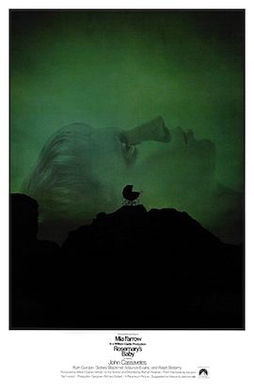
Behind the film
- Year
- 1968
- Director
- Roman Polanski
- Writers
- Roman Polanski
- Genres
- Horror, Psychological horror, Drama, Religious horror
- Production
- Paramount Pictures
- Country
- United States
- Cast
- Mia Farrow, John Cassavetes, Ruth Gordon, Sidney Blackmer, Maurice Evans, Ralph Bellamy, Elisha Cook Jr., Charles Grodin
About the film
Contains story spoilers.
Rosemary and Guy move into the Bramford, where elderly neighbours Minnie and Roman Castevet become involved in their lives. Guy’s acting prospects improve, and a drugged conception night leaves Rosemary with memories of a demonic assault. During pregnancy, the neighbours and their doctor control her care and dismiss her pain. Her friend Hutch investigates, falls into a coma and leaves her a book before dying. Rosemary discovers evidence of a coven and fears for the baby. A second doctor returns her to Guy and the conspirators, who restrain her through childbirth. Told the baby has died, she later follows its cries through a hidden doorway. The coven reveals Satan is the father and Guy accepted the arrangement for career rewards. Rosemary rejects Guy, then approaches the crying infant and rocks its cradle.
The horror grows from a household that appears to be becoming secure. Roman Polanski’s screenplay makes the wish for a settled future central to Rosemary’s vulnerability, because ordinary expectations give other people opportunities to define what should happen next. Neighbourliness, marital confidence and professional advice each arrive in a recognisable form before their implications become frightening. The supernatural element does not remove the social problem. It makes a betrayal literal that has already been taking place through small restrictions on a person’s judgment. A home can be arranged attractively while its owner’s ability to decide what occurs within it is steadily being reduced.
Mia Farrow’s performance gives that reduction a human scale. Rosemary has to remain perceptive enough for the audience to follow her suspicions, while encountering people who treat perception itself as evidence that she needs to be managed. Her attempts to obtain reassurance can deepen the trap when reassurance comes from someone invested in her dependence. The tension therefore involves more than deciding whether an alarming event is real. It involves deciding whom she can ask about it without allowing the question to be used against her. Farrow’s changing physical presence makes the cost visible, but the film’s interest remains in a person’s effort to maintain an account of her own experience.
John Cassavetes makes Guy’s professional ambition part of the domestic atmosphere. An actor’s wish to be chosen might seem unrelated to his wife’s pregnancy, yet the story places both beneath systems in which access can be granted by someone else. The difference lies in what each person is willing to surrender for a desired future. Guy’s behaviour makes intimacy an especially dangerous source of apparent credibility. Someone who knows a person’s habits can sound reassuring precisely because the reassurance feels familiar. The film uses that familiarity to expose a betrayal that cannot be repaired by explaining how much the betrayer expected to gain.
Ruth Gordon’s Minnie turns intrusion into a social skill. Excessive interest can be presented as kindness, and an offered favour can create pressure to accept the next one. Sidney Blackmer’s Roman supplies a different authority, lending certainty to a shared account of what is reasonable. Together, the neighbours make refusing attention feel impolite before attention becomes overt control. The performances help preserve the story’s dark comedy: alarming people can be tedious, chatty and recognisably ordinary rather than maintaining a constant sinister dignity. That ordinariness matters because Rosemary is living among them. Avoiding them would require more than recognising a theatrical signal that something is wrong.
The apartment building turns proximity into uncertainty. A shared wall normally separates private lives while allowing evidence that other lives exist nearby; here, that evidence can acquire significance without becoming immediately explainable. Richard Sylbert’s production design and William A. Fraker’s photography help make domestic spaces feel inhabited and incomplete at the same time. A room offers a portion of the world, leaving other portions behind walls and doorways. The viewer cannot obtain security merely by seeing what Rosemary sees, because a familiar interior can conceal relationships that its occupant has not been allowed to understand. The building’s appeal and its threat therefore occupy the same physical setting.
Medical authority is another part of the film’s fictional conspiracy, rather than a basis for general claims about pregnancy or treatment. Rosemary’s difficulty is that an expert’s confidence can displace her testimony when everybody around her agrees to treat confidence as sufficient. The audience knows her access to independent judgment is narrowing, making apparently sensible instructions sound increasingly like commands. That is the dramatic use of professional status in this story: it allows coercion to arrive in the language of care. The distinction matters because the horror rests on betrayal by particular people within a fictional plot, not on the assertion that seeking care is itself dangerous.
The ending leaves maternal attachment beside the knowledge of exploitation. Rosemary’s response cannot undo the arrangement made without her consent, and her concern for the infant does not retroactively approve it. The coven wants to turn that concern into a means of completing its plan, making compassion another vulnerability it hopes to use. The final movement therefore refuses a simple opposition between love and horror. A person may feel responsibility toward a child whose existence has been shaped through violence, while continuing to reject the people responsible. The film leaves that emotional contradiction active, locating the nightmare in the discovery that even an apparently private bond can be surrounded by other people’s claims.