
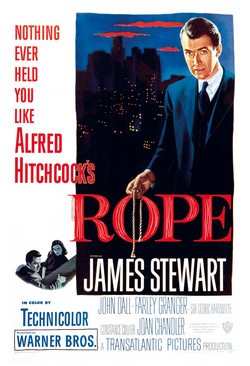
Behind the film
- Year
- 1948
- Director
- Alfred Hitchcock
- Writers
- Arthur Laurents
- Runtime
- 1h 20m
- Genres
- Thriller, Crime thriller, Lgbtq-related, Drama
- Production
- Transatlantic Pictures, Warner Bros. Entertainment
- Country
- United States
- Cast
- James Stewart, John Dall, Farley Granger, Joan Chandler, Constance Collier, Cedric Hardwicke, Edith Evanson, Douglas Dick
About the film
Contains story spoilers.
Rope gives away its central crime immediately, leaving suspense to grow from the effort required to continue behaving as though it has not happened. The killers do not merely want to escape discovery. They bring people into the room where the body is concealed and attempt to make the evening a demonstration of their own superiority. Every ordinary act of hospitality therefore carries a second meaning. Food, conversation and the movement of a guest can appear harmless to somebody attending the party while becoming intolerably consequential to an audience that already knows what the hosts have done and where the evidence lies.
Alfred Hitchcock directs the 1948 film, with John Dall as Brandon, Farley Granger as Phillip and James Stewart as Rupert Cadell. Arthur Laurents wrote the screenplay, with an adaptation credit for Hume Cronyn, from Patrick Hamilton's play. Most of the action stays within an apartment overlooking Manhattan. Long takes and concealed edits give the evening a sense of continuing duration, although the film is not a single unbroken shot. That formal choice keeps viewers with the gathering as time passes, making an exit, a pause or a return feel like a change in pressure within a space whose secret cannot move away.
Brandon and Phillip kill David Kentley and put his body in a chest, then serve dinner from it. David's relatives, fiancée and acquaintances attend, alongside their former teacher Rupert. Brandon courts danger through insinuations, while Phillip struggles to hide his distress. David's absence troubles the guests, and inconsistencies lead Rupert to return after the party. He opens the chest and discovers the body. Horrified that the young men have used his earlier talk about intellectual superiority to justify murder, he repudiates their reasoning and summons attention from outside. The evening ends with exposure replacing the approval Brandon had imagined.
Brandon's confidence depends on treating other people as components of an arrangement he has designed. He wants the party to work as proof that he can move among them, manipulate their conversations and retain control of information they cannot access. Yet that ambition also creates the conditions under which he can be discovered. Concealment alone would not satisfy his desire to display mastery, so he keeps drawing attention towards the secret he claims to be able to manage. His behaviour makes success unstable from the beginning: the demonstration requires an audience, but an audience brings its own observations and reactions.
Phillip makes the cost of that arrangement visible. He has participated in the crime without possessing Brandon's appetite for the performance that follows it. Anxiety interrupts the image of effortless control his companion wants to maintain. Their shared knowledge therefore does not produce a shared attitude, and the gap between them becomes another feature of the room that cannot be reliably managed. A glance or an answer may carry more than either intends. The film uses their differences to show how a supposedly perfect scheme must depend on human behaviour that remains vulnerable to fear, irritation and the strain of prolonged pretence.
Rupert occupies a particularly uncomfortable position because recognition requires him to reconsider his own words. Brandon has taken ideas that could be aired as clever, provocative conversation and turned them into permission to harm somebody. Discovering the body forces Rupert to confront that transformation. The film does not make an intellectual discussion equivalent to committing the murder, but it refuses to let him dismiss the relationship between the two as entirely irrelevant. His revulsion must include the fact that his authority helped make the ideas attractive to people who wanted a justification for placing themselves above others.
The guests' concern for David gives his absence a presence the killers cannot suppress. He is not simply evidence hidden inside furniture; he belongs to relationships that continue reaching towards him throughout the evening. Those relationships challenge Brandon's attempt to reduce the victim to an object through which an argument can be proved. The audience knows why he cannot arrive, and each ordinary expectation of his arrival keeps that knowledge active. Hitchcock lets the social structure of the party work against its hosts, because people who care about somebody will eventually ask questions the hosts cannot comfortably answer.
At the end, the apartment remains the same space, but the terms under which it can be occupied have changed. Rupert no longer participates in a conversation whose most important information is being withheld from him. Brandon's imagined acknowledgment of brilliance becomes acknowledgment of responsibility, and Phillip's distress no longer has to function as a secret signal. The confined setting lets that reversal occur without moving into a separate investigative world. Everything needed to expose the crime has gathered around it over the course of the evening, leaving the killers inside the consequences of the superiority they believed would put consequences beyond their reach.