
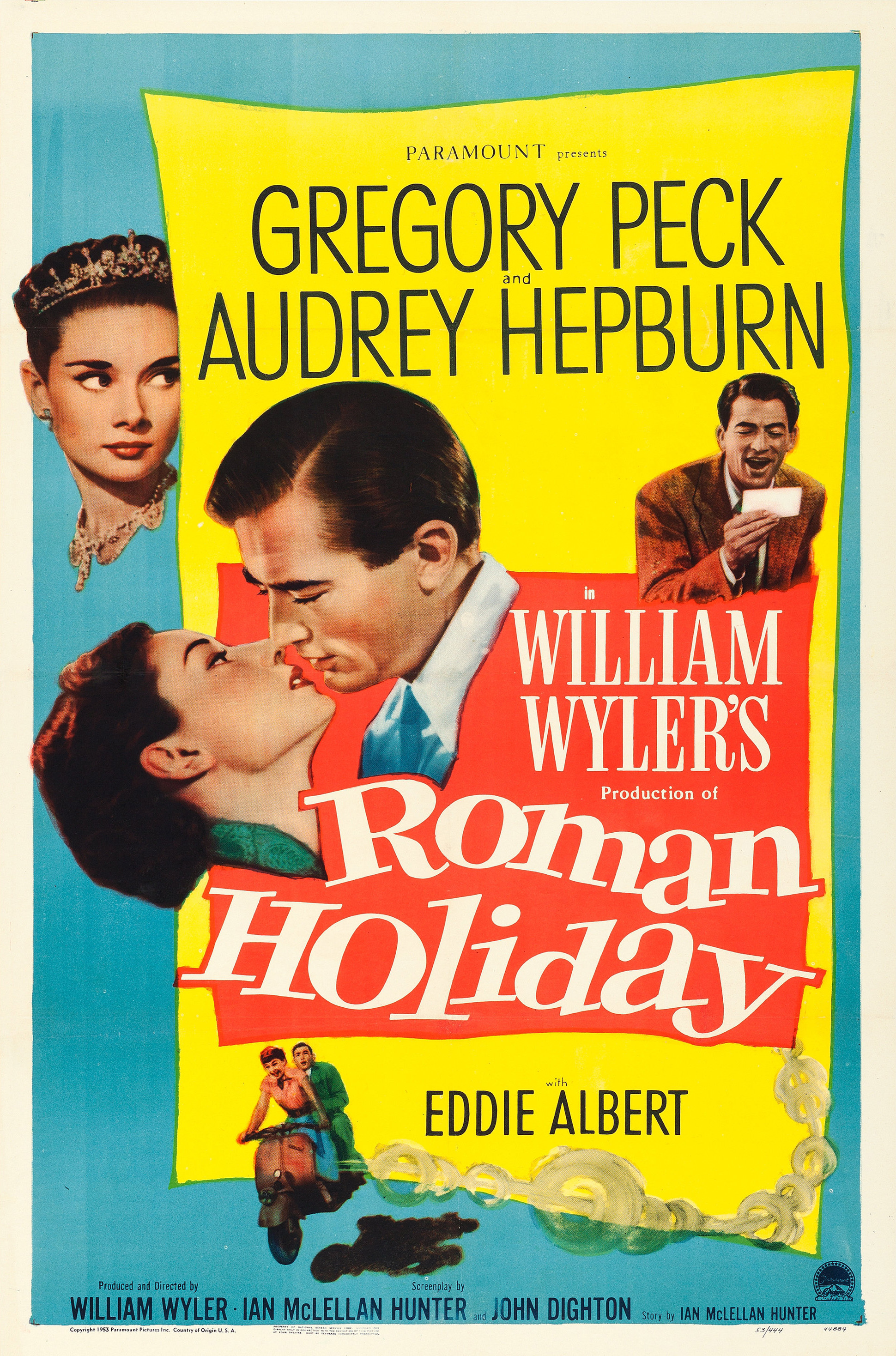
Behind the film
- Year
- 1953
- Director
- William Wyler
- Writers
- Dalton Trumbo, John Dighton, Ian McLellan Hunter
- Runtime
- 1h 58m
- Genres
- Romantic comedy, Comedy, Drama
- Production
- Paramount Pictures
- Country
- United States
- Cast
- Audrey Hepburn, Gregory Peck, Eddie Albert, Tullio Carminati, Paolo Carlini, Claudio Ermelli
About the film
Contains story spoilers.
Princess Ann arrives in Rome as part of a tightly managed European tour, where official appearances and polite routines leave her exhausted. After a doctor gives her a sedative, she secretly leaves the embassy. She falls asleep on a low wall and is found by Joe Bradley, an American reporter who assumes she is drunk and takes her to his apartment. The next morning Joe realizes that his unexpected guest is the princess from a cancelled press conference. His editor offers money for an exclusive interview and bets that Joe cannot get it, turning Ann's escape into a professional opportunity before either of them knows the other well.
Joe calls his photographer friend Irving Radovich and introduces Ann, who calls herself Anya, to Rome without revealing that he is a reporter or that he knows her identity. Their day becomes a tour of ordinary pleasures that her official itinerary could not accommodate: a street market, a haircut, a café and the Spanish Steps. Irving takes photographs with a camera concealed in a cigarette lighter, preserving evidence while pretending to be a casual companion. The arrangement is ethically uneven—Joe is collecting material for a story—but Ann is also making choices for herself. She says she is playing truant from school, allowing the princess to become briefly anonymous in the city.
The famous Vespa ride is funny because Ann's freedom has no training wheels: she drives through Rome's traffic with Joe clinging on, and their ride ends in arrest. Joe and Irving show press credentials and invent that he and Anya are about to marry to get them released. They continue to the Colosseum, then to the Mouth of Truth, where Joe tells Ann that a liar's hand will be bitten off. He startles her by pretending the stone has taken his hand. These games build trust, but the hidden camera keeps Joe's deception present. He is both the person sharing her day and the person preparing to sell it.
At a dance on a boat, government agents try to force Ann back into their custody. She fights alongside Joe, Irving and the barber who invited them, even smashing a guitar over one pursuer's head. When Joe is knocked into the river, Ann jumps in after him, and the two escape together. Back at Joe's apartment, a radio bulletin reports concern over the princess's health. Ann asks him to drive her near the embassy, where they share a final kiss before she insists that he not follow. The moment ends the day's romance without pretending that a secret outing can erase her public position.
Ann returns to the embassy and reminds those around her that she knows her duty to her family and country. Joe tells his editor that he did not obtain the story, though he allows Irving to decide whether to sell his photographs. Both men attend the rescheduled press conference. Ann recognizes Joe among the journalists and speaks about her faith in international relations; asked which city she liked best, she answers Rome. Irving gives her the photographs as a memento. Joe stays behind after the others leave, and the film ends on a separation communicated through restraint rather than a reunion. Their affection is real within the story, but Ann's decision is to return to the life she left.
William Wyler's film was shot in Rome, and its setting is more than scenic backdrop: streets, steps and public landmarks let Ann experience the city at pedestrian speed instead of through a motorcade. The black-and-white photography gives the comic outing a crisp, documentary-like texture, while Peck and Hepburn play the difference between public roles and private speech with lightness. The screenplay credits reflect a history of blacklisting: Dalton Trumbo wrote the script, with Ian McLellan Hunter fronting for him, and Trumbo's credit was later restored. That authorship history belongs to the production record; the on-screen story remains a one-day romance shaped by a choice to return to duty.
The photographs change their meaning as the day progresses. Irving's tiny lighter camera allows him to record a woman who thinks she is among friends; at the final reception, the journalists' conspicuous cameras belong to a public occasion she has agreed to attend. Between those two settings, Ann has chosen a haircut and ridden through the streets under a borrowed name. These are small freedoms, but her attendants normally manage even her schedule and appearance. Joe's apartment also gives the princess a temporary place outside that supervision, although his knowledge of her identity makes the refuge less innocent than she realizes. When Irving places the prints in her hands at the reception, the images return to the person whose private experience they preserve. Joe remains alone in the hall afterward. The long walk away allows the room to empty without supplying a last-minute reversal or another meeting to soften the separation.