
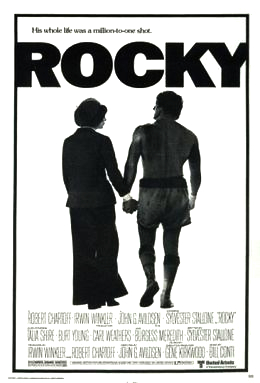
Behind the film
- Year
- 1976
- Director
- John G. Avildsen
- Writers
- Sylvester Stallone
- Genres
- Drama, Action, Boxing
- Production
- United Artists
- Country
- United States
- Cast
- Sylvester Stallone, Talia Shire, Burt Young, Carl Weathers, Burgess Meredith, Thayer David, Joe Spinell, Tony Burton
About the film
Contains story spoilers.
Rocky opens in a small Philadelphia boxing club, where Rocky Balboa wins a rough fight and then returns to a working-class neighborhood that offers little glamour. At home, his turtles are the only audience for his report of the match. He visits the pet shop where shy clerk Adrian Pennino works, but she barely responds. As a collector for loan shark Tony Gazzo, Rocky cannot bring himself to break a debtor’s thumb, earning Gazzo’s displeasure. At the gym, he discovers Mickey Goldmill has given his locker to a new contender, then argues with the trainer who sees him as wasted potential.
Heavyweight champion Apollo Creed loses his scheduled opponent to injury and decides to stage a Bicentennial bout in Philadelphia. Wanting an underdog for publicity, he chooses Rocky partly because ‘The Italian Stallion’ sounds marketable. Promoter Miles Jergens offers Rocky the title fight, and Rocky at first refuses, convinced he cannot win. After he has talked through what the opportunity means, he changes his mind and chases Mickey, the trainer who had offered to manage him. Rocky initially rejected Mickey’s offer, saying he should have cared ten years earlier; agreeing to work together means both men must put aside that grievance.
Rocky’s first training weeks are improvised. He runs through the city at four in the morning, climbs the Philadelphia Museum of Art steps and punches frozen meat at Paulie’s plant, turning familiar work spaces into a makeshift gym. Mickey starts coaching him, correcting his stance and pushing him through sparring and roadwork. Rocky also works the speed bag and skips rope, gradually turning a few improvised routines into a full preparation. Mickey asks him to avoid women during training. Rocky continues spending time with Adrian. Their first date goes badly when Paulie’s surprise Thanksgiving setup embarrasses her; after she retreats to her room, Rocky takes her to a closed ice rink and convinces the attendant to let them skate. They talk about their perceived weaknesses and begin a relationship at Rocky’s apartment.
Paulie’s jealousy complicates the household as the fight grows nearer. He arranges a television interview for Rocky in the meat locker, then threatens Rocky and Adrian after overhearing them argue about his behavior. Adrian finally tells her brother she owes him nothing and will no longer accept being called a loser; she and Rocky decide she will move in with him. Apollo’s publicity campaign continues while Rocky trains, and the neighborhood begins cheering him on. On the night before the fight, Rocky visits the empty Spectrum and admits that he doubts he can win. He wants to last all fifteen rounds so he can prove to himself that he is more than a neighborhood bum.
Apollo enters the New Year’s Day fight in a Washington costume and treats the bout as a spectacle. Rocky lands a surprise punch that knocks the champion down for the first time, making Apollo abandon his relaxed exhibition manner. He breaks Rocky’s nose, and Rocky keeps answering with hard punches despite the beating. After fourteen rounds, both men are still standing. Rocky asks his cut man to slice his swollen eye so he can see; Apollo, injured and struggling to breathe, tells his corner to let him continue. The final bell arrives after fifteen rounds, and the judges give Apollo a split decision. Friends from Rocky’s neighborhood watch the contest on television at a local tavern, extending the bout beyond the arena. The crowd’s response matters because the film has spent time showing these people as part of his ordinary life, not as a cheering audience assembled only for a championship.
Rocky is barely listening to the verdict. He calls repeatedly for Adrian, who makes her way through the reporters and into the ring; they embrace and declare their love. The result matters less to him than reaching the goal he set before the match. Apollo has retained the championship, but his confidence has been changed by a challenger he expected to dismiss. The ending holds both facts at once instead of replacing the judges’ decision with a more convenient victory.
John G. Avildsen’s direction keeps the story close to Philadelphia streets, gyms, apartments and workplaces. The Museum steps recur as an actual measure of Rocky’s conditioning, while the meat locker connects his training to Paulie’s job and his ordinary economic life. The ring receives a theatrical entrance from Apollo, then turns into an endurance test. Sylvester Stallone wrote the screenplay and plays Rocky; the film’s attention to small embarrassments and daily routines gives the title bout a life beyond the sports spectacle. The early locker dispute establishes a practical question about his place in that world: Mickey has judged another fighter more deserving of the space, while Rocky still wants to be treated as someone with a future. Gazzo’s collection work exposes another limit. Rocky’s reluctance to injure the debtor is a kindness that makes him less useful to his employer, long before his boxing endurance becomes valuable to a promoter. His ordinary decisions therefore establish the character that the championship spectacle later puts under pressure.