
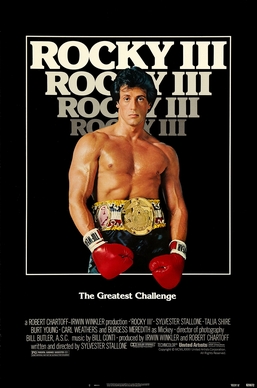
Behind the film
- Year
- 1982
- Director
- Sylvester Stallone
- Writers
- Sylvester Stallone
- Runtime
- 1h 39m
- Genres
- Drama, Action, Boxing
- Production
- United Artists
- Country
- United States
- Cast
- Mr. T, Carl Weathers, Talia Shire, Burt Young, Burgess Meredith, Tony Burton, Hulk Hogan, Sylvester Stallone
About the film
Contains story spoilers.
Rocky III begins with a champion whose success has become an environment as much as an achievement. Fame supplies expectations, ceremonies and attention that can make continuing to look successful easier than recognising what a new challenge requires. The film puts that environment under pressure by introducing an opponent who has not acquired its comforts. Their contrast is not simply between a hero and an aggressive challenger. It is between two relationships to ambition, one shaped by having reached the top and the other directed towards getting there, with the title becoming the point at which those relationships must be tested. The contrast gives the audience a way of understanding why another victory cannot simply be demanded from the record of earlier victories. Achievement has changed the conditions under which Rocky acts, so the abilities associated with his reputation need to be tested again.
Sylvester Stallone wrote, directed and stars in the 1982 film. Talia Shire returns as Adrian, Burgess Meredith as Mickey and Carl Weathers as Apollo Creed, with Mr. T playing Clubber Lang. The sequel places Rocky inside the consequences of victory rather than replaying the conditions under which he first sought recognition. His vulnerability comes partly from being valued, protected and displayed. That gives the return to training a different emotional purpose. He needs to recover an honest relationship to his abilities without expecting the earlier version of himself to reappear unchanged simply because he wants the championship back.
Clubber challenges Rocky, and Mickey admits that earlier opponents were chosen to protect the champion. Rocky accepts the fight but trains amid distractions. Before the bout, Clubber shoves Mickey, who suffers a heart attack. Rocky loses and subsequently grieves Mickey's death. Apollo offers to prepare him for a rematch, while Adrian helps him acknowledge fear and guilt. With a changed approach, Rocky defeats Clubber and regains the title. He then honours the favour Apollo requested: the former rivals return to a ring for a private, friendly encounter, ending the story on their altered relationship rather than another public celebration.
Mickey's protective choices make care uncomfortable to reassess. Rocky has depended on a trainer whose judgment helped create his success, so discovering what that judgment withheld cannot be separated from the affection he feels. The revelation damages his confidence in the championship and complicates his grief. Anger and love have to coexist rather than arriving in a sequence where one can be resolved before the other begins. The film makes that mixture central to the problem of returning, because Rocky cannot simply replace a training routine and leave untouched the relationship that gave the routine its authority.
Clubber's presence makes the cost of comfort visible through contrast. He is not distracted by maintaining the public experience of already being a champion, and his determination exposes how much Rocky's preparation has become entangled with attention. The title fight brings their immediate priorities together under conditions that publicity cannot soften. The film's interest in fame thus reaches the ring through behaviour rather than remaining a general complaint about celebrity. Rocky has to recognise that the image others celebrate cannot do the work required when the opponent in front of him is capable of defeating him.
Apollo's help changes the meaning of rivalry. Somebody once understood through opposition becomes capable of offering knowledge Rocky needs, requiring both men to inhabit a relationship their earlier fights did not establish. Accepting that help involves relinquishing the idea that the old methods must be sufficient because they once produced victory. The new partnership also gives Apollo's abilities a purpose beyond proving himself against the same opponent again. Their cooperation allows competition to generate respect without requiring either man's history to be erased, making the rematch a collective effort whose value extends beyond the belt.
Adrian's conversation with Rocky addresses a part of the problem that technique alone cannot settle. Fear has become difficult to acknowledge because it appears to conflict with the identity expected of a champion. Naming it makes the return possible on less defensive terms. The emotional work is therefore not a decorative encouragement placed beside the physical preparation. It changes what preparation can accomplish, because a person avoiding the reason for hesitation cannot reliably solve that hesitation by becoming stronger. Her role gives the film's training movement a connection to trust and honesty within the family.
The recovered championship does not restore Mickey or undo the earlier defeat. Its importance comes from Rocky reaching it through a different understanding of what his success requires. The private encounter with Apollo then reduces the public scale of the ending, allowing two men to enjoy a relationship transformed by the work they have done together. Stallone's sequel closes with competition detached from the need to defend a celebrity image. Rocky has returned to the title, but the final moment suggests another recovery alongside it: the ability to enter a ring without requiring the entire event to confirm the reputation that once kept him from recognising his limits.