
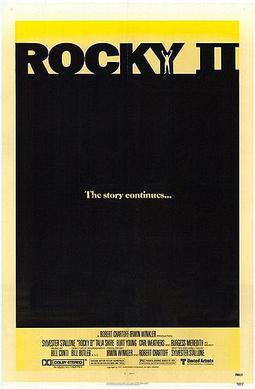
Behind the film
- Year
- 1979
- Director
- Sylvester Stallone
- Writers
- Sylvester Stallone
- Runtime
- 1h 59m
- Genres
- Drama, Action, Boxing
- Production
- United Artists
- Country
- United States
- Cast
- Talia Shire, Burt Young, Carl Weathers, Burgess Meredith, Tony Burton, Sylvester Stallone, Joe Spinell, Frank Stallone
About the film
Contains story spoilers.
Rocky II begins with a problem that the first film's emotional finish cannot settle: what does Rocky Balboa do with the rest of his life? Going the distance against Apollo Creed has given him recognition, but recognition is not a profession, a secure income or a plan for the future. Sylvester Stallone's sequel makes that uncertainty central to the return bout. The question is no longer simply whether an overlooked fighter deserves a chance. It is whether a man who has already been noticed can build a life around something other than the opportunity that made people notice him.
After losing narrowly to Apollo, Rocky retires with a damaged eye, marries Adrian and struggles to earn a living. Apollo wants a rematch to erase doubts about his victory. Rocky returns to training, but Adrian fears for his health. Her premature labour leaves her in a coma; after she recovers, she encourages him to win. Mickey prepares Rocky to fight right-handed to protect his injured eye. In the final round, Rocky returns to his natural southpaw stance. Both fighters fall, but Rocky beats the count and becomes champion. The changed result grows out of a renewed commitment to boxing and family, rather than pretending the first contest had already solved his problems.
The domestic material gives the sequel its particular shape. Rocky's awkwardness outside the ring is not merely a joke about a boxer encountering ordinary life. It shows the gap between a public story about success and the practical skills needed to benefit from it. His body can absorb punishment, but that does not make selling an image or finding dependable work simple. Money and attention arrive with expectations he does not fully understand. The film consequently makes everyday uncertainty feel like a genuine continuation of the original struggle, rather than an inconvenient pause while everyone waits for another training montage.
Talia Shire's Adrian is essential to that change in emphasis. Her concern introduces a measure of consequence that the boxing audience cannot supply: the fighter who takes the risk is also the person she expects to come home. Reading her hesitation only as an obstacle to his ambition would flatten the relationship. The film gives Rocky's desire to compete a competing responsibility, and their reconciliation makes his renewed focus emotionally possible. Her encouragement does not make the injury disappear. It changes how the decision is shared, allowing the climax to carry the weight of a marriage and a child as well as a championship.
Carl Weathers gives Apollo a motive that is more interesting than simple contempt for an underdog. Being the official winner has not secured the interpretation of his performance. Rocky's endurance has become the memorable story, leaving Apollo determined to control what the rematch means. That makes reputation a pressure felt by both men, although they occupy very different positions. One is trying to stabilise a new identity; the other is trying to defend an established one. Their conflict extends the first film without erasing the champion's skill or turning him into an uncomplicated villain whose only purpose is to make Rocky seem admirable.
Training restores a rhythm that the early scenes deliberately unsettle. Mickey's instructions make preparation a process of adaptation rather than a promise that wanting victory is enough. The switch of stance matters because Rocky cannot simply repeat what worked before; his damaged eye imposes a practical limit on the familiar approach. The Philadelphia run expresses a different kind of change. Its accumulating public energy turns an individual routine into a shared occasion, giving the city a place in his renewed effort. The sequence works as celebration because it follows uncertainty, so physical momentum also registers as the return of emotional direction.
The boxing scenes have a different dramatic function now that the audience knows both fighters. Apollo’s showmanship and Rocky’s persistence are not simplified into villain and hero. The champion wants to secure his legacy; Rocky wants to prove what he can do, but his motives are now tied to Adrian and their child. The final bell and count compress these motives into a physical decision, while the fight’s bruising rhythm keeps the victory costly. The result is a public achievement and a personal milestone, not a promise that Rocky’s future will be free of hardship.
Stallone writes and directs a sequel that keeps its centre close to the people whose lives boxing can disrupt. The final count supplies a more decisive sporting outcome than the original, but the route toward it remains full of compromises: confidence must coexist with vulnerability, and ambition with dependence on others. Rocky's championship is meaningful because the film has spent time showing what a title cannot automatically provide. That tension also explains why the familiar formula still has room to develop. The rematch repeats the arena while changing the relationships around it, making victory a new chapter in an ongoing life rather than a cure for every difficulty.