
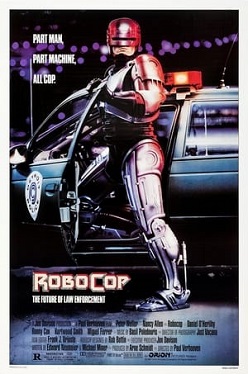
Behind the film
- Year
- 1987
- Director
- Paul Verhoeven
- Writers
- Edward Neumeier, Michael Miner
- Runtime
- 1h 42m
- Genres
- Action, Science fiction, Superhero, Dystopian
- Production
- Orion Pictures
- Country
- United States
- Cast
- Peter Weller, Nancy Allen, Dan O'Herlihy, Ronny Cox, Kurtwood Smith, Miguel Ferrer, Ray Wise, Felton Perry
About the film
Contains story spoilers.
RoboCop imagines a Detroit where public safety has become a corporate project. Omni Consumer Products, or OCP, holds power over the city's police and plans a new development called Delta City. Police officer Alex Murphy arrives in a deteriorating precinct with partner Anne Lewis, then is brutally killed by a gang led by Clarence Boddicker. OCP turns his body into a law-enforcement cyborg, retaining his memories beneath a programmed set of directives. Peter Weller plays Murphy and Nancy Allen plays Lewis. The premise takes the police story of a partner lost on duty and makes the institution itself responsible for rebuilding him as property. The future city is not defined by futuristic convenience; it is divided between failing public spaces and corporate ambitions.
Murphy's return to the streets initially seems to fulfil OCP's promise of a tireless officer. RoboCop can process commands, withstand gunfire and bring a new kind of force to the city's crime problem. But the system that governs him also limits what he can do. His directives place corporate authority inside his body, while fragments of memory keep surfacing through patrol and investigation. The gap between what RoboCop is ordered to be and what he remembers makes identity a practical conflict. He needs to discover what happened to Murphy, yet his investigation leads back to the people who created the machine and expect to control it. His return is both a police assignment and a question about who owns his labour and decisions.
Verhoeven builds the world through sharp changes of register. News broadcasts report civic crisis and international absurdities; commercials interrupt violence with products and corporate promises; boardroom scenes show executives treating the city as an investment opportunity. These satirical interludes establish the public language around the main plot, where every problem can be described as a market opening. Detroit's decaying neighbourhoods and OCP's polished corporate spaces belong to the same urban system, but offer radically different ideas of who deserves protection. The setting makes the cyborg's body a site of both technological innovation and corporate ownership. The advertising also links the film's exaggerated media landscape to its depiction of a society where consumers are constantly addressed even as institutions fail them.
Murphy and Lewis's partnership gives the story a human connection that the program cannot entirely erase. Lewis recognizes aspects of the officer she knew, while Murphy has to work through memories he cannot initially trust. Clarence and his gang provide a direct threat, but the larger conflict reaches into OCP and the executives who designed RoboCop's restrictions. Dick Jones, played by Ronny Cox, treats power as a matter of internal corporate hierarchy; Bob Morton, played by Miguel Ferrer, is the ambitious manager behind the cyborg project. The contrast between street violence and boardroom manoeuvring keeps responsibility from ending with the criminals. Murphy's memories surface in fragments that give his search emotional force without restoring his former life all at once.
The action is hard-edged, but the film also uses the artificial body for dark comedy. RoboCop's mechanical motions and flat delivery sit beside human reflexes and memories trying to re-emerge. The ED-209 enforcement robot, a rival corporate design, turns bureaucratic confidence into a grotesque spectacle when its demonstration goes disastrously wrong. The violence and commercial interruptions can be abrasive; together, they depict a culture in which brutality and advertising coexist. The craft draws on science-fiction effects and familiar police-thriller beats, allowing one genre to distort the other. RoboCop's armour gives him physical protection but makes visible how thoroughly the corporation has transformed his body into equipment. Its stark surfaces are set against the city's disrepair and the human vulnerability the program cannot fully remove.
The climax brings Murphy back into conflict with his makers. OCP's senior leadership has inserted a directive that prevents RoboCop from arresting a high-ranking executive, a limit that reveals the supposedly neutral program to be political. The solution depends on recognizing that the rules were written by people who assumed they would never be challenged. When Murphy pursues the executives and criminals who shaped his fate, his action is both police investigation and a struggle to reclaim a name. The city and its corporate structure remain, but the person inside the machine has asserted himself. That recovery of identity gives the satire an emotional anchor. Verhoeven's story does not pretend that one act resolves Detroit's crisis; it offers the narrower but hard-won victory of a man recognized as himself rather than as a corporate product.
The film's news interruptions widen that conflict beyond Murphy's personal case. They report violence, political tension and consumer products with the same brisk television tone, as if each were another item in a continuous broadcast. This creates a world where the language of public information has itself become part of the spectacle. The news clips also serve a practical storytelling purpose: they fill in the conditions of Detroit and the wider society without requiring Murphy to stop and explain them. Viewers can see how the city is discussed by institutions that treat public disorder as material for business. Against that detached voice, Murphy's recovering memories supply a specific human history that the corporate image cannot fully contain.