
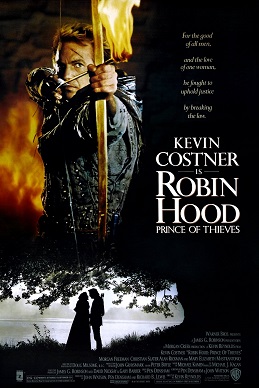
Behind the film
- Year
- 1991
- Director
- Kevin Reynolds
- Writers
- Pen Densham, John Watson
- Runtime
- 143 minutes
- Genres
- Swashbuckler, Adventure, Action, Drama
- Production
- Morgan Creek Entertainment
- Country
- United States, United Kingdom
- Cast
- Kevin Costner, Morgan Freeman, Mary Elizabeth Mastrantonio, Christian Slater, Alan Rickman, Geraldine McEwan, Michael McShane, Brian Blessed
About the film
Contains story spoilers.
Robin Hood: Prince of Thieves builds its adventure around the difference between inheriting status and earning people's trust. Robin returns with a name that once meant security, but a name cannot protect a community by itself. The legend becomes a story about learning what leadership requires when the ordinary structures of protection have become predatory. Its world is organised around contrasting spaces: a home that no longer provides shelter, a forest that must become a refuge, and a castle that concentrates authority. Movement between those places gives the film its scale, while each asks a different question about who is allowed to belong.
Kevin Reynolds directs the 1991 film, with Kevin Costner as Robin, Morgan Freeman as Azeem, Mary Elizabeth Mastrantonio as Marian and Alan Rickman as the Sheriff of Nottingham. Pen Densham and John Watson wrote the screenplay. The story adapts an outlaw legend into a large romantic adventure rather than presenting a documentary account of medieval England. Its castles, journeys and political dangers give the familiar characters a particular dramatic setting. The important distinction is between understanding this version's invented conflicts and treating those conflicts as historical evidence. Its stakes concern the promises and loyalties the film establishes for its own ensemble.
Robin escapes captivity with Azeem, whose life-debt brings him to England. Robin's dying companion asks him to protect Marian. At home, Robin discovers his father's murder and the Sheriff's abusive rule. He joins the outlaws of Sherwood, develops their resistance and falls in love with Marian. Will Scarlett's hostility gives way to reconciliation when he reveals that he is Robin's half-brother. After the Sheriff captures Marian and threatens the outlaws, Robin's allies infiltrate Nottingham to rescue them. Robin kills the Sheriff; Azeem saves Robin from Mortianna. King Richard returns and blesses Robin and Marian's marriage, closing this version of the legend.
Azeem complicates the idea that Robin's own culture supplies everything he needs. Their partnership involves different assumptions about obligation, competence and how a promise should be honoured. The resulting contrast is useful because familiarity can make a hero's inherited authority seem automatic. A companion who does not share those assumptions can question them without losing the capacity to help. Their friendship therefore has more substance than simply pairing a leader with an assistant. It brings another perspective into the adventure and asks Robin to operate within a relationship whose terms he cannot entirely dictate, even when he believes he understands the situation.
The outlaw community makes another demand on him. People who need food and protection have practical reasons to distrust impressive claims, and resistance is not made credible by a stirring declaration alone. A leader has to connect individual frustration to something people can actually do together. That is the appeal of Sherwood as a setting: it allows the legend to become social, showing the difference between an isolated act of defiance and a group capable of sustaining it. The forest's promise is conditional. It must be maintained through cooperation, and the people depending on it have more at stake than the pleasure of an adventurous life.
Marian's position brings the relationship between power and consent into the romance. An arrangement can wear the outward appearance of honour while denying the person at its centre a meaningful choice. The Sheriff's political authority extends into his understanding of what another person's future should be. That makes romance and resistance parts of the same conflict rather than unrelated attractions added to an action story. Freedom has to include the ability to refuse a role imposed by somebody stronger. The film's romantic resolution gains its meaning from that requirement; affection cannot be measured simply by the success of the person who claims to want it.
Family creates a more complicated account of belonging than the uncomplicated fellowship associated with an outlaw band. Shared ancestry does not prevent resentment, and good intentions do not make an earlier absence irrelevant. Robin's relationships ask him to see what other people experienced while he was elsewhere. That is a useful counterweight to a story centred on his return: coming home gives him a new beginning, but it does not automatically give everyone around him the same one. Reconciliation requires room for grievances that his perspective did not previously contain. The community's strength depends partly on whether those differences can be acknowledged without destroying its common purpose.
The film combines those concerns with the pleasures of a broad adventure: contested territory, dangerous entrances, shifting alliances and a confrontation with concentrated power. Its hero becomes effective through relationships rather than through a complete independence from everyone else. The contrast between forest and castle makes that principle visible, setting a precarious communal refuge against an institution designed to preserve privilege. The ending brings the legend back towards lawful restoration, but its movement has depended on people acting before that restoration arrived. This Robin Hood story gives the familiar bow and outlaw identity a particular context: a struggle to make promises useful to those who have the least protection.