
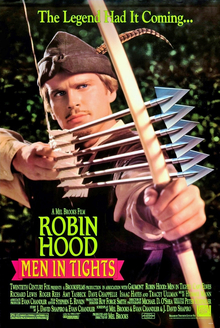
Behind the film
- Year
- 1993
- Director
- Mel Brooks
- Writers
- Mel Brooks, J. David Shapiro
- Runtime
- 1h 44m
- Genres
- Action, Comedy, Parody
- Country
- France, United States
- Cast
- Cary Elwes, Richard Lewis, Roger Rees, Amy Yasbeck, Avery Schreiber, Dave Chappelle, Tracey Ullman, Isaac Hayes
About the film
Contains story spoilers.
Robin Hood: Men in Tights takes its green tights and feathered hats from an earlier screen outlaw. In a 1993 interview with Chris Hicks, Mel Brooks said the foundation was The Adventures of Robin Hood, the 1938 Errol Flynn film, especially its costumes and fighting. Kevin Costner's Robin Hood: Prince of Thieves supplied a more recent target: Brooks singled out the missing English accent, which becomes a joke for Cary Elwes's Robin. The film's medieval world follows those screen versions, with contemporary habits and objects interrupting the familiar adventure. Brooks described developing the script with Evan Chandler and J. David Shapiro after they brought him an outline. He recalled six or seven months of work, visualising the scenes before filming and leaving about a tenth of the material open to spontaneous additions. Physical jokes needed drawings as well as words. His storyboards helped determine what the camera would actually see, including how many people a shot needed. The finished comedy's departures from the legend therefore began with a planned sequence of images.
Elwes initially thought the invitation itself might be a joke. Speaking to SYFY in 2019, he recalled Brooks calling him directly at home without an assistant introducing the conversation. He hung up, assuming someone was impersonating the director, and Brooks called back to establish that the offer was real. Once cast, Elwes trusted Brooks to guide him if the performance went wrong. He understood that getting the comedy right involved tone as well as behaviour. Casting gave Elwes another way into that tone. In his American Masters interview, he remembered reading with actors auditioning for Ahchoo, the role played by Dave Chappelle. He also suggested Patrick Stewart for King Richard, having worked with him on Lady Jane, and Robert Ridgely for the hangman. Ridgely's appearance linked the film to his horse-hanging character in Blazing Saddles. Elwes wanted Dom DeLuise involved too; DeLuise became Don Giovanni, an imitation of a screen Mafia patriarch inside the outlaw adventure.
Robin's job within this company was often to stay comparatively straight. Elwes said he and Brooks discussed that balance beforehand: the surrounding performers needed a stable figure against whom their jokes could work. He trained again in sword fighting, this time with larger weapons for his scenes opposite Roger Rees. Rehearsal could change a line or add a discovery, but Elwes remembered the story's structure remaining largely intact. The performance had room for adjustments without requiring the cast to invent a new plot each day. Brooks was also making comedy out of the film's own existence. Roger Friedman's interview, first published in 1993, records him describing villagers reacting to the opening credits after their village has burned. They recognise the director's name and object to his arrival. Another gag puts a blind man at a wooden post, whittling while a sword fight happens around him. The danger and the everyday task occupy the same space, with the character unaware of their collision. Brooks described his role as changing a story audiences already knew, rather than introducing that story from scratch.
The forest and castle belonged to a California production rather than an English location shoot. Studio production notes identify Sable Ranch, north of Los Angeles, as the setting for Sherwood Forest, the Spring Fair and the castle; interiors were filmed at Warner Hollywood Studios. The film even interrupts its closing business for a cameo sequence identifying Brooks, Stewart, DeLuise, Dick Van Patten and Ridgely. That acknowledgement of the performers comes before the last bedroom joke, allowing the romance one more unfinished task after the ceremonial ending.
Hummie Mann's score treats the adventure more seriously than many of the people inhabiting it. In his account of composing the music, Mann explains that he and Brooks agreed it should support action and adventure without competing with the jokes. He avoided comic musical gestures that might themselves solicit a laugh. A sword fight could therefore retain the musical manner of an adventure even while the action supplied something ridiculous. His preparation involved watching other Robin Hood films, especially the 1991 Costner version scored by Michael Kamen and the 1938 Flynn version scored by Erich Wolfgang Korngold, alongside an animated treatment. Since Brooks was principally sending up the Costner film, Mann considered whether its music offered something he could use. His account also distinguishes a story's period from the musical conventions of the films telling it. He heard Korngold's work as drawing on the late Romantic language adopted by Hollywood adventure scoring, rather than simply recreating music from Robin Hood's supposed era. The musical world, like the costumes, had a history on screen.
The story sends Robin out of imprisonment with Asneeze's help, then home to find Loxley Hall repossessed. He joins Ahchoo, Blinkin, Little John and Will Scarlet against Prince John. At the Sheriff's archery trap, Robin consults the script and discovers he gets another shot; Blinkin foils an assassination. Marian promises to marry the Sheriff to save Robin. The outlaws interrupt the wedding, and Robin wins their duel but accidentally stabs his opponent while sheathing his sword. Latrine saves the Sheriff in exchange for marriage. King Richard returns, orders John imprisoned and lets Robin marry Marian; Ahchoo becomes sheriff. Robin's inherited key should open Marian's chastity belt, but the lock still refuses. Their wedding night ends with a call for a locksmith, leaving the promised treasure inaccessible even after the villains have been dealt with.