
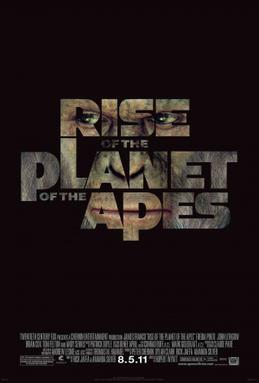
Behind the film
- Year
- 2011
- Director
- Rupert Wyatt
- Writers
- Rick Jaffa, Amanda Silver
- Runtime
- 1h 44m
- Genres
- Science fiction, Action, Drama, Dystopian
- Production
- 20th Century Studios, RatPac-Dune Entertainment, Ingenious Media
- Country
- United States
- Cast
- James Franco, Freida Pinto, John Lithgow, Brian Cox, Tom Felton, Andy Serkis, Tyler Labine, David Oyelowo
About the film
Contains story spoilers.
Rise of the Planet of the Apes begins in a San Francisco biotechnology lab, where chemist Will Rodman is testing ALZ-112, a viral therapy intended to restore cognitive ability in people with Alzheimer’s disease. A chimpanzee called Bright Eyes shows a dramatic increase in intelligence, but during a public presentation she breaks from her enclosure and is shot. Will’s employer, Steven Jacobs, cancels the project and orders the test animals killed. Will’s assistant Robert Franklin explains that Bright Eyes had recently given birth. Will takes the infant home, names him Caesar and discovers that the treatment’s effects have passed to the young chimpanzee.
Will’s father Charles has Alzheimer’s, which gives the research a family motive as well as a corporate one. Will secretly administers the original drug, ALZ-112, and for a time Charles’s memory and musical ability improve. Caesar grows up in the Rodman household, learns sign language and enjoys a close attachment to Will and primatologist Caroline Aranha. Will brings him to Muir Woods, where Caesar can climb and move among redwoods instead of remaining inside the house. The film lets the relationship feel intimate and ordinary: Caesar is treated as a child, but he is also an animal whose strength, curiosity and needs cannot be reduced to human routines.
Five years pass. Caesar is now an adult and increasingly aware that he occupies an ambiguous place. When Charles’s illness returns, he becomes confused and drives a neighbor’s car. Caesar attacks the man while defending him, and animal control sends Caesar to a primate shelter. The transition is abrupt: the young ape moves from Will’s home into cages, routines and dominance rules. Rocket, the alpha chimp, challenges him, and guard Dodge Landon uses violence to control the animals. Caesar befriends Maurice, an orangutan who also knows sign language, and studies how the shelter’s hierarchy works before deciding that passive survival will not be enough.
Meanwhile, Will develops ALZ-113, a more powerful airborne version of the treatment. Jacobs wants to proceed with testing, even after Franklin becomes ill through accidental exposure while testing the drug on a bonobo named Koba. Charles refuses further doses and dies overnight. Will quits his job as the danger becomes clear. Caesar escapes from the shelter and steals canisters of ALZ-113 from Will’s house, then releases the gas among the apes at the facility. The treatment increases their intelligence. When Dodge tries to force Caesar back into a cage, Caesar speaks for the first time and leads the others out, turning an escape into an organized uprising.
The apes break into the Gen-Sys laboratory, release Koba and other captive apes, and add animals from the San Francisco Zoo to their group. Their escape moves toward the Golden Gate Bridge and the redwood forest beyond the city. Police and vehicles block the bridge, creating a chokepoint where the apes must choose whether to fight through or be returned to confinement. Caesar’s strategic thinking now operates on a larger scale, but he still recognizes individual loyalties. Buck, the gorilla, sacrifices himself to bring down a helicopter threatening Caesar; Koba takes revenge on Jacobs, pushing his helicopter into the water. The group’s victory is not bloodless or unanimous in motive.
Will catches up with Caesar in the forest and warns that humans will hunt the apes. He asks him to come home, but Caesar tells him that the forest is home. The exchange gives the film’s central relationship a painful resolution: Will has loved and protected Caesar, yet he cannot define where Caesar belongs. The apes settle among the redwoods, with Maurice and the others now members of a community rather than specimens. The closing images also reveal that the consequences of ALZ-113 extend beyond this local uprising. Will’s neighbour Hunsiker, infected after contact with Franklin, arrives at the airport, and the film traces the virus’s early spread across the world.
Rupert Wyatt’s film builds its drama around a gradual shift in point of view: the laboratory first treats apes as test subjects, the shelter treats them as property, and the final bridge confrontation asks viewers to read the crowd as a society acting to survive. Andy Serkis’s motion-capture performance gives Caesar an expressive vocabulary built from gaze, posture and sign, so the moment he speaks carries the weight of a decision rather than a trick. James Franco and John Lithgow ground the scientific premise in a father-son relationship, while the redwood setting gives Caesar’s departure a visual destination. The story stands on its own as the 2011 film’s account of one ape’s liberation and the first consequences of the drug. The visual effects make Caesar’s changing agency readable without turning every beat into a speech. In the shelter he watches keys, doors and guard habits; later he uses signs to coordinate movement among animals who have different sizes and forms of strength. The bridge battle grows from those observations. Its motion-capture work gives the apes a shared physical vocabulary, while Caesar’s stillness often distinguishes him from the guards’ hurried control.