
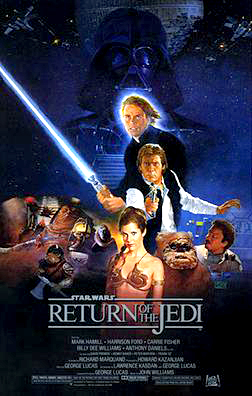
Behind the film
- Year
- 1983
- Director
- Richard Marquand
- Writers
- Lawrence Kasdan, George Lucas
- Runtime
- 2h 12m
- Genres
- Science fiction, Adventure, Fantasy, Action
- Production
- Lucasfilm
- Country
- United States
- Cast
- Harrison Ford, Carrie Fisher, David Prowse, Mark Hamill, Ian McDiarmid, Billy Dee Williams, Anthony Daniels, Kenny Baker
About the film
Contains story spoilers.
Return of the Jedi opens with Luke, Leia, Lando and the droids arriving at Jabba the Hutt's palace on Tatooine. Han has been frozen in carbonite and delivered to Jabba, who keeps the bounty hunter's prize as decoration. Luke's friends infiltrate the palace through disguises and separate plans, but Jabba sees through them and captures the group. He sentences Luke and Han to die in the Sarlacc pit. Luke has anticipated parts of the trap and uses his lightsaber to fight free. Leia kills Jabba aboard the sail barge as the escape unfolds, and the group flies away together. Their rescue succeeds because Luke has become more confident and strategic, but the mission also shows how dangerous the galaxy's criminal networks remain.
The Rebels learn that the Empire has begun constructing a second Death Star, an even greater battle station. It is protected by a shield generator on the forest moon of Endor. The Rebel fleet plans a coordinated attack, with a team sent to disable the shield so fighters can reach the station. Luke joins the mission with Han and Leia, but his attention is divided by Vader, who senses him and reports his presence to the Emperor. Luke believes there may still be good in his father. The others focus on the military plan; Luke carries a private hope that could jeopardize the operation if it turns into a confrontation with Vader.
On Endor, Leia becomes separated from the others and meets Wicket, an Ewok from the forest. Wicket takes Leia to the Ewok village. The Ewoks have separately captured Han, Luke, Chewbacca and the droids in the forest. The Ewoks treat C-3PO as a deity. Luke uses the Force to lift him into the air, convincing their captors to release his friends. Han and Luke persuade the Ewoks to help the Rebel mission. The forest setting makes the fight against the Empire depend on local knowledge rather than superior weapons. The Ewoks’ traps and guerrilla tactics help the Rebels fight Imperial troops, keeping the story moving across very different kinds of conflict.
Luke surrenders himself to Vader, hoping to reach his father before the Emperor can turn him. The Emperor tries to provoke Luke into anger by showing him the threat to his friends and the Rebel fleet. As the battle develops, Luke fights Vader and briefly gives in to rage. He defeats Vader, but stops when he sees that he is close to becoming like the Emperor. He throws away his weapon and refuses the offer to join the dark side. The Emperor attacks Luke with Force lightning, and Vader finally turns against him to save his son. The Emperor dies, while Vader is mortally injured. Luke removes his father's mask, and Anakin dies after their brief reconciliation.
The battle over Endor reaches its climax as the Rebels discover that the unfinished Death Star already has a functioning superlaser, turning their attack into an Imperial trap. The Imperial fleet initially traps them, but the ground team disables the shield generator. Lando leads the fighter attack into the station's interior, while the Emperor's defeat changes Vader's choices. The Death Star explodes and the Rebel forces win a decisive victory. The film cuts between the space battle, the forest fighting and Luke's confrontation with the Emperor, so the political and personal outcomes unfold together. Luke's refusal to kill his father is tied to the survival of the Rebellion, even though these are not the same problem.
Richard Marquand directs a story that resolves the original trilogy's central conflicts through interlocking action. The Tatooine sequence pays off the characters' plan-making and sets Luke up as someone capable of leading a rescue. Endor's battle plays with scale: tiny Ewoks face armored troops, and the forest's trees become cover and obstacles. In space, the Rebel fleet appears outmatched by a station whose shield makes a direct attack impossible. These practical constraints keep the climax understandable as a series of problems that the characters have to solve. John Williams's score binds the different locations together, giving the final operation a sense of momentum without reducing the personal confrontation to another battle scene.
Luke's faith in Anakin is the film's emotional centre. The Emperor insists that the only outcome is obedience or destruction, and Vader appears to accept that view. Luke's refusal to strike the final blow gives Anakin a chance to act from care rather than fear. It does not erase the harm he has caused, but it changes what he chooses at the last moment. Leia's role in the rescue and battle confirms that she is an active leader in the Rebellion, not simply the person Luke is trying to save. Han's return to the group and his partnership with Lando show how personal relationships support the larger cause, even as the film gives each character a different part in the operation.
The ending moves quickly from destruction to celebration. The Rebels gather on Endor, Luke sees the spirits of Obi-Wan, Yoda and Anakin, and the survivors celebrate the Empire's defeat. The immediate war has been won, though the film does not detail how a new government will be formed or how every remnant of the Empire will be handled. Luke has lost his father but prevented himself from repeating his father's path. The final image of Anakin among the Jedi offers reconciliation beside, rather than erasure of, the consequences of his past. Return of the Jedi closes the trilogy by letting the military victory and the family story reach their endings together.