
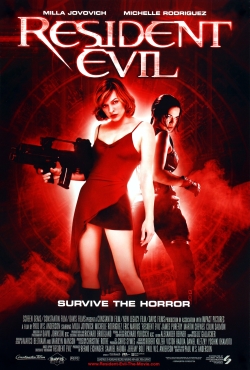
Behind the film
- Year
- 2002
- Director
- Paul W. S. Anderson
- Writers
- Paul W. S. Anderson
- Genres
- Action, Horror, Science fiction, Girls with guns
- Production
- Constantin Film
- Country
- France, United Kingdom, Germany
- Cast
- Milla Jovovich, Michelle Rodriguez, Eric Mabius, James Purefoy, Martin Crewes, Colin Salmon, Heike Makatsch, Pasquale Aleardi
About the film
Contains story spoilers.
Resident Evil begins with the unsettling possibility that the place designed to contain a disaster has become the disaster itself. Beneath Raccoon City, the Umbrella Corporation’s Hive is a research complex with its own artificial intelligence, security systems and sealed internal spaces. Above it, an apparently ordinary mansion hides the entrance. Paul W. S. Anderson’s 2002 film takes those ingredients from the world of Capcom’s games and arranges them around Alice, played by Milla Jovovich. Her missing memories let the audience encounter the operation without already knowing whom to trust. The film’s immediate territory is much smaller than the city named above it: corridors, laboratories, maintenance routes and the train linking the facility to the surface. Escaping one room frequently means learning that the next is worse.
The Red Queen has shut down the Hive after a T-virus release, killing its occupants to prevent an outbreak beyond the facility. A commando team enters with Alice, Matt and Spence, then discovers that the dead employees have become threats themselves. Disabling the computer opens containment doors as well as stopping its defences. Alice’s returning memories reveal that she was cooperating with Matt’s sister Lisa against Umbrella; Spence stole the virus and released it. The survivors seek an anti-virus and a route out while facing infected staff, dogs and a Licker. Spence’s betrayal costs him his life, and the escape train provides no safe ending for Rain or Kaplan. Alice and Matt reach the mansion, where Umbrella takes them into custody. Alice subsequently awakens in a hospital and emerges into a devastated Raccoon City.
The plot builds uncertainty into the team’s basic understanding of its assignment. Professional equipment and weapons suggest that the commandos can impose order, but they are entering a system whose logic they do not control. Colin Salmon’s One gives that confidence a human face, while the laser corridor makes the limits of their preparation brutally clear. The danger is not just something that can be shot. It is built into architecture, access permissions and mechanisms designed to work regardless of who is standing in front of them. A straight line through a corridor can become a trap. Anderson uses the clean appearance of the facility against the expectation that cleanliness means safety, placing bodily destruction inside spaces that look engineered to eliminate uncertainty. Technical competence offers a temporary advantage rather than immunity.
The Red Queen complicates the usual distinction between rescuer and monster. Her measures are horrific for the people inside the Hive, yet the disaster she seeks to prevent is real within the film’s fictional world. Turning her off feels like a victory because it removes an immediate threat, but it also removes barriers the team has not fully understood. That change gives the story a useful cause-and-effect structure: the characters alter their surroundings and have to survive the consequences. The computer’s childlike image also creates a mismatch between appearance and authority. The figure delivering instructions does not resemble the scale of the machinery behind her. Conversations with her become negotiations over lives, access and information, keeping the facility’s intelligence active in the story even when the action moves into creature horror.
Alice’s amnesia makes identity another form of restricted access. She can act before she can explain why certain skills or fragments of recognition feel familiar. A recovered memory is therefore both character information and a change to the audience’s understanding of the mission. James Purefoy’s Spence occupies the same apparent condition, but that similarity does not establish a shared purpose. Eric Mabius’s Matt brings a connection to people inside the Hive that is separate from the company’s official account. His sister Lisa gives the dead staff a particular human identity rather than leaving them as an anonymous mass. Alice’s emerging connection to her places resistance to Umbrella inside the building before the commandos arrive. The corporation’s secrecy has already produced competing motives among people who appear, at first, to belong to the same operation.
Michelle Rodriguez’s Rain supplies a different kind of momentum: direct physical resistance under increasingly poor conditions. Infection makes time part of the threat, since surviving an attack does not necessarily end its consequences. The possibility of an anti-virus introduces hope without guaranteeing recovery. The Licker, meanwhile, shifts the scale of danger away from recognisably human attackers towards a manufactured creature whose body expresses the facility’s experiments. Those threats give the film several forms of suspense rather than a single repeating pursuit. A door can hide an infected person, an automated defence or a route that will close before anyone reaches it. The people moving through those spaces must keep revising what survival means, while the company behind the building retains the ability to seize them even after they have escaped its internal dangers.
The final move into Raccoon City changes the meaning of everything that came before it. The Hive was presented as a boundary around the crisis; the ruined streets show that a boundary the characters fought to cross has failed on a much larger scale. Alice’s journey out of the hospital gives her another awakening, but this time the missing explanation belongs to the world around her. The film finishes with a survivor facing a city rather than a contained mission reaching a tidy conclusion. For viewers approaching from the games, this is the beginning of the Alice-led screen series, not a scene-by-scene retelling of a single playable campaign. Its emphasis lies on a group under pressure, a corporation that controls information and bodies, and a succession of spaces whose apparent security keeps turning into another reason to be afraid.