
Behind the film
- Year
- 2007
- Director
- Russell Mulcahy
- Writers
- Paul W. S. Anderson
- Genres
- Action, Horror, Science fiction, Girls with guns
- Production
- Constantin Film
- Country
- Canada, United Kingdom, France, Germany, United States, Mexico
- Cast
- Milla Jovovich, Oded Fehr, Ali Larter, Iain Glen, Ashanti, Mike Epps, Chris Egan, Spencer Locke
About the film
Contains story spoilers.
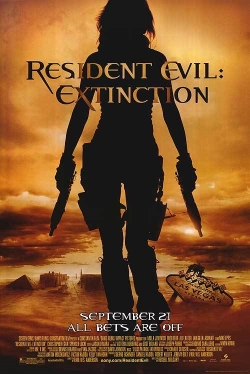
Resident Evil: Extinction takes the danger associated with an outbreak and makes it the condition of an entire landscape. The third film in the live-action series follows Milla Jovovich’s Alice through a world where survival means movement between places that no longer provide dependable shelter. Russell Mulcahy directs from a screenplay by Paul W. S. Anderson. The desert setting changes the sense of threat: an open horizon does not promise freedom when the resources needed to cross it have become scarce. The infected remain a physical danger, but the larger environment makes every decision about fuel, supplies and company consequential. Staying alive requires more than winning the next fight.
Alice meets Claire Redfield’s convoy and shares information suggesting Alaska may offer refuge. Umbrella’s Dr Isaacs tracks her powers and sends experimental infected against the group. Losses include Carlos, who sacrifices himself to help the survivors reach a helicopter. Alice stays behind at Umbrella’s facility, where she discovers cloned versions of herself and confronts the mutated Isaacs. A clone helps her survive the lethal corridor in which he is destroyed. The ending separates the survivors’ journey towards Alaska from Alice’s challenge to Umbrella’s leadership in Tokyo, supported by other clones. It opens a new confrontation rather than showing the world cured or the proposed refuge verified.
The convoy gives the film a community that has to operate under continual pressure. People cannot organise their lives around a secure home, so practical cooperation becomes the basis of what home remains. A vehicle, a shared task or someone willing to stand watch can supply temporary stability. Ali Larter’s Claire has responsibility for that fragile arrangement, while Alice arrives with abilities outside the group’s ordinary resources. The relationship between them puts exceptional power beside everyday leadership. An extraordinary individual may save people in a crisis, but keeping a group alive between crises requires decisions that cannot depend entirely on that individual being present.
Alice’s isolation also carries a different meaning in a world full of frightened strangers. Travelling alone can reduce exposure to betrayal or infection, yet it removes the ordinary support through which people recover from danger. The film’s encounters with survivors bring that cost into view without turning company into a guarantee of safety. Attachment creates obligations, and those obligations may make an escape more difficult. The group’s vulnerability gives Alice something to protect beyond her own movement through the wasteland. Her power has consequences for people who cannot duplicate it, making the decision to use it a form of involvement rather than simply another display of superiority.
Umbrella’s continuing experiments make the catastrophe more disturbing than a disaster no one now controls. The institution remains interested in managing bodies, refining results and recovering useful specimens after the wider world has been ruined. That persistence reveals a division between what survival means for ordinary people and what progress means inside the laboratory. The convoy seeks somewhere safe; the organisation seeks a more effective procedure. Alice belongs to both lines of interest because she is a survivor and the object of an experiment. Her conflict with Umbrella therefore concerns the right to direct her own life as well as the immediate need to prevent another attack.
The clones make that struggle visible through repetition. A person’s distinctive face becomes a pattern the laboratory can reproduce, suggesting that identity is being handled as a manufacturing problem. Failed bodies can be discarded while the experiment continues towards a useful outcome. For Alice, seeing herself repeated exposes the distance between being alive and being recognised as someone whose life belongs to her. The film’s scientific horror lies in the organisation’s ability to treat that distinction as irrelevant. An individual can resist control, but the attempt to control her does not stop with the original body. It expands into versions that make escape from classification more difficult.
The desert action changes the series’ visual relationship to contamination. Instead of keeping horror entirely within dark interiors, the film lets danger emerge into exposed, brightly visible surroundings. Clear sight is not the same as security. A landmark can remain recognisable while the social world that once gave it meaning has disappeared. That contrast lets the wasteland register as more than empty space: it contains evidence of former activity without offering its protections. The laboratory supplies the opposite environment, with controlled architecture concealing the violence of its purpose. Both settings are unsafe, but one announces collapse while the other continues to advertise order.
The final separation of the convoy and Alice preserves two different aims. Ordinary survival requires a place to go, while resistance to Umbrella requires confronting the power still trying to determine what Alice is. Neither aim can stand in automatically for the other. A defeated experiment does not restore the devastated world, and a possible refuge does not neutralise the laboratory’s ambitions. Resident Evil: Extinction uses that gap to extend its story beyond the immediate escape. Its desert journey creates a need for shared protection, while its cloning plot gives the protagonist a reason to turn from flight towards a more deliberate challenge to the institution that keeps pursuing her.