
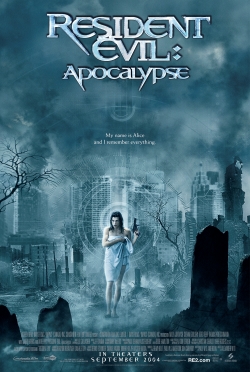
Behind the film
- Year
- 2004
- Director
- Alexander Witt
- Writers
- Paul W. S. Anderson
- Genres
- Action, Horror, Science fiction, Girls with guns
- Production
- Constantin Film
- Country
- Canada, United Kingdom, France, Germany, United States
- Cast
- Milla Jovovich, Sienna Guillory, Oded Fehr, Thomas Kretschmann, Jared Harris, Mike Epps, Sophie Vavasseur, Razaaq Adoti
About the film
Contains story spoilers.
Umbrella's reopening of the Hive spreads the T-virus through Raccoon City, and the company seals residents inside. Alice joins survivors including Jill Valentine and Carlos Olivera. Scientist Charles Ashford offers escape if they find his daughter Angela before Umbrella destroys the city. They rescue her and reach a helicopter, but Major Cain forces Alice to confront Nemesis. She discovers the creature is her former ally Matt. He turns against Umbrella and dies protecting her. The survivors flee as a nuclear strike destroys Raccoon City; their helicopter crashes and Alice is killed saving Angela. She later awakens in an Umbrella facility with new abilities. Her friends retrieve her, but the apparent escape is part of the company's continuing experiment rather than a complete release from its control.
Resident Evil: Apocalypse changes the scale of the film series from an underground facility to a city whose familiar systems have become unreliable. Streets, police stations and escape routes still look like places designed for ordinary human movement, but their usefulness now depends on forces beyond the survivors' control. Alexander Witt's film uses that expanding environment to connect a zombie emergency with a corporate enclosure. The city is dangerous because of what moves through it and because somebody else has decided who may leave. The two pressures reinforce each other, making survival a struggle against both immediate physical threats and a managed boundary.
Milla Jovovich's Alice is an action figure whose unusual abilities remain attached to the organisation she opposes. Power does not automatically establish independence when its source also wants to measure and direct it. That gives the performance's physical confidence an uncertain meaning. A spectacularly capable body can appear to promise an escape from ordinary vulnerability while making the character more valuable to an experiment. The film's action therefore carries a question about ownership beneath its heroic surface. Alice can act forcefully without possessing a complete understanding of what has been done to her or how that alteration might continue to shape her choices.
Sienna Guillory's Jill and Oded Fehr's Carlos bring different forms of professional preparation into the improvised group. Familiar equipment and training can help people respond, yet the institutional identities attached to them no longer ensure trustworthy direction. That instability is useful to the ensemble: skills acquired inside established organisations have to be redirected toward people those organisations have abandoned. Cooperation becomes provisional, built through the immediate evidence of another person's conduct. The film does not require its survivors to share a settled worldview before working together. Their common situation supplies practical obligations faster than a normal relationship could develop.
Umbrella's power has a particularly unsettling shape because it can describe destruction as management. Thomas Kretschmann's Cain gives that logic an armed representative, while Jared Harris's Ashford brings a personal stake into scientific knowledge. The contrast makes technical expertise difficult to treat as uniformly sinister or reassuring. A person can understand a mechanism while lacking the authority to decide how it will be used. The company's scale also changes the meaning of accountability. An individual confrontation may resolve an immediate threat without reaching the organisation that made the threat possible or the system through which its conduct can be concealed.
Nemesis gives corporate violence a body that is both recognisable as a manufactured weapon and difficult to fit inside an ordinary human category. Its size and armament make it a spectacle of intimidation, but the film also places identity beneath the intimidating surface. That arrangement complicates the pleasure of treating every creature as a target. The central action fantasy depends on quick distinctions between the person to save and the thing to destroy; transformation can make those distinctions unstable. Horror then concerns more than the prospect of being killed. It includes the possibility that someone's body may be taken over as material for another purpose.
The movement between enclosed encounters and larger urban confrontations gives the film a different rhythm from its predecessor. An apparently open street need not provide safety if the perimeter is controlled, while a smaller space can concentrate danger until the survivors must act immediately. The spectacle combines firearms, physical combat and grotesque creatures, making this an adult action-horror entry rather than a restrained mystery about an outbreak. Its fictional virology belongs to that genre world. The T-virus supplies a mechanism for transformation and threat; it should not be mistaken for a model of real infection, medical treatment or emergency response.
The film borrows names and creatures from Capcom's games while continuing the separate screen story centred on Alice. That distinction helps explain why recognition of Jill or Nemesis does not imply a scene-for-scene adaptation of a particular game. Paul W. S. Anderson's screenplay builds another stage in a continuing struggle, and the ending makes the value of an apparent escape deliberately uncertain. The title promises a citywide catastrophe, but the more persistent danger is an organisation capable of turning even survival into useful data. Apocalypse closes with physical endurance and personal agency still separated, leaving its heroine's growing power inside a conflict she has not yet been allowed to define for herself.