
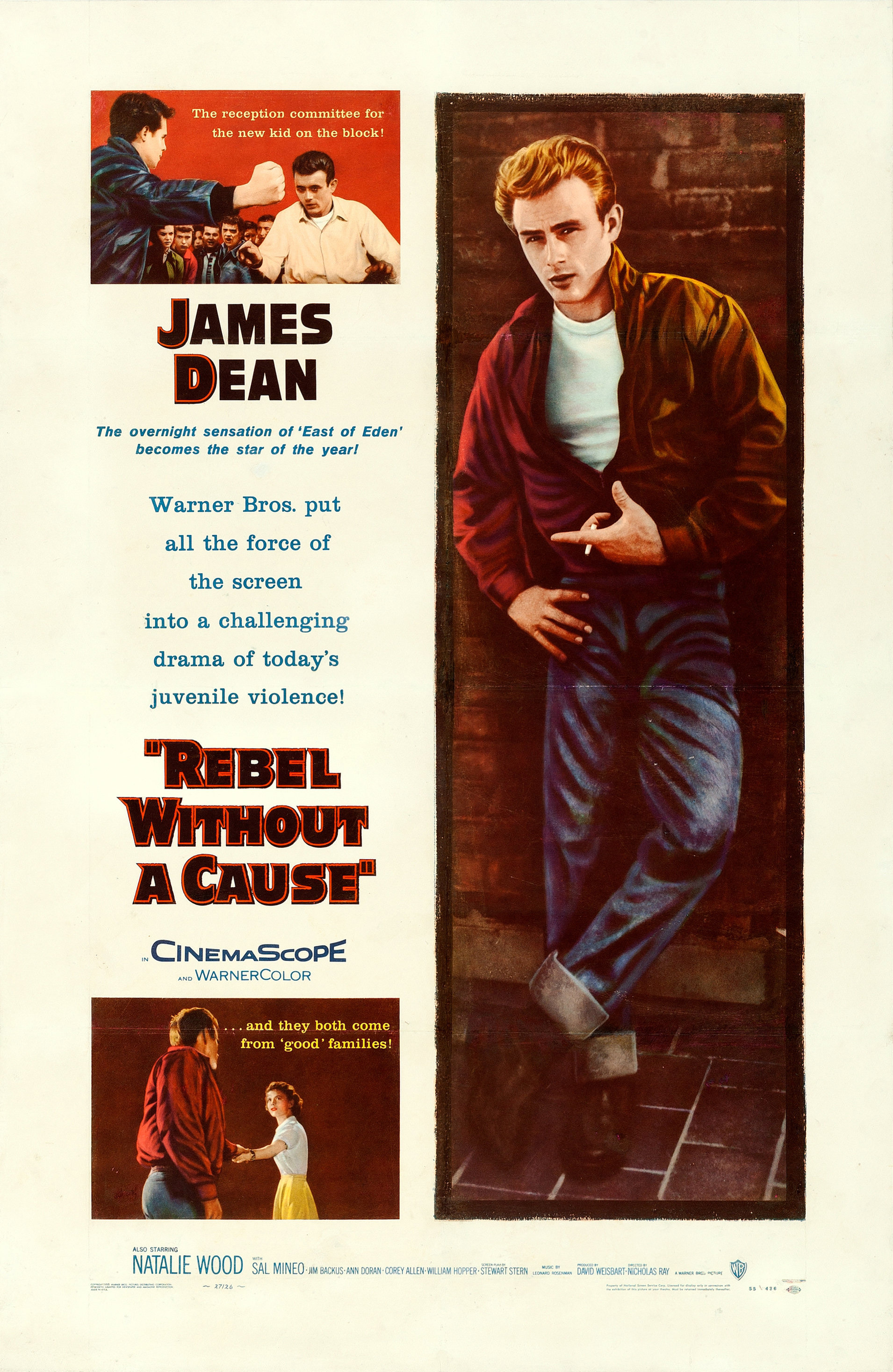
Behind the film
- Year
- 1955
- Director
- Nicholas Ray
- Writers
- Stewart Stern
- Genres
- Teen, Coming-of-age, Drama
- Production
- Warner Bros. Pictures
- Country
- United States
- Cast
- James Dean, Natalie Wood, Sal Mineo, Jim Backus, Ann Doran, Corey Allen, William Hopper, Rochelle Hudson
About the film
Contains story spoilers.
Rebel Without a Cause looks at teenage defiance through the need for someone to respond seriously to it. James Dean plays Jim Stark, whose frustration with his parents travels with him into another new setting. Nicholas Ray directs, with Stewart Stern writing the screenplay from earlier story and adaptation work. Natalie Wood’s Judy and Sal Mineo’s Plato bring different forms of loneliness into Jim’s path. The film does not make rebellion an uncomplicated expression of freedom. Its young people are searching for dependable relationships, but they often conduct that search through acts that increase their exposure to danger. Being noticed can become inseparable from proving they are willing to take a risk.
Jim meets Judy and Plato at a police station, then encounters them again around school. A challenge from Judy’s boyfriend Buzz leads to a car race towards a cliff, where Buzz dies. Jim’s attempt to accept responsibility brings another conflict with his parents. He, Judy and Plato retreat to an abandoned mansion and imagine a family of their own. Threatened by Buzz’s friends, Plato fires a gun and flees to the observatory. Jim removes its ammunition and persuades him outside, but police see the weapon and kill him. Jim’s father promises greater support, and Jim introduces Judy to his parents amid grief rather than an untroubled fresh start.
Jim’s anger has a specific domestic source: he wants guidance that feels strong enough to trust, yet the arguments at home leave him uncertain about what either parent can offer. His challenge to his father is therefore more complicated than a simple rejection of parental authority. He is asking for authority capable of being useful. Dean’s performance gives that demand a restless physical presence, with vulnerability close beneath confrontation. The film’s idea of a troubled teenager includes someone who wants an adult to help him make a difficult choice. What is missing is not every rule, but a relationship through which a rule or principle can become dependable.
Judy’s conflict turns attention towards the way parental affection can change as a child grows older. Natalie Wood’s character needs recognition from a father whose responses make that need painful. The peer group offers another place to seek approval, though its terms can be just as unstable. Her position within that group helps explain why an encounter with Jim cannot be judged only by what she privately feels. Public association brings consequences, and the pressure to act as expected can override kindness. The film lets her movement towards Jim involve an admission of that pressure, giving the romance a basis in changing conduct rather than attraction alone.
Plato’s attachment carries a more acute fear of abandonment. Jim’s attention offers him a possibility of connection large enough to become an imagined solution to his loneliness. That intensity makes small absences feel threatening. Mineo’s role brings the emotional cost of inconsistency into the central trio: reassurance can be genuine and still fail to feel secure to the person receiving it. The mansion’s make-believe family is important because it temporarily supplies roles and belonging that the characters have not found reliably elsewhere. The play is tender, but it is also fragile. An imagined household cannot provide the protections that a real network of care would need to sustain.
The cliff challenge turns approval into a deadly measurement. Courage is being assessed by willingness to remain inside an escalating risk, making survival and status seem opposed. The event exposes the inadequacy of that definition before Jim knows how to step beyond it. The group’s response afterwards adds another problem: responsibility is treated as betrayal when telling the truth threatens the group’s security. Jim’s effort to make a different choice therefore creates danger as well as moral direction. The film keeps the consequences physical, refusing to let a debate about honour remain detached from the bodies placed at risk by its demands.
The observatory gives the final confrontation a place already associated with a wider view of existence. That contrast makes the characters’ immediate fear appear both intensely important and painfully small within the setting. Jim’s practical attempt to reduce danger cannot control how everyone else reads the scene. The emptied gun matters to him and Plato, but the police do not possess the same knowledge. The resulting tragedy grows from a gap between action, appearance and communication. It also shows the limits of the adolescent effort to protect another adolescent when adult force enters the situation. Good intention cannot substitute for the shared understanding needed to make the intervention safe.
The father’s promise at the end offers recognition that Jim has been seeking, but it arrives after a death it cannot prevent. That timing gives the reconciliation its emotional weight and its limit. Rebel Without a Cause finishes with the possibility of a more dependable relationship while keeping the cost of earlier failures present. Its young characters do not need to be admired as symbols of rebellion to be taken seriously. The film asks what they are trying to obtain through the behaviour adults find alarming, and what happens when that need goes unanswered until a crisis forces recognition. Belonging is the desire; danger is the route they have been left to improvise.