
Behind the film
- Year
- 1954
- Director
- Alfred Hitchcock
- Writers
- John Michael Hayes
- Runtime
- 1h 52m
- Genres
- Crime, Mystery, Thriller, Detective
- Production
- Paramount Pictures
- Country
- United States
- Cast
- James Stewart, Grace Kelly, Thelma Ritter, Wendell Corey, Raymond Burr, Judith Evelyn, Georgine Darcy, Ross Bagdasarian
About the film
Contains story spoilers.
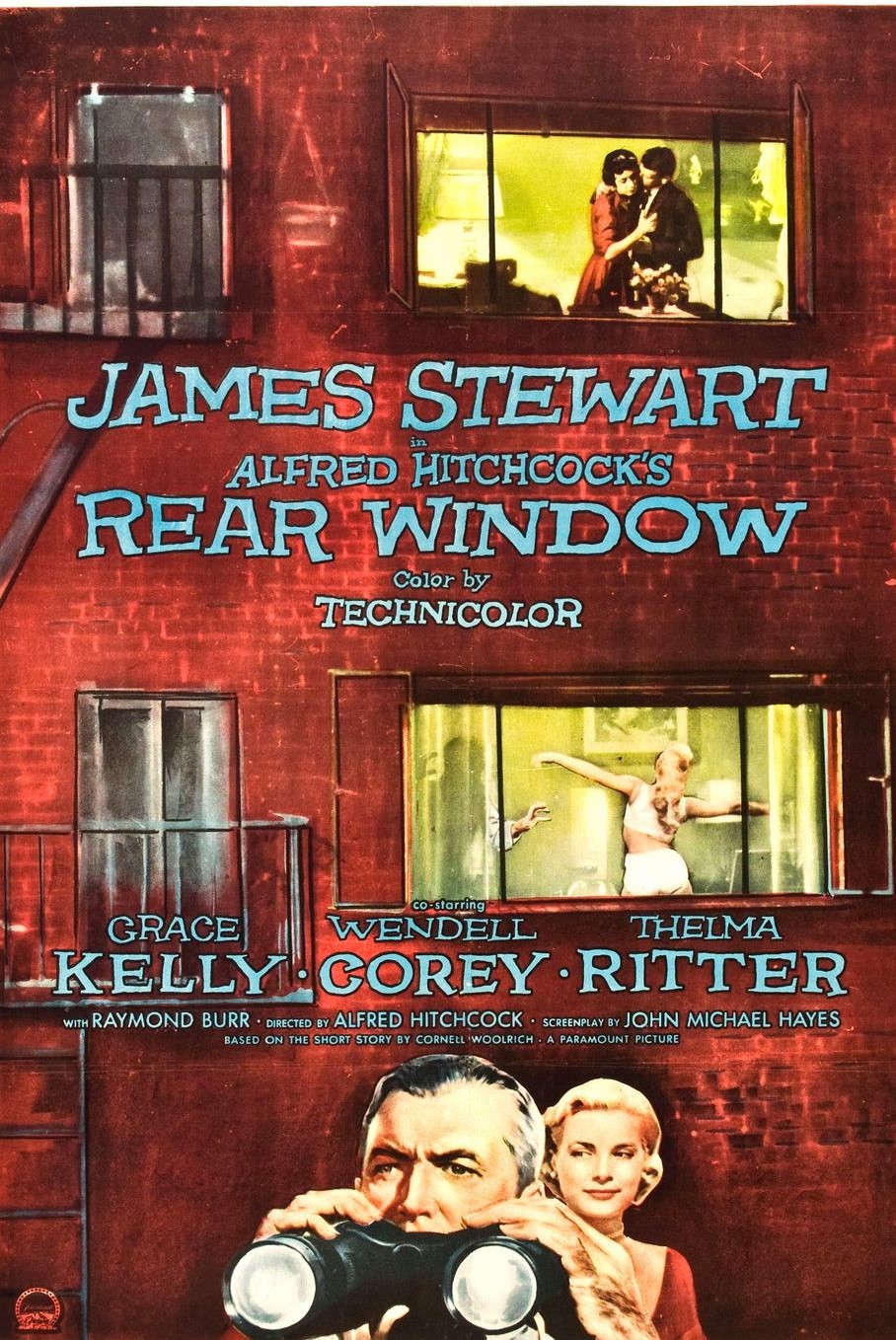
Rear Window gives its central character a view of the world and takes away his ability to enter it. L. B. Jefferies is a photographer accustomed to travelling for difficult assignments, but a broken leg has confined him to his New York apartment. The heat encourages neighbours to leave windows open, making their rooms visible across a shared courtyard. Alfred Hitchcock establishes those rooms as separate lives within one field of vision. A dancer rehearses, a musician struggles with his work, a lonely woman prepares imaginary company and a newly married couple retreat behind a blind. Jeff can watch each story without knowing much about the people living it.
James Stewart plays his restlessness alongside a sharper habit of judgement. Jeff gives the neighbours labels and uses their relationships to think about his own reluctance to marry Lisa Fremont. Grace Kelly makes Lisa’s arrival elegant and assured, but her ability to arrange a beautiful dinner becomes evidence, in Jeff’s mind, that she cannot share his unpredictable working life. He is willing to imagine a stranger’s marriage from a few visible gestures while insisting that he already knows what Lisa could manage. Nurse Stella, played by Thelma Ritter, challenges his voyeurism and evasions with a bluntness that punctures both the mystery and the romance.
The camera keeps returning to Jeff’s position, so a piece of behaviour acquires importance through what he can see and what he thinks it means. Lars Thorwald argues with his bedridden wife, then makes repeated journeys during the night. Her subsequent absence and his handling of objects in the apartment give Jeff material for a disturbing account of what may have happened. None of these observations initially provides the certainty of witnessing a crime. The spaces between them are filled by imagination, and the film makes that activity inviting. We have learned to search the courtyard with him, noticing movement in a room or the sudden absence of someone usually present.
Detective Doyle brings a different method to the suspicion. His inquiries suggest an ordinary explanation for Mrs Thorwald’s departure, exposing how easily the fragments Jeff has collected might support a misleading story. Lisa and Stella become interested nonetheless, and their involvement changes the investigation from private entertainment into shared action. The death of a neighbour’s dog renews their alarm, particularly because Thorwald does not join the other residents responding to its owner’s distress. The woman’s outcry also briefly gives the courtyard a voice of its own. People who live within sight of one another have watched without necessarily forming a community capable of recognising someone else’s pain.
Hitchcock uses sound to let those lives cross the distances the image preserves. Music from the composer’s apartment, conversations, traffic and cries can reach Jeff’s room without granting him a complete understanding of their sources. The courtyard becomes a small world whose occupants affect one another unknowingly. A piece of music can interrupt the lonely woman’s despair while Jeff and his companions are concentrating on another apartment. That parallel activity prevents the murder suspicion from consuming every life on screen. It also makes looking morally complicated: Jeff’s attention can identify a danger, but it can move away from another person’s crisis when a more compelling event demands it.
Lisa’s decision to enter Thorwald’s apartment puts her beyond the protection of the viewing distance. Jeff can see her moving through the room but cannot cross the courtyard to help when Thorwald returns. The suspense depends on that separation, with the person who has been interpreting danger forced to watch someone else experience it. Her discovery of Mrs Thorwald’s wedding ring supplies evidence that matters because it connects an object to the missing woman’s habits. Signalling the ring toward Jeff also reveals the line of observation to Thorwald. A gesture intended to communicate success transforms the apartment window from a safe vantage point into a place the suspected killer can identify.
Thorwald’s arrival at Jeff’s door collapses the distance on which the entire film has depended. Jeff uses photographic flashbulbs to slow him, turning a tool associated with recording images into a temporary defence. The bursts interrupt the attacker’s vision, but they cannot give Jeff mobility or remove the danger. His fall from the window brings the police and a resolution to the murder, while leaving him with another injury. The investigation has exposed a real crime without making every assumption he formed about the courtyard reliable. Lisa’s actions have also made his dismissal of her courage difficult to maintain, though their relationship retains its comic negotiation.
The final return to the neighbours gives their lives conclusions that revise the stories Jeff assigned them. Miss Torso welcomes a boyfriend whose appearance differs from the company Jeff had imagined for her; the composer and the lonely woman find a connection through music. Jeff sleeps with both legs in casts while Lisa briefly exchanges an adventurous book for a fashion magazine. She can accommodate his image of her without disappearing inside it. The film ends in the same contained world, but looking has changed the people doing it. Its suspense comes from the possibility that an ordinary window conceals a crime, and its humour from the equally persistent possibility that a watcher has misunderstood the life beyond it.