
Behind the film
- Year
- 2018
- Director
- Steven Spielberg
- Writers
- Zak Penn, Ernest Cline
- Genres
- Science fiction, Adventure, Dystopian, Action
- Production
- Warner Bros. Entertainment, Amblin Entertainment, Village Roadshow Pictures
- Country
- United States
- Cast
- Tye Sheridan, Olivia Cooke, Ben Mendelsohn, Lena Waithe, T. J. Miller, Simon Pegg, Mark Rylance, Philip Zhao
About the film
Contains story spoilers.
Ready Player One imagines an escape so widely shared that controlling it becomes a form of power over everyday life. The OASIS gives people possibilities that their physical surroundings cannot easily provide, but those possibilities belong to a system somebody can own. That contradiction gives the treasure hunt its stakes. Winning is not simply a matter of acquiring a prize within a game. It can determine what kind of place the game will remain for everybody using it. The adventure therefore connects the pleasure of entering an imaginative world with the less comfortable question of who sets the conditions of entry and participation.
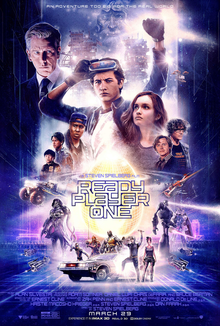
Steven Spielberg directs the 2018 adaptation of Ernest Cline's novel, with a screenplay by Zak Penn and Cline. Tye Sheridan plays Wade, Olivia Cooke plays Samantha, Ben Mendelsohn plays Sorrento and Mark Rylance plays Halliday. The film's 2045 setting separates physical hardship from the apparently expansive virtual environment. Its popular-culture material gives that environment a recognisable vocabulary, but knowing a reference is not the whole purpose of the contest. The clues turn a creator's memories into a structure that somebody else must interpret, making the difference between collecting information and understanding a person's regrets central to the race.
After Halliday's death, a three-part contest offers control of the OASIS. Wade and his friends compete against IOI, whose ambitions extend beyond winning fairly. The group survives attacks and helps free Samantha from the company's control. Wade completes the challenges and refuses a contract that would repeat Halliday's betrayal of Morrow. The friends inherit the system together and limit its availability to encourage life outside it. The resolution changes ownership and acknowledges a problem that victory alone cannot solve: a virtual refuge still needs a relationship with the world from which its users retreat.
Wade's avatar allows him to participate without presenting every part of his physical life. That can be liberating, but it also makes recognition incomplete. Knowing somebody's abilities within a shared activity is not the same as knowing the circumstances under which they enter it. The film uses that difference to give friendship a second stage. Relationships formed through the virtual environment have to become capable of meeting the people beyond their chosen appearances. This does not make the earlier connection false. It makes it partial, with trust becoming more substantial when it can accommodate information that the original encounter did not require anyone to disclose.
Halliday's archive turns private history into the landscape of a public competition. His choices and missed opportunities have been preserved as material that others can examine, yet preservation does not guarantee comprehension. A fact can be memorised without its emotional significance being understood. The contest makes that distinction useful because a conventional idea of winning does not always explain what a challenge is asking. The creator's regrets require a different kind of attention from the accumulation of trivia. The film's nostalgia consequently includes disappointment as well as pleasure, treating the remembered past as something whose meaning depends on what was lost or failed to happen inside it.
IOI supplies a competing understanding of the same system. Where players find a space for experience and connection, the company sees an arrangement whose users can be managed for profit. That contrast does not require every commercial activity to become identical with the villain's methods. It makes a particular danger visible: a refuge can be made exploitative when the people relying on it have little power over its conditions. The physical consequences prevent the competition from remaining safely abstract. An avatar can disappear within a game, but coercion directed at the person using it follows that person into a world where restarting is not available.
The group matters because the prize could encourage solitary ambition. A contest offering ownership to a winner invites a person to regard everyone else as an obstacle. The film instead builds its resolution through contributions that cannot be collapsed into one participant's skill. Sharing the result acknowledges that structure rather than pretending the outcome belongs entirely to the person reaching the final gate. The friendship story and the ownership story therefore meet in a practical decision. The OASIS becomes something held through a relationship, with the possibility of disagreement and responsibility carried into the arrangement rather than removed by the fantasy of a perfect individual ruler.
The final limits on access leave the virtual world's value intact while refusing to let it become the only available idea of living. That is a complicated conclusion for a film whose imaginative spectacle makes escape attractive. The attraction is part of the point: a place can offer genuine pleasures and still become inadequate when it replaces every relationship outside itself. Ready Player One joins a race for control to a question about attention. Its most significant prize is the chance to decide how an invented world fits into human lives, and its ending suggests that protecting such a world includes acknowledging where its usefulness should stop.