
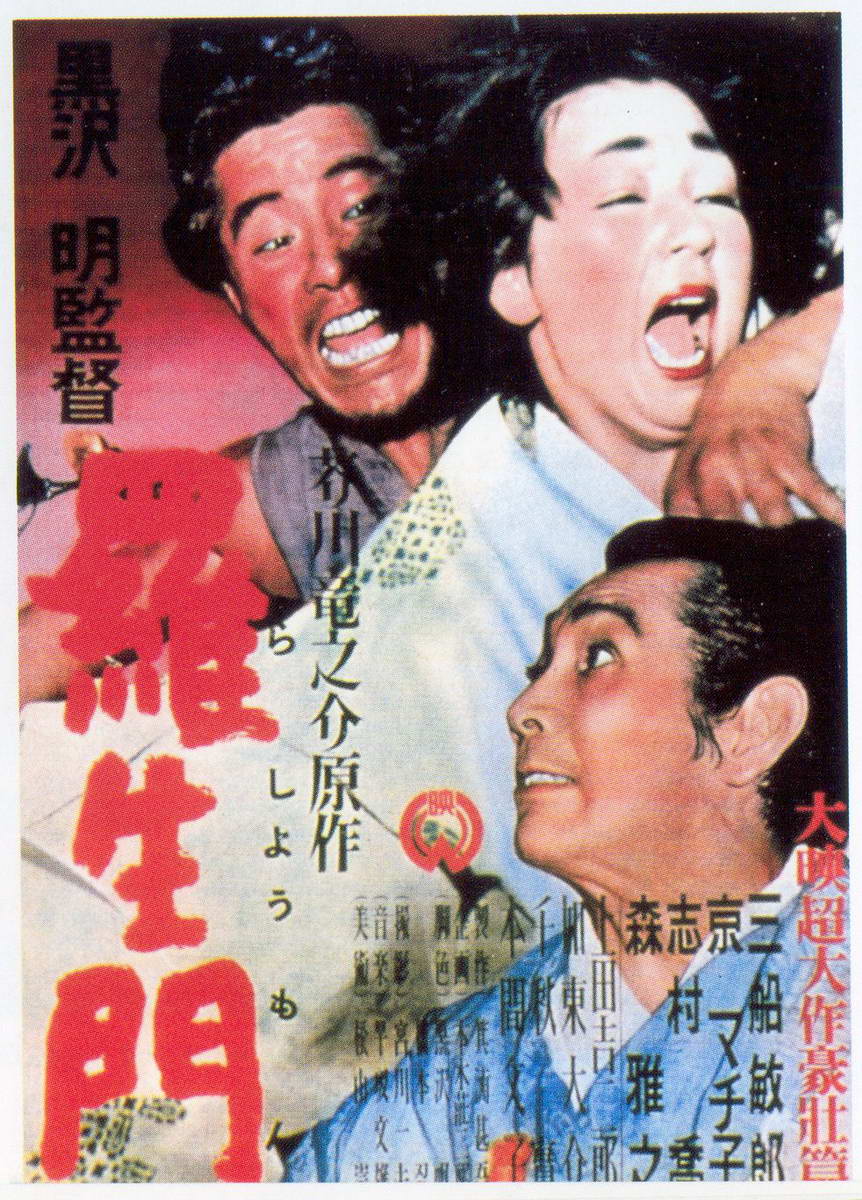
Behind the film
- Year
- 1950
- Director
- Akira Kurosawa
- Writers
- Akira Kurosawa, Shinobu Hashimoto
- Runtime
- 1h 28m
- Genres
- Drama, Crime, Flashback, Samurai cinema
- Production
- Kadokawa Pictures, Daiei Film
- Country
- Japan
- Cast
- Toshiro Mifune, Machiko Kyo, Takashi Shimura, Masayuki Mori
About the film
Contains story spoilers.
Akira Kurosawa’s Rashomon opens at a ruined gate during a downpour. A woodcutter and a priest shelter there, shaken by what they have heard in court; a passerby asks them to explain. Their account returns to a trial over the death of a samurai and the assault of his wife in eleventh-century Japan. The central event is repeated through testimony from the bandit Tajomaru, the wife Masako, the dead samurai speaking through a medium, and eventually the woodcutter, who says he witnessed more than he first admitted. Each version shifts the emotional shape of the encounter and the participants’ claims about bravery, shame and responsibility. The film does not offer a neutral flashback to settle the matter. Instead, each recollection is staged as a complete, persuasive scene, and the differences among them make the act of watching part of the investigation.
Tajomaru tells the court that he lured the samurai into the forest with a story about buried weapons, tied him up and assaulted Masako. He presents himself as a formidable fighter and describes a duel in which the samurai chooses to face him. Masako’s testimony gives the encounter a different emotional centre: after the assault, she says, her husband’s contemptuous gaze leaves her unable to bear the humiliation. The medium’s account, spoken for the dead samurai, reframes the same events again, claiming that Masako asked Tajomaru to kill her husband and that the samurai later took his own life. These statements do not simply disagree on minor details; they assign different motives and forms of agency to the same people. The trial’s formal setting promises a route to truth, yet the film’s visual language turns testimony into a contest in which each speaker can shape what the court imagines.
The woodcutter eventually provides another version, claiming that he saw the encounter from concealment in the forest. His account strips away the heroic duel Tajomaru described: both men appear frightened, clumsy and desperate, while Masako urges them to fight after freeing the samurai. Their swordplay is awkward and dangerous rather than noble. Even this supposedly fuller version cannot become an unquestionable answer, because the woodcutter has already withheld his presence at the scene. The passerby at the gate suspects that he is concealing a stolen dagger, and the woodcutter’s explanation leaves the object and his honesty in doubt. The film therefore refuses an easy hierarchy in which a later account automatically corrects earlier ones. New information changes what seems plausible, but the narrator’s own interest remains part of the evidence.
Kurosawa’s adaptation draws on two stories by Ryunosuke Akutagawa: “In a Grove” supplies the conflicting accounts, while “Rashomon” contributes the ruined gate and its atmosphere of social collapse. The film’s frame story makes the gate more than a place to wait out the rain. A commoner listens as the priest and woodcutter debate whether people can be trusted, and their despair seems to be confirmed when an abandoned infant is discovered nearby. The commoner steals the child’s clothing and departs, exposing his own selfishness while mocking the woodcutter’s moral concern. Then the woodcutter offers to take the baby home. The priest’s faith in human goodness returns, though the film does not ask the audience to forget that the woodcutter may have lied about the crime. The act is modest, practical and uncertain, rather than a proof that all has been repaired.
The film’s form makes uncertainty vivid through weather, movement and light. The woodcutter’s walk through the forest becomes a chain of changing angles and shifting shadows, as leaves and sunlight repeatedly interrupt the view. The camera looks toward the sky and across the trees, making the forest seem both open and difficult to read. At the gate, heavy rain turns the frame into a sheltered enclosure, while the testimony moves back into the forest through flashbacks. Fumio Hayasaka’s score gives the story a rhythmic pulse that can suggest forward movement without resolving the competing accounts. Editing and framing preserve differences among the narratives; they do not merge into one stable point of view. That approach made the film a landmark in discussions of subjective storytelling, but its effect is not just intellectual. Each retelling asks the viewer to feel the force of a speaker’s version before the next account unsettles it.
Masako is especially difficult to reduce to a single description because each account turns her into a different figure: victim, shame-filled wife, instigator or witness to the men’s fear. The film’s structure exposes how the men narrate her actions to explain themselves, but it also leaves her own testimony open to the same question of motive that it applies to everyone. A careful reading should not treat any one speaker’s claim as the film’s established truth. What can be observed is how each version places responsibility and how the characters seem to need a story that protects their image of themselves. The criminal proceeding offers no visible verdict that could settle these competing accounts. The viewer is left with a case whose facts remain unstable and a separate moral decision at the gate about whether to care for a child.
The final movement does not solve the murder; it changes the scale of the question. The priest entrusts the infant to the woodcutter, who walks away carrying the child after the rain stops. This gesture offers a basis for trust without proving that the people involved are truthful or innocent. The ending has often been read as an affirmation of human goodness, but the film keeps that possibility grounded in an action rather than a declaration: someone accepts the work of caring for a vulnerable child. The damaged gate, the storm and the unresolved testimony remain behind. Rashomon’s lasting force comes from holding two truths at once: people can reshape events to protect themselves, and a choice to help someone can still be made without full certainty.