
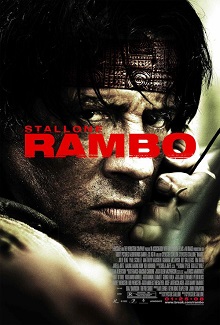
Behind the film
- Year
- 2008
- Director
- Sylvester Stallone
- Writers
- Sylvester Stallone, Art Monterastelli
- Genres
- Action, Action thriller, Splatter, Independent
- Production
- Starz Entertainment, Millennium Media
- Country
- United States, Germany
- Cast
- Sylvester Stallone, Julie Benz, Matthew Marsden, Graham McTavish, Jake La Botz, Tim Kang, Paul Schulze, Ken Howard
About the film
Contains story spoilers.
Rambo finds its central character living at a distance from the causes and relationships that might ask him to fight again. Sylvester Stallone's 2008 film makes that distance a practical arrangement rather than an abstract state of mind. John has work, knowledge of his surroundings and a way of limiting what other people can ask of him. The adventure then puts a request beside that arrangement and tests whether refusal can keep its meaning unchanged. His history makes violence available to him, but availability is different from a settled belief about when he should act. The tension concerns a person trying to remain outside a situation that keeps drawing his attention back.
Aid workers persuade Rambo to ferry them from Thailand into Burma, where they hope to help Karen villagers. After soldiers attack the village and capture survivors, he transports mercenaries sent to recover the prisoners. Their leader initially rejects his participation, but Rambo joins the operation when its danger becomes clear. The rescue group fragments during escape and some are recaptured. Rambo and sniper School Boy intervene, with mercenaries and Karen rebels fighting together against Major Tint's forces. Rambo kills Tint as he tries to flee. Afterwards, he leaves for the United States and approaches his father's home in Arizona. The rescue changes his direction without settling the wider conflict around it.
The movie’s landscape is not a neutral backdrop. Rivers, jungle and uneven ground shape who can move, hide or see danger, and the boat gives Rambo a role that initially depends on knowing a route rather than commanding a group. The journey from quiet river work into the wreckage of the village changes the film’s visual register. Stillness and green space give way to burned homes, armed patrols and prisoners forced into danger. The contrast makes the mercenary mission feel less like a clean tactical puzzle and more like an encounter with a landscape already made unsafe for its residents.
Julie Benz's Sarah gives the initial request a persistent moral presence. Her conviction contrasts with Rambo's guarded manner, but the difference is more substantial than optimism facing cynicism. Each approaches danger through a different understanding of what a person can usefully offer. The film allows her insistence to challenge his withdrawal without making her possess his experience or making his experience an answer to every question she raises. Their exchanges give action a point of disagreement before it becomes a shared necessity. A decision to help is consequently attached to another person's expressed purpose, rather than emerging solely from a hero's desire to demonstrate capability.
The mercenaries bring another kind of professional confidence into the story. Graham McTavish's Lewis and Matthew Marsden's School Boy belong to a group whose task has already been defined, yet a defined assignment cannot guarantee control over the circumstances in which it must be completed. That disparity gives the ensemble a role beyond providing additional fighters. Their expectations can meet an environment that does not organise itself around the mission's timetable. Rambo's knowledge then becomes consequential within a collective effort rather than an isolated display. The film's tension grows from how different people respond when a plan no longer supplies an adequate account of what they must do next.
This brutality is part of the film’s point of view, but it also narrows the story’s attention. Burmese soldiers are shown committing atrocities, while the Karen people appear chiefly as those harmed by the regime and as fighters who join the final resistance. The movie frames its fictional characters and mission within an actual regional crisis, yet its dramatic events are not a documentary record. Keeping that distinction clear matters: the film’s political frame gives its adventure urgency, while the characters and set pieces remain constructed for a narrative about Rambo’s return to action.
The extremity of the action makes the body's vulnerability difficult to separate from the apparent effectiveness of force. A successful intervention can be visibly destructive, refusing the impression that a weapon only supplies a clean change of advantage. This creates discomfort within the rescue narrative: the audience is following an effort to preserve lives through images that insist on what combat can do to them. Stallone places that contradiction inside the film's spectacle rather than resolving it through a reassuring distinction between graceful action and ugly consequences. The result keeps survival and damage close together, even when the direction of the immediate struggle seems clear.
Stallone directs the film as a compact action drama with a strong division between Rambo’s guarded opening and the extreme escalation that follows. The snake-catching and river work establish how he has turned knowledge of danger into a livelihood, while the rescue plot tests whether that control can be maintained when civilians are threatened. Rather than presenting a full life story, the film focuses on a single decision and its consequences. Rambo’s eventual departure toward Arizona gives the film an endpoint grounded in motion toward connection, even as the violence that precedes it remains unresolved. The final journey points toward family, although it cannot undo the harm shown along the river or settle the wider conflict.