
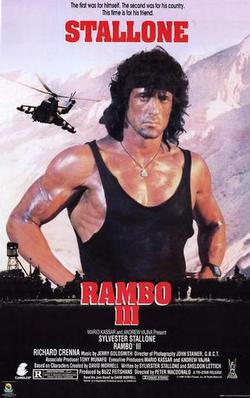
Behind the film
- Year
- 1988
- Director
- Peter MacDonald
- Writers
- Sheldon Lettich, Sylvester Stallone
- Genres
- Action, Thriller, War
- Production
- Carolco Pictures
- Country
- United States
- Cast
- Sylvester Stallone, Richard Crenna, Marc de Jonge, Sasson Gabai, Kurtwood Smith, Spiros Focas, Doudi Shoua
About the film
Contains story spoilers.
Rambo lives near a Thai monastery and declines Colonel Trautman's invitation to join a mission supporting Afghan fighters against Soviet forces. When Trautman is captured, Rambo undertakes a rescue without official protection. Guide Mousa brings him to an Afghan village, where a Soviet attack makes the danger immediate. Rambo attacks the prison base with help from Mousa and young Hamid, but must retreat after both he and the boy are injured. Returning alone, he frees Trautman and other prisoners. Their helicopter is damaged, forcing Rambo and Trautman to continue on foot through further attacks. Soviet commander Zaysen intercepts them near the border, but Afghan fighters arrive to help. Rambo uses a captured tank in the final battle and survives Zaysen's helicopter attack. He and Trautman leave Afghanistan together. The story uses a real war as the setting for fictional rescue adventures, not as a comprehensive historical account.
The opening gives Rambo's withdrawal a physical form. Work around the monastery offers a different use for a body the series has repeatedly placed inside violence. Sylvester Stallone's presence makes that contrast clear without needing a lengthy explanation of every earlier mission. The character can be capable of fighting and still want a life in which fighting does not determine his purpose. That distinction matters to the rescue premise. Returning to danger does not simply mean that peace was an illusion; it means an attachment has created a demand he cannot comfortably ignore. The film gives an enormous action machine an intimate reason to start moving again.
Trautman's importance lies in the continuity he offers across Rambo's disrupted life. Richard Crenna brings an established familiarity to their exchanges, making affection legible through the way the men understand each other's habits. Their bond is connected to military experience but not reducible to a command that must be obeyed. A request can be refused, and concern can persist after that refusal. This gives loyalty a personal rather than purely institutional meaning. Rambo's capabilities may have been shaped by organizations, but his decision is attached to a particular person. The film turns that distinction into a source of emotional clarity amid a conflict otherwise presented on a sweeping scale.
The Afghan setting changes the relationship between an individual fighter and the people around him. Rambo arrives with a specific task, while the residents face dangers that will not end when that task is completed. The movie gives him allies and guides rather than treating his knowledge as sufficient for every situation. Mousa's practical importance makes that dependence visible, and the presence of younger characters brings civilian vulnerability into the action's immediate field of attention. These connections create a moral reason for cooperation beyond the mechanics of escape. At the same time, the film remains centred on its visiting hero, so the setting receives a selective treatment rather than the fullness of a history told from within it.
Peter MacDonald's direction emphasizes changes in scale. A body moving through a confined space is placed beside vehicles, fortifications and wide terrain, making ingenuity and strength feel measurable against large obstacles. The action's clarity often depends on a simple immediate objective: reach someone, move away from danger or make a machine unusable. That directness helps the audience follow a story whose political setting is more complicated than its rescue structure. The film's spectacular solutions belong to an exaggerated action language. Its interest is in making determination physically visible, rather than offering a realistic account of how one person could operate across every situation it presents.
Stallone's physical performance also gives injury a practical role. Pain has to be managed while the task continues, which makes endurance part of the character's competence. The film can therefore make strength visible through effort rather than merely through an imposing appearance. Rambo's body is both an advantage and something exposed to damage. This contributes to the series' central fantasy: a person treated as an instrument can assert a purpose of his own, using the very capacities that made him useful to others. In the third film, that purpose is attached to rescue and friendship, giving the spectacle a consistent human reference point even when the action becomes extravagant.
The historical setting calls for a distinction between the film's moral geography and the wider war. Its opposition between a cruel commander, threatened communities and a rescuing hero is a dramatic construction, not a substitute for understanding the conflict's many participants or consequences. Recognizing that limit does not prevent the story's immediate stakes from being clear. It helps explain what kind of film this is: a large-scale rescue adventure that uses loyalty to organize its violence. Rambo III makes commitment almost inexhaustible in physical terms, then anchors that commitment in a relationship carried across the series. The enduring connection between Rambo and Trautman gives its most implausibly large confrontations a smaller reason to matter.