
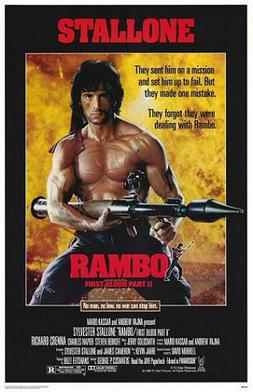
Behind the film
- Year
- 1985
- Director
- George P. Cosmatos
- Writers
- Sylvester Stallone, James Cameron
- Genres
- Action, Thriller, Drama
- Production
- Carolco Pictures, TriStar Pictures
- Country
- United States
- Cast
- Sylvester Stallone, Richard Crenna, Charles Napier, Steven Berkoff, Julia Nickson, Martin Kove, George Cheung, Andy Wood
About the film
Contains story spoilers.
Rambo: First Blood Part II places its hero between two different ideas of duty. There is the assignment written by people who remain safely behind, and there is the obligation he feels when somebody needs help in front of him. The film builds its action around the collision between those ideas. Its world can be read as a system that values a soldier’s abilities while avoiding the responsibility that comes with using them. Rambo’s physical confidence therefore exists alongside a deep insecurity about belonging. Being capable of completing a mission does not guarantee that anybody will welcome him afterwards. That contradiction gives the adventure its anger and makes its spectacular violence feel connected to an older injury.
Imprisoned Rambo accepts a reconnaissance mission to investigate American prisoners in Vietnam, with a possible pardon as his reward. From a base in Thailand, Murdock orders him to photograph evidence without attempting a rescue. After losing much of his equipment during insertion, Rambo meets local contact Co Bao and discovers prisoners in a camp. He frees Banks, but Murdock orders the extraction helicopter away once a living prisoner threatens the operation’s convenient expectations. Captured and tortured by Soviet personnel, Rambo escapes with Co’s help. Their brief hope of leaving together ends when she is shot, sending him back into the conflict with renewed fury. He seizes a helicopter, attacks the camp and brings the prisoners out, surviving an aerial pursuit before returning to base. There he destroys mission-control equipment and confronts Murdock, insisting that the remaining prisoners be rescued. The mission ends with people brought home, but its hero still uncertain where home belongs.
The rescue premise produces a particularly sharp dramatic distinction between proof and action. An image can satisfy an investigation without changing the condition it records. Rambo refuses that distance. In the film’s moral imagination, the value of seeing suffering depends on whether the witness is prepared to respond. This is a forceful idea for an action story because it makes disobedience understandable before the fights become extravagant. The mission can be completed according to its instructions and still feel like a failure. That tension also helps explain why the administrative world carries such menace: it can turn moral urgency into a technical question about whether the appropriate steps have been followed. Rambo brings that urgency back into the room.
His relationship with Trautman gives the story a second measure of loyalty. A bond formed through shared danger cannot easily be replaced by an official position or a reassuring briefing. Trautman represents the possibility that somebody recognises the person behind the exceptional skills. Read alongside the wider mission, that recognition matters because Rambo is repeatedly treated as a resource rather than a participant in decisions. The contrast creates an emotional hierarchy the audience can follow without studying the operation’s machinery. Authority may issue an order, but trust has to rest on something more substantial. The film asks whether responsibility means controlling a subordinate or remaining answerable for what happens to him when the assignment becomes inconvenient.
Co’s place in the adventure introduces a fragile possibility of connection beyond military usefulness. She makes the prospect of another life imaginable, and that prospect is important in a story whose hero is so closely identified with combat. Their relationship offers a way to understand him through expectation rather than capability: he can hope, make a promise and picture a future. That gives the violence an emotional counterweight. The action may expand until a single body seems capable of changing an entire battlefield, but the desire underneath it remains comparatively small. A life that includes mutual care would be a different kind of victory. The film’s loss of that possibility keeps its triumphant imagery from providing a completely settled ending.
As action entertainment, the sequel favours a bold, easily understood arrangement of pressure and release. The hero is isolated, betrayed, confined and then able to turn his skills against the forces that have limited him. That structure makes competence satisfying because it has first been frustrated. Physical resourcefulness becomes a way of restoring agency, and the escalating scale turns private defiance into a visible event. The result belongs to heightened adventure rather than a balanced historical explanation. Its Vietnam setting supplies the fictional conflict, but the film’s dramatic assertions should be understood as assertions within that story. The rescue fantasy gives anger a clear target and a decisive form; reality need not be equally simple for the mechanism to be legible.
The film’s final concern is what a successful return actually solves. Bringing people out of danger can answer the immediate question while leaving the larger question of care unresolved. Rambo’s unease gives that distinction weight. A country can celebrate an achievement without understanding the person who performed it, just as an institution can need somebody while leaving him without a place. The sequel’s scale makes him into an almost impossible figure of strength, but strength remains an incomplete answer to loneliness. That is the thread to follow beneath the explosions: the story is interested in whether loyalty can survive when it moves in only one direction, and whether being remembered requires more than another dangerous task.