
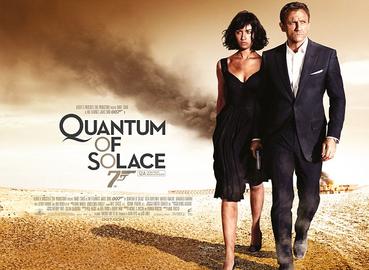
Behind the film
- Year
- 2008
- Director
- Marc Forster
- Writers
- Paul Haggis, Neal Purvis, Robert Wade
- Runtime
- 1h 46m
- Genres
- Spy, Adventure, Action
- Production
- Sony Pictures, Metro-Goldwyn-Mayer, United Artists
- Country
- United Kingdom, United States
- Cast
- Daniel Craig, Olga Kurylenko, Mathieu Amalric, Judi Dench, Giancarlo Giannini, Jeffrey Wright, Gemma Arterton, Jesper Christensen
About the film
Contains story spoilers.
Quantum of Solace starts immediately after Casino Royale, with James Bond transporting the captured Mr White through Italy while armed pursuers try to stop him. The questioning that follows should expose the organisation behind Vesper Lynd’s death, but instead reveals how deeply it has penetrated the institutions chasing it. One of M’s own bodyguards attacks her, and White escapes during the confusion. Bond kills the fleeing traitor and begins tracing his contacts. This is a Bond story in which the mission does not provide emotional distance from the previous one. Vesper is dead, the explanation of her betrayal is incomplete, and M cannot be certain that her agent is investigating rather than looking for someone to punish.
A lead takes Bond to Haiti, where he encounters Camille Montes and businessman Dominic Greene. Greene presents himself as an environmental benefactor, but his private dealings involve General Medrano, an exiled Bolivian military figure planning a return to power. Camille has her own reason to get close: Medrano murdered her family. Bond interrupts her attempt to reach him without yet understanding that purpose, so his rescue is not initially welcome. Greene’s interest in a seemingly worthless piece of Bolivian desert appears to be part of a larger political bargain. Foreign intelligence officials assume oil explains it and are prepared to tolerate a coup if their countries gain access. Greene’s public language of conservation hides a business built on dependency.
The organisation, Quantum, becomes visible at an opera performance in Bregenz. Its members use earpieces to conduct a meeting while Tosca continues onstage, turning an audience of respectable patrons into a hidden boardroom. Bond interrupts their conversation and photographs people leaving, gaining identities through their reaction to exposure. The resulting violence worsens his relationship with M, who believes he has killed a bodyguard attached to an influential official. She cancels his cards and orders him home. He instead seeks help from René Mathis, whose earlier treatment by British intelligence has already made their relationship difficult. Mathis accompanies him to Bolivia, where consular employee Strawberry Fields is supposed to put him on a return flight.
Bolivia brings the cost of Bond’s pace into focus. After a party hosted by Greene, police stop the car carrying Bond and Camille and reveal an injured Mathis in the boot. Mathis dies during the confrontation, urging Bond to stop carrying his anger toward both himself and Vesper. A flight over Greene’s desired territory ends in an attack and a crash, but Bond and Camille discover the purpose of the barren land: Quantum has been diverting and storing fresh water. Control of the supply would let Greene dictate prices to the new government and the people dependent on it. Back at the hotel, Bond learns that Fields has been murdered and left covered in oil, a warning aimed at him and the assumptions surrounding the deal.
Felix Leiter provides information about the meeting where Greene will finalise his bargain with Medrano. Bond and Camille reach a desert hotel as the general learns that the promised assistance comes with a water contract he cannot refuse. Their separate objectives collide in the same building. Camille confronts and kills Medrano, while Bond fights Greene and the security protecting the transaction. Fire spreads through the hotel’s hydrogen-powered systems, trapping Camille in conditions that recall the violence of her childhood. Bond gets her out before the building is destroyed. Her revenge is completed, but the film leaves room for the shock afterward: achieving the act she planned does not instantly tell her what comes next.
Bond forces information from Greene, then abandons him in the desert with a container of engine oil. The later discovery of Greene’s body suggests that Quantum also punishes failure. The emotional conclusion comes elsewhere, in Russia, where Bond finds Yusef Kabira, Vesper’s former lover, using another relationship to compromise an intelligence officer. He warns the woman and lets MI6 arrest Kabira instead of killing him. That decision gives M evidence that he can distinguish a useful capture from a personal execution. Vesper’s actions now make more sense as the result of manipulation, and Bond leaves her necklace in the snow. The film resolves the immediate investigation through restraint rather than a final encounter that could bring her back.
Marc Forster’s film moves between crowded public events and places where access to water, money and information determines who can act. Daniel Craig’s Bond is physically forceful, but the plot repeatedly makes his ability to survive different from his ability to protect companions. Olga Kurylenko’s Camille has an agenda that runs alongside his instead of becoming a romance that settles it. The opera sequence, the political party and the desert hotel all place violence within arrangements that appear civilised until their terms are challenged. Quantum’s power comes from those arrangements as much as from gunmen. The film is a direct continuation of one damaged relationship, set inside an espionage network whose reach remains larger than the people Bond manages to identify.