
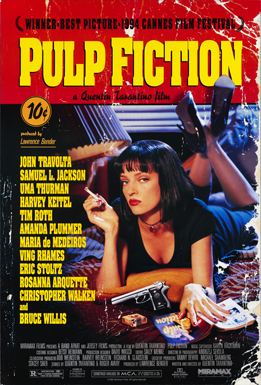
Behind the film
- Year
- 1994
- Director
- Quentin Tarantino
- Writers
- Quentin Tarantino
- Runtime
- 2h 34m
- Genres
- Independent, Crime, Crime drama, Drama
- Production
- A Band Apart, Jersey Films, Miramax
- Country
- United States
- Cast
- John Travolta, Samuel L. Jackson, Bruce Willis, Uma Thurman, Tim Roth, Ving Rhames, Harvey Keitel
About the film
Contains story spoilers.
Pulp Fiction opens with a couple in a diner deciding to rob the customers, then cuts away before their plan is resolved. The film shifts into a set of Los Angeles stories whose order is deliberately scrambled, so characters can disappear from one episode and return later in a different light. Vincent Vega and Jules Winnfield retrieve a briefcase for gangster Marsellus Wallace; Vincent escorts Marsellus’s wife Mia; boxer Butch Coolidge accepts money to lose a fight; and Pumpkin and Honey Bunny return to the diner. The structure asks viewers to connect the episodes rather than follow a single straight line from cause to consequence.
Vincent and Jules’s collection job sets several of the stories in motion. They visit Brett and his associates to recover Marsellus’s briefcase, and Jules turns the encounter into a ritual performance before the men shoot Brett and another armed man who emerges from a bathroom. On the drive afterward, Vincent accidentally kills Marvin in the car. Jules and Vincent take the vehicle to Jimmie’s house, where Winston, known as the Wolf, arrives to coordinate the cleanup before Jimmie’s wife returns. The sequence moves from threat to logistical problem-solving, allowing the killers’ workday conversation to coexist with a corpse and a bloodied car.
After the cleanup, Jules and Vincent go for breakfast. Jules says he intends to leave criminal life because he reads their survival at Brett’s apartment as a sign. Pumpkin and Honey Bunny begin their robbery while Vincent is in the bathroom, and Jules calmly takes control of the situation. He chooses to let the pair leave with money from his wallet rather than escalate the confrontation. This episode appears near the beginning of the film and returns at the end, where the same diner scene now carries a different weight: Jules’s change of mind matters because the audience has seen what his usual work looks like.
Another chapter follows Vincent’s evening with Mia, who has asked him to take her out while Marsellus is away. They eat at a retro-themed restaurant, enter a twist contest and return to her home. Vincent has bought heroin earlier, and Mia mistakes it for cocaine while he is in the bathroom. He finds her unconscious and drives her to his dealer Lance, where they revive her with an adrenaline injection. The near-disaster remains between Vincent and Mia, while the potential cost of Marsellus learning about it hangs over their agreement to stay silent. The story treats the episode as frightening and absurd at once.
Butch’s chapter is introduced out of sequence through a childhood visit from Captain Koons, who brings him his father’s gold watch and explains its history. Years later, Butch takes Marsellus’s money to throw a boxing match but wins instead and kills his opponent. He plans to leave town with his girlfriend Fabienne, only to discover that she has forgotten the watch. Butch returns to his apartment for it and encounters Vincent, whom he kills. On the road he later collides with Marsellus; their pursuit leads them into a pawnshop basement, where both men are captured by the shopkeeper Maynard and a man named Zed.
Butch frees himself while Zed sexually assaults Marsellus. Rather than leave his enemy behind, he returns with a sword to rescue him. He kills the shopkeeper, frees Marsellus and receives permission to leave town without further pursuit. The choice complicates the film’s shifting ideas about loyalty: Butch has betrayed the fixed fight and the crime boss, yet risks himself to save him from a worse danger. Across the episodes, characters survive accidents, make choices they cannot undo and sometimes receive an unexpected chance to stop. Jules’s decision at the diner and Butch’s return to the basement are different kinds of refusal to continue along the obvious path.
The film’s craft rests on conversation, rhythm and carefully selected shifts of register. Characters debate ordinary subjects at length, then the scene may turn abruptly toward danger; the tonal change is part of the design. Sally Menke’s editing lets the nonlinear chapters echo each other, while Andrzej Sekula’s images make diners, apartments, cars and bars feel like distinct social spaces. The soundtrack draws on familiar songs without functioning as a continuous emotional guide. The objects that pass through the stories—a briefcase whose contents remain unseen, a watch, a syringe—gain force from how differently each character reacts to them.
Pulp Fiction’s final diner scene returns to the opening couple, but it is not the earliest event in the film’s internal chronology. Jules has come through the cleaning episode and the apartment shooting before he faces Pumpkin; Vincent is alive in this diner scene even though another chapter will show his death later. The ending gives Jules a choice to de-escalate rather than a conventional victory over the criminals. Because the movie rearranges time, that choice becomes the final image of his story while the audience carries knowledge of what will follow for Vincent and Butch. The film closes by leaving its pieces connected but not neatly resolved.