
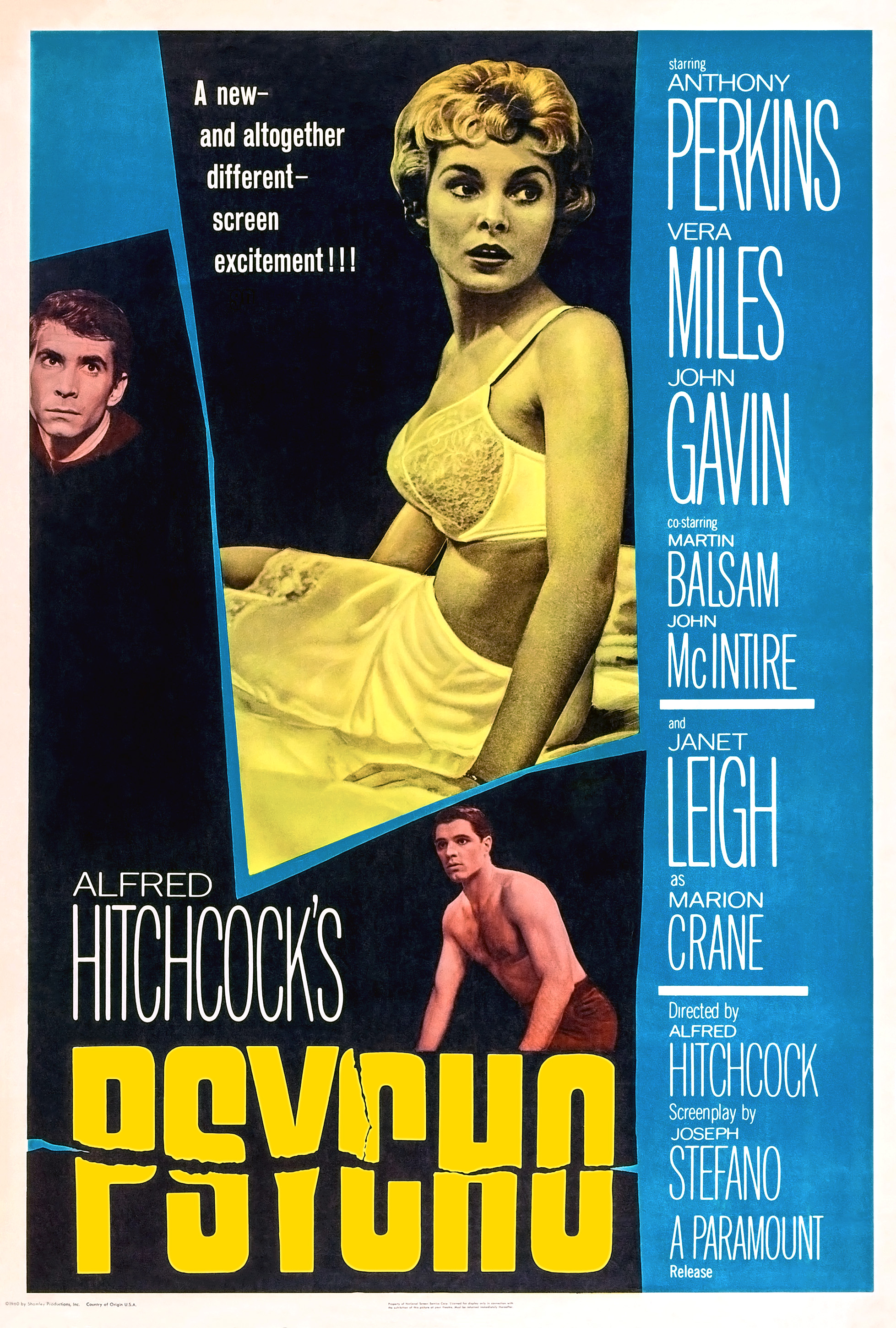
Behind the film
- Year
- 1960
- Director
- Alfred Hitchcock
- Writers
- Joseph Stefano
- Genres
- Thriller, Slasher, Mystery, Psychological horror
- Production
- Paramount Pictures
- Country
- United States
- Cast
- Anthony Perkins, Janet Leigh, Vera Miles, John Gavin, Martin Balsam, John McIntire, Simon Oakland, Patricia Hitchcock
About the film
Contains story spoilers.
Marion Crane works as a real-estate secretary in Phoenix and takes money from her employer after hearing her boyfriend, Sam Loomis, explain that his debts are delaying their marriage. She drives toward Sam’s home in California, changes cars after an encounter with a suspicious policeman, and continues through a rainstorm until she reaches the Bates Motel. Norman Bates, its proprietor, registers her under an alias and invites her to eat with him in the office. Their conversation touches on his taxidermy hobby and his mother’s supposed illness, and Marion’s suggestion that the mother might need care offends him.
Marion decides to return to Phoenix the next morning and give back the stolen money. While she showers, a shadowy figure enters and stabs her to death. Norman rushes to the room, apparently horrified by what his mother has done, then cleans the scene and puts Marion’s body, belongings, and the hidden cash in her car. He sinks the car in a nearby swamp. The film’s attention shifts abruptly from the stolen money to the effort to erase a murder, leaving Marion’s sister Lila and Sam to discover that she has disappeared without knowing that Norman has already disposed of her car.
A week later, Lila tells Sam about the theft and demands to know where Marion has gone. A private investigator named Arbogast has also been hired to recover the money. He questions Norman at the motel, notices the proprietor’s nervous and inconsistent answers, and finds Marion’s name in the guest register. Arbogast calls Lila to explain his suspicions and says he will return to speak with Norman’s mother. When he goes back and enters the Bates house, a shadowy figure stabs him on the staircase. Sam and Lila hear nothing further from him and go to the motel themselves.
Sam sees a silhouette in an upstairs window and assumes it is Norman’s mother. A local sheriff tells him and Lila that she died ten years earlier in a murder-suicide, which makes Arbogast’s disappearance more alarming rather than resolving it. Sam and Lila check into the motel, with Sam keeping Norman occupied in the office while Lila enters the house. Norman knocks Sam unconscious and heads toward the house. Lila hides in the fruit cellar and finds the mummified body of Norman’s mother. Norman arrives wearing a dress and wig and tries to attack her, but Sam recovers and subdues him.
At the police station, a psychiatrist explains that Norman killed his mother and her lover out of jealousy, then could not bear the guilt. He stole his mother’s corpse and treated it as if she were alive, developing an alternate personality that took over whenever he was attracted to another woman. The revelation makes the earlier conversations at the motel newly disturbing: Norman’s references to his mother were not merely a son’s defense of a living parent. The psychiatrist’s explanation gives the characters a factual account of the murders, but it cannot undo the deaths or the terror Marion, Arbogast, and Lila experienced.
The motel office reveals Norman through the objects he keeps around him. Stuffed birds surround the conversation with Marion, and their poses make the small room feel watched even before the murders begin. Later, he removes a picture and looks through a concealed opening into her room, exposing a private intrusion beneath his outward politeness. The road’s change of route has left the motel isolated, but Norman remains tied to the house above it rather than beginning another life elsewhere. Marion briefly imagines that she can return from her own wrong turn; Norman’s talk of traps suggests a far more entrenched confinement.
The ending returns to Norman in a jail cell, where the mother's interior voice insists that he committed the murders and that she would never be suspected. The camera holds on his still face while he imagines that the police are watching him. A fly settles on his hand; he does not move, and the final image cuts to Marion's car being winched out of the swamp. That recovery closes the practical question left by Norman's cleanup but does not soften the unease of the explanation. The film leaves the audience with both the public solution to the case and the intimate voice that continues to occupy Norman's mind.
Alfred Hitchcock uses the motel, the house above it, and the swamp as a compact geography of concealment. The shower scene is brief but built from sharp cuts and Bernard Herrmann’s stabbing strings, while the staircase attack makes the house itself feel like a place where the viewer cannot safely interpret what is visible. Joseph Stefano adapts Robert Bloch’s novel, but the film’s pacing and point of view make Marion’s disappearance a structural break as much as a plot event. By the end, the psychiatrist’s explanation names Norman’s divided identity, yet the final focus remains on the unease of watching an ordinary place hide a violent history.