
Behind the film
- Year
- 1997
- Director
- Hayao Miyazaki
- Writers
- Hayao Miyazaki
- Runtime
- 2h 13m
- Genres
- Fantasy, Fantasy anime, Action, Anime
- Production
- Studio Ghibli
- Country
- Japan
About the film
Contains story spoilers.
Ashitaka protects his Emishi village when a raging boar god attacks, but the creature leaves a spreading curse in his arm before he kills it. The village elders identify the boar as Nago and explain that an iron ball lodged in its body turned it into a demon. The curse gives Ashitaka terrible strength and threatens to kill him, so he leaves his home and rides west to learn where the iron came from. Tiny kodama guide him through an ancient forest, where he sees the deer-like Forest Spirit. The journey gives him a new problem: the forces behind the curse are still at war, and neither side can be understood from a distance.
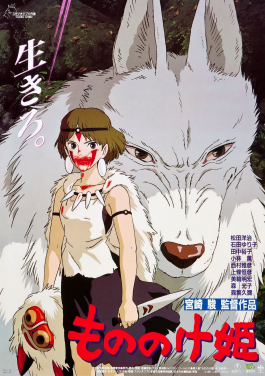
The forest is home to animal gods, including the wolf goddess Moro and her adopted human daughter San. Humans call San Princess Mononoke; she considers herself part of the forest and fights to defend it. Ashitaka also reaches Iron Town, a settlement where furnaces turn mined ore into weapons. Lady Eboshi leads the town and protects people who have been cast aside elsewhere, including former sex workers and people affected by disease. They have work, shelter and a degree of independence there. Eboshi’s community offers real safety to its residents, but the town’s growth clears forest and brings its people into direct conflict with the animal gods.
Ashitaka learns that Eboshi shot Nago, whose wounded body carried the iron bullet that started the curse. She has also joined Jigo, a mercenary monk working for the Emperor, in a plan to kill the Forest Spirit and deliver its head, which is believed to grant immortality. Ashitaka’s arm reacts with violent force when he becomes angry, making it harder for him to separate his own judgement from the curse. When San attacks Iron Town, she and Eboshi fight until Ashitaka intervenes. A townsperson shoots him during the struggle. He carries San away before collapsing, and she takes him to the Forest Spirit, which closes his wound but does not remove the curse.
The conflict grows when Okkoto, a blind boar god, leads the remaining boar clan into battle. Their attack is overwhelmed by Iron Town’s guns. San and the wounded Okkoto retreat into the forest, unaware that Eboshi and Jigo have followed using the dead boars as cover. Okkoto’s pain turns him into a mass of writhing corruption that engulfs San. Ashitaka and Moro pull her free, but the Forest Spirit gives both Okkoto and Moro a peaceful death. It is a costly reprieve: the gods have been driven toward extinction, while the human settlement remains vulnerable to the very weaponry it used to defend itself.
At sunset, the Forest Spirit changes into a towering nightwalker. Eboshi takes aim and shoots off its head, then Jigo carries the trophy away. The headless body releases a dark flood that spreads across the land and kills what it touches. Even the forest is swept into the destruction, and Moro’s severed head briefly returns to bite Eboshi’s arm. San joins Ashitaka in chasing Jigo to recover the head. Ashitaka helps the people of Iron Town evacuate as the flood reaches them; San and Ashitaka catch Jigo and return the head to the nightwalker. At sunrise, the Forest Spirit dissolves into the wind. The devastation remains, but green growth returns and Ashitaka’s curse is lifted.
The ending leaves the main characters with different choices rather than forcing them into a single settlement. Eboshi survives and decides to rebuild Iron Town in a better form. Ashitaka chooses to stay and help her, taking responsibility for what the town becomes. San loves him but cannot forgive humanity or abandon the forest, so she remains with Moro’s surviving wolves. They agree to meet again. The choice respects both the bond Ashitaka has formed with San and the damage Iron Town caused. Reconciliation is possible at a personal scale, but the forest has not returned to its former state and the human settlement has not disappeared.
Hayao Miyazaki makes the setting feel inhabited through work as much as through gods and battles. Iron Town’s furnaces, guns, roofs and crowded walkways give the settlement a material life; the forest is full of creatures that move, watch and respond to injury. The small kodama offer a quiet presence that makes the forest feel active even when the great animal gods are absent. The film’s hand-drawn detail and digital effects work together to make Nago’s corruption and the Forest Spirit’s transformation unnerving without turning the world into a simple contest between nature and machines. Ashitaka’s path repeatedly crosses from settlement to forest, so we see both environments as homes to people and beings with competing needs.
Ashitaka tries to see events clearly even when his cursed arm pushes him toward violence. That effort puts him between Eboshi’s community and San’s defense of the forest, but it does not make him a neutral observer: he intervenes, protects people and makes choices with consequences. Eboshi is dangerous to the gods, yet she has built a place where vulnerable people can work and live. San is fierce and loyal to her home, but distrusts the human world for reasons the story makes concrete. Their positions remain in tension at the end. The film’s attention to those particular lives, alongside its enormous landscapes and battles, gives its conflict a human scale without pretending that one decision can repair every loss.