
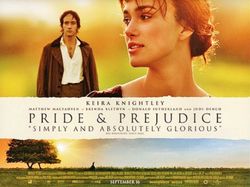
Behind the film
- Year
- 2005
- Director
- Joe Wright
- Writers
- Deborah Moggach
- Genres
- Drama, Romance
- Production
- Working Title Films, StudioCanal
- Country
- United Kingdom, France, United States
- Cast
- Keira Knightley, Matthew Macfadyen, Brenda Blethyn, Donald Sutherland, Rosamund Pike, Jena Malone, Tom Hollander, Judi Dench
About the film
Contains story spoilers.
The Bennet household is lively, crowded and financially uncertain. Mr. and Mrs. Bennet have five daughters, and the Longbourn estate will pass to a male heir, making marriage a question of security as well as romance. Elizabeth is quick to notice hypocrisy and slower to trust wealthy strangers; her mother sees every eligible man as a chance to secure one of the girls' futures. When Charles Bingley rents nearby Netherfield, the sisters enter a wider social circle. At the first assembly, Bingley is warm toward Jane, while his friend Fitzwilliam Darcy seems aloof and dismissive. Elizabeth overhears his slight and decides that his position has made him careless of other people. Their judgments begin before either knows much about the other.
Jane and Bingley's attraction develops through invitations and visits, but Caroline Bingley's polished manners conceal her wish to direct her brother's future. Elizabeth visits Jane when she is ill at Netherfield and finds herself judged by Caroline and Darcy. Her refusal to perform the exact decorum expected of a guest unsettles their assumptions. Meanwhile, militia officer George Wickham tells Elizabeth that Darcy denied him an inheritance promised by Darcy's father. The story fits her first impression, so she accepts it without much question. Mr. Collins, a clergyman and the Bennets' closest male relative, arrives intending to marry one of his cousins. He proposes to Elizabeth; when she refuses, he quickly turns to her friend Charlotte Lucas, who accepts the security the match offers.
While visiting Charlotte and Mr. Collins at their parsonage near Rosings, Elizabeth meets Darcy again. He proposes during a rainstorm, confessing love while emphasizing the social disadvantages he believes he has overcome. Elizabeth rejects him, condemning his part in separating Jane from Bingley and in Wickham's misfortune. Earlier, Colonel Fitzwilliam has inadvertently let slip that Darcy arranged the separation after Bingley had become attached to Jane. Darcy gives her a letter explaining that Wickham squandered the bequest left by Darcy's father and later tried to elope with Darcy's young sister Georgiana for her fortune. Elizabeth has to face how readily she accepted Wickham's account and how pride in her own judgment made her resist evidence that challenged it. Darcy's letter does not erase his earlier arrogance, but it forces both characters' actions into a more complicated light.
Later, Elizabeth visits Darcy's estate at Pemberley with her aunt and uncle, expecting to avoid its owner. The housekeeper describes him as a generous master, and Darcy arrives behaving with a new courtesy toward Elizabeth's relatives. He introduces Georgiana, who is shy but clearly close to her brother. The visit allows Elizabeth to see Darcy outside the ballrooms and arguments where her first impression formed. An urgent letter from Jane then says Lydia has run away with Wickham. Elizabeth returns home fearing that the scandal will damage all the sisters' prospects. The elopement leaves the family exposed, and the person Elizabeth had most recently begun to understand disappears before she can speak with him again.
Darcy quietly finds Lydia and Wickham in London, pays Wickham's debts and arranges their marriage, then leaves the Bennets unaware of his role. Lydia lets the secret slip after returning home as a bride. Bingley and Darcy later visit Netherfield; Bingley proposes to Jane, who accepts. Lady Catherine de Bourgh then confronts Elizabeth and demands she refuse any future engagement to Darcy. Elizabeth will not promise. The next morning Darcy apologizes for his aunt's interference and asks whether Elizabeth's feelings have changed. She accepts, and after learning what Darcy did for Lydia, Mr. Bennet gives his consent. Elizabeth's choice follows new knowledge and her own judgment, while the resolution also alters the family future that seemed so fragile at the beginning.
Joe Wright's film keeps the ensemble moving through crowded ballrooms, muddy lanes, parlors and open countryside, making rank visible in how people share or withhold space. Keira Knightley's Elizabeth observes rooms before she speaks; Matthew Macfadyen's Darcy is often most revealing in pauses and incomplete gestures. The lively Bennet home contrasts with the scale and order of Pemberley, while the camera also attends to servants, animals and the work surrounding a country estate. Dario Marianelli's piano-led score follows Elizabeth's changing impressions without turning the story into a sequence of declarations. The final movement rests on revised judgment rather than a simple change in status: affection becomes possible after both characters recognize where pride distorted what they saw.
The film briefly steps away from Elizabeth to show Darcy helping Bingley prepare to ask Jane to marry him. Bingley rehearses what he intends to say, and Darcy's practical coaching gives the friendship its own small scene rather than making Bingley only a device in Jane's courtship. That moment creates dramatic irony: the viewer sees the proposal taking shape while Jane remains uncertain about Bingley's absence and intentions. It balances the Bennet sisters' limited information with a glimpse of the men trying, awkwardly, to manage their own feelings. The quiet rehearsal contrasts with the public dances where much of the courtship has to be read through glances and manners.