
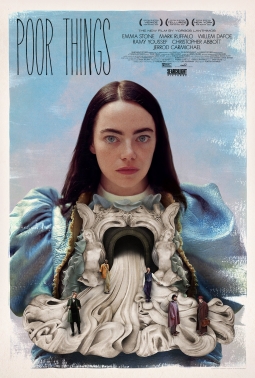
Behind the film
- Year
- 2023
- Director
- Yorgos Lanthimos
- Writers
- Tony McNamara
- Genres
- Thriller, Fantasy, Arthouse science fiction, Black comedy
- Production
- Film4 Productions, Element Pictures, TSG Entertainment
- Country
- United States, United Kingdom, Ireland
- Cast
- Emma Stone, Mark Ruffalo, Willem Dafoe, Ramy Youssef, Christopher Abbott, Suzy Bemba, Jerrod Carmichael, Kathryn Hunter
About the film
Contains story spoilers.
Poor Things gives its protagonist a world to discover and surrounds her with people eager to decide what discovery should mean. Bella's unfamiliarity makes her curious, but it also makes other people's authority look less natural than it might to somebody trained to accept it. A rule can be encountered as an unexplained demand rather than a timeless truth. That gives the fantasy its central energy. Learning is not simply acquiring the information needed to behave correctly within an existing arrangement. It can involve recognising that the arrangement has been made by people whose interests do not necessarily coincide with the person being taught to obey it.
Yorgos Lanthimos directs the 2023 adaptation of Alasdair Gray's novel, with a screenplay by Tony McNamara. Emma Stone plays Bella, Willem Dafoe plays Godwin Baxter, Ramy Youssef plays Max and Mark Ruffalo plays Duncan. The invented world draws on Victorian forms while giving them a deliberately fantastical environment. Its scientific premise is not a plausible medical account, and its central experiment should not be read as one. The altered setting allows the film to bring several forms of authority into contact: a creator's claims about his creation, a companion's expectations and a social world's instructions about what a woman may properly want.
Godwin reanimates Bella through an experiment that gives her a radically new beginning. She leaves with Duncan, whose enthusiasm becomes controlling as her understanding grows. Travel exposes her to deprivation and unequal relationships before she returns to the dying Godwin. A claim from the body's former husband, Alfie, leads to another confrontation with ownership. Bella resists him, and the ending places her with Max and Toinette in a household of her own choosing. The journey makes an origin important without allowing it to become the final authority over every relationship and decision that follows.
Godwin's care is complicated because he supplies both safety and the conditions limiting Bella's experience. Gratitude does not settle whether a protected person should remain protected in exactly the way a guardian prefers. That distinction makes leaving consequential beyond the excitement of travel. It asks whether somebody can recognise what another person has provided while refusing to accept that provision as a permanent claim upon their future. The film's creation premise exaggerates the guardian's position, but the underlying tension is recognisable. Helping a person become capable and wanting that person to remain dependent can coexist within a relationship that understands itself as benevolent.
Duncan's changing response makes independence visible through its inconvenience to someone else. Curiosity can seem attractive when it promises novelty within his own preferred arrangement. It becomes threatening when it produces opinions or choices he cannot direct. That shift exposes the conditional quality of his apparent openness. The film does not need Bella to possess a complete explanation of every encounter for her refusal of control to matter. Her growing understanding makes an initially flattering invitation harder to accept on its original terms, revealing that another person's enjoyment of her freedom may depend on how little freedom she actually exercises against him.
The journey also brings limits to an education based entirely on private pleasure. Encountering deprivation changes what it means to have the means to travel and choose. Bella's response introduces concern for people whose circumstances cannot be solved by curiosity alone. The film's fantasy gives that encounter a sharp contrast with her earlier protected world, while refusing to make learning a smooth progression towards perfect judgement. Wanting to help does not guarantee that help will reach its intended destination. This gives the education an outward-facing dimension: a person can become more aware of inequality while still having to learn how knowledge, intention and practical action connect.
The claim made through Bella's former identity asks whether a past relationship can define someone who no longer accepts its conditions. Recognition becomes coercive when another person treats it as a right to reclaim rather than a reason to listen. That problem links the final confrontation to the earlier relationships without making them identical. Different forms of control can present themselves as science, romance or established obligation, yet each may require Bella to remain legible through somebody else's preferred account. Her refusal becomes more substantial as she recognises those accounts as claims to assess, rather than facts that automatically remove her ability to decide.
The concluding household gives autonomy a relational shape. Bella's independence does not require a future without other people; it requires relationships whose terms she can participate in choosing. The fantasy's transformations are grotesque, but the ending's central change concerns authority over an ordinary question: who gets to say what this life is for? Poor Things makes education inseparable from that question. Its invented beginning supplies a person whom others believe they can define, while its journey allows definition to become something contested. The film's world becomes clearest through the difference between being cared for as a dependent object and being met as someone whose understanding can continue to change.