
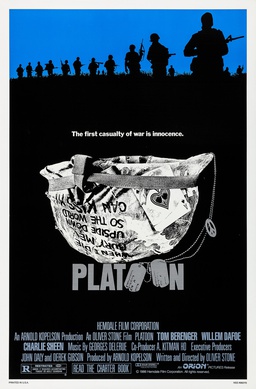
Behind the film
- Year
- 1986
- Director
- Oliver Stone
- Writers
- Oliver Stone
- Genres
- War, Drama, Action
- Production
- Hemdale films
- Country
- United States, Philippines
- Cast
- Charlie Sheen, Tom Berenger, Willem Dafoe, Forest Whitaker, Kevin Dillon, John C. McGinley, Keith David, Johnny Depp
About the film
Contains story spoilers.
In 1967, Chris Taylor arrives as a volunteer infantryman in a U.S. Army platoon near the Cambodian border. He is new to the routines that organize the men’s days: patrols through thick terrain, watches at exposed positions, sudden firefights and long stretches of exhaustion. His letters to his grandmother give the story a personal frame, but the immediate world is the squad, where rank, experience and temperament shape every decision. Chris’s arrival makes him an outsider, trying to understand a group whose jokes and irritations continue beside lethal danger. The forest is not a backdrop they can leave behind between scenes; it dictates visibility, movement and the fear of what may be waiting just beyond the path.
Two sergeants become the strongest forces in that world. Bob Barnes is hard, suspicious and accustomed to taking control; Elias Grodin is more humane and protective of the men under him. Their disagreements concern how the platoon should act when it enters villages and encounters civilians, and how far fear or anger can govern soldiers. Chris sees men share a mission while holding sharply different ideas of duty. Barnes can command obedience and still behave brutally; Elias can oppose him and still lead men into danger. Their conflict gives the unit’s daily strain a personal center, and makes ordinary choices—who speaks, who follows, who objects—part of a larger struggle over authority.
An early ambush establishes how little control the men have over terrain or timing. Chris is wounded and sent away to recover, returning to a platoon altered by losses and shifting loyalties. On a later patrol, the soldiers find evidence that the enemy has used a village. Their search becomes a raid: Bunny kills a villager, Barnes shoots the village chief’s wife, and Chris intervenes when soldiers threaten a young woman. The episode leaves consequences that cannot be folded neatly into a tactical report, and intensifies Elias’s challenge to Barnes’s leadership. Chris’s intervention shows him moving from observation to action, but it cannot undo the harm that has already been done.
Elias reports Barnes' killing to the commanding officer, but the men return to patrol before the matter is resolved. During another ambush, Elias takes a small group around the enemy's flank. Barnes later finds him separated from the others and shoots him, then tells Taylor that Elias has died. The lie becomes visible when the departing soldiers see Elias still running below their helicopter, pursued and killed by enemy troops. Taylor understands what Barnes has concealed. Back at camp, his attempt to confront the sergeant ends with Barnes overpowering and cutting him. A threat within the unit now accompanies the danger beyond it, and command has not supplied a safe way to resolve either.
The final battle brings the platoon into a night assault that overwhelms its position. Captain Harris orders an air strike within the perimeter as the enemy breaks through. Barnes tries to attack Taylor during the chaos, but the strike knocks both men down. The next morning Taylor finds Barnes wounded and shoots him. Survival has not separated him from the violence he feared becoming part of. Francis injures himself to secure evacuation, and Taylor is lifted out by helicopter after his wounds. His narration treats departure as a burden rather than a victory parade. The battlefield can be left geographically while remaining part of what the survivor must understand about himself.
Smaller frictions establish how combat reshapes ordinary conduct. Men trade jokes and insults, argue about assignments and try to sleep between watches, yet a routine patrol can turn suddenly dangerous. Chris’s wounds leave him briefly outside the group, and recovery gives him a view of the platoon’s altered atmosphere when he returns. Belonging is unstable: he wants acceptance, but the unit’s rival models of authority demand that he decide what kind of soldier he is willing to become. Figures such as King, Junior, Bunny and Rhah bring different motives and loyalties into the same small world, preventing the platoon from dividing into a simple collection of heroes and villains.
Oliver Stone keeps the point of view close to Chris, whose uncertainty contrasts with the confidence of men already hardened by the war. He cannot control patrol routes, the village search or the fire support, but becomes responsible for interpreting what he sees. Close patrols, sudden combat and the pressure of a confined group give the film its form. Chris’s letters to his grandmother offer a private voice amid the noise, although the story’s immediate meaning comes from actions between the soldiers. Stone’s Vietnam service partly informed the screenplay, but these characters and incidents remain a fictional dramatic construction rather than a documentary account of one unit.
The platoon's informal divisions give its rival sergeants supporters without making every soldier's position equally secure. Experienced men such as King have practical knowledge Taylor needs, while Bunny's cruelty can emerge under the cover of an operation everyone is expected to obey. Rhah can see danger in a confrontation without being able to remove Barnes from power. These different responses complicate the novice's wish to find a trustworthy group and remain within it. The argument over conduct is being carried by people who must keep sharing patrols and positions. Every objection has immediate social and physical consequences, so Taylor's education is inseparable from the pressure to belong.