
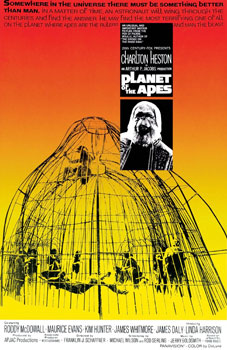
Behind the film
- Year
- 1968
- Director
- Franklin J. Schaffner
- Writers
- Michael Wilson, Rod Serling
- Genres
- Science fiction, Speculative fiction, Dystopian
- Production
- 20th Century Studios
- Country
- United States
- Cast
- Charlton Heston, Roddy McDowall, Kim Hunter, Maurice Evans, James Whitmore, James Daly, Linda Harrison, Lou Wagner
About the film
Contains story spoilers.
Astronaut George Taylor and two surviving crewmates awaken after a crash on an unknown planet, where a society of talking apes hunts mute humans. Gorillas shoot Taylor and capture the explorers; chimpanzee psychologist Zira and archaeologist Cornelius study him, while Dr. Zaius, the orangutan official, wants him silenced. Once Taylor recovers his voice, he argues that he comes from another world, but the hearing treats him as a dangerous specimen. Zira, Cornelius and their young assistant Lucius help Taylor and Nova escape toward the Forbidden Zone. There, Cornelius finds evidence of an older human civilization, and Zaius admits he has long known of it. Taylor and Nova continue along the coast. A half-buried Statue of Liberty reveals that the supposedly alien world is Earth, devastated by humanity’s past.
Franklin J. Schaffner builds the society around a hierarchy that is legible before anyone explains it. Gorillas enforce the rules, orangutans hold political and religious authority, and chimpanzees work in medicine and research. The arrangement gives the film a social order rather than a simple reversal gag: uniforms, courtrooms, museums and laboratories all tell Taylor that the apes have institutions designed to preserve their account of the world. Their professions seem to follow species roles, making social position appear as permanent as biology. Humans are denied language and treated as animals, so Taylor’s refusal to accept that status becomes a threat to a system that depends on making it seem natural.
The film’s strongest dramatic tension comes from language as evidence. Taylor’s voice returns, but speech alone does not persuade the people who control the legal process. His gestures, writing and attempts to reason are constantly assessed by authorities who have already decided what a human can be. Charlton Heston gives Taylor an abrasive certainty that makes him difficult to mistake for a polite visitor; that temperament helps him resist humiliation, while also isolating him from potential allies. The courtroom framing turns each pause into a contest over who may define the terms of the exchange. His intelligence is clear to the audience long before it is accepted within the ape society, creating a useful gap between seeing and being believed.
Zira and Cornelius make the conflict more complicated than a single villain blocking the hero. Zira’s professional curiosity lets her recognize Taylor as a person, while Cornelius’s archaeological interests give him reason to challenge official history. Their sympathy has limits and risks: they occupy a society whose everyday classifications already privilege apes, and they must weigh scientific discovery against personal safety. Kim Hunter and Roddy McDowall play the couple with distinct energies, Zira more direct and Cornelius more cautious, making their partnership feel like a genuine intellectual and domestic bond within a restrictive order. Their private disagreements and professional habits make resistance feel like a cost of conscience, rather than an uncomplicated break with their community.
The ape makeup is central to the movie’s acting, not just a disguise laid over it. Facial shapes constrain expression, so the performers use posture, eye direction and small movements to distinguish species and status. The practical makeup took hours to apply, and that labor gives the community a tactile consistency: characters can share a frame without the world feeling like a parade of masks. John Chambers’s makeup helps turn a shared species resemblance into individual characters, so a face can register as an official, an ally or an observer rather than only an effect. The effect allows the film to turn familiar human institutions into something newly strange while keeping emotional reactions readable through the transformed faces.
Schaffner and cinematographer Leon Shamroy move between barren terrain and carefully organized built spaces. The early landscape makes the astronauts look small and exposed; Ape City is arranged in streets and interiors that suggest continuity and authority. The contrast supports the film’s changing idea of civilization. The ape world is not a primitive wilderness but a functioning culture, while the Forbidden Zone’s empty surface conceals the remains of an earlier technological one. The sets combine practical stonework, civic halls and domestic rooms, giving different institutions a common architectural language. The locations and production design let the viewer infer history from what is still standing, often before the characters can agree on what the evidence means.
The film’s argument about history reaches beyond the question of whether a particular witness is telling the truth. A society can organise itself around an account that is useful to those in charge, then call that usefulness proof. Against such an arrangement, discovery is dangerous because it demands more than an adjustment to a textbook: it changes who can claim authority and whose suffering can be dismissed. The science-fiction setting makes that conflict unfamiliar enough to be examined, while the recognisable institutions keep it close to ordinary experience. The disturbing possibility is that intelligence offers no protection against organised denial. Knowing how to reason and being willing to accept a conclusion are separate achievements.