
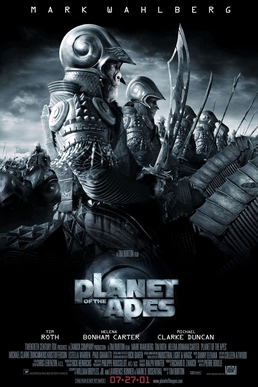
Behind the film
- Year
- 2001
- Director
- Tim Burton
- Writers
- William Broyles, Jr., Lawrence Konner, Mark Rosenthal
- Runtime
- 2h 0m
- Genres
- Science fiction, Post-apocalyptic, Action, Speculative fiction
- Production
- 20th Century Studios
- Country
- United States
- Cast
- Mark Wahlberg, Tim Roth, Helena Bonham Carter, Michael Clarke Duncan, Paul Giamatti, Estella Warren, Cary-Hiroyuki Tagawa, David Warner
About the film
Contains story spoilers.
Astronaut Leo Davidson follows his chimpanzee Pericles into an electromagnetic storm and reaches a world ruled by apes who enslave humans. With help from Ari, an ape who opposes that treatment, Leo escapes and leads a group pursued by General Thade. He discovers that their sacred site is the wreck of his own space station, which reached the planet long before him; its survivors became this world's ancestors. Pericles arrives during the battle and is mistaken for a returning divine figure. Leo traps Thade inside the wreck, leaves Pericles with Ari and flies back through the storm. He reaches an Earth where Thade is memorialised and the authorities are apes. The film offers this disturbing reversal without fully explaining the history that produced it.
Tim Burton's Planet of the Apes is a separate reimagining from the 1968 film and the later Caesar-centred series. Its world turns a familiar assumption about authority into an immediately visible physical arrangement. Humans occupy the positions normally assigned to captive animals, while apes conduct politics, commerce and military operations. That reversal matters beyond the novelty of a speaking creature. It asks how naturally a dominant group can describe its privileges when another kind of person has been excluded from the category deserving consideration. The adventure premise makes that exclusion practical, giving it cages, transactions and pursuit rather than leaving it as a philosophical proposition.
Mark Wahlberg's Leo brings the habits of an astronaut into a setting where his expertise no longer guarantees status. He has a strong practical objective, which gives the film momentum, but the people around him have lives that cannot be reduced to his desire to get home. That difference makes the outsider's role uncertain. A visitor may recognise an injustice while still approaching its victims chiefly as companions in his own escape. The film's human group therefore gives the journey a social demand alongside its technical problem. Returning to familiar coordinates cannot alone settle what responsibility the traveller has acquired in unfamiliar circumstances.
Helena Bonham Carter's Ari creates another complication because concern does not automatically place someone outside the privileged world that shaped her. Her sympathy has to operate through relationships and customs belonging to ape society. That makes her an important bridge without turning the surrounding hierarchy into a simple misunderstanding. Understanding another person's vulnerability requires more than a kindly disposition when institutions continue arranging who can be owned or commanded. The performance gives that moral discomfort an expressive face, allowing disagreement within the dominant group to become visible rather than presenting every ape as a single undifferentiated threat.
Tim Roth's Thade makes authority feel physically volatile. His movement and aggressive attention turn the leader into someone whose control of others is inseparable from an appetite for domination. Michael Clarke Duncan's Attar gives military force a different weight, while Paul Giamatti's Limbo brings commercial opportunism and a comic register into the same society. These contrasting presences make the ape world more than a collection of identical masks. A system can sustain coercion through several temperaments at once: violent certainty, disciplined loyalty and adaptable self-interest can arrive at the same practical result through very different kinds of behaviour.
The makeup and costuming are central to how that world becomes legible. The figures must remain expressive enough to carry social distinctions while different enough to unsettle the human viewer's usual expectations. A mouth, a glance and a posture can communicate an individual even beneath an elaborate transformed surface. That balance gives the film its characteristic physical fascination. The audience is invited to notice the construction of another species' civilisation while also following personalities inside it. The most meaningful difference between characters may therefore concern temperament or status rather than whether their appearance feels familiar to a human eye.
The religious and historical dimensions of the setting connect authority with control over origins. A community's account of where it came from can make its present arrangements seem inevitable. Discovering another explanation becomes dangerous when the established story has supplied a reason for inequality. The film uses science-fiction time displacement to complicate that relationship without requiring the viewer to master a precise physics of travel. Its world is built around the consequences of a history people have interpreted through power. Knowledge can disturb that interpretation, but exposing an origin does not automatically dissolve the habits formed in its name.
The final return refuses to make home a stable answer to the traveller's disorientation. A familiar monument can become frightening when it announces an unfamiliar political order, and recognition supplies the shock precisely because the image seems close to something the viewer already understands. The screenplay by William Broyles Jr., Lawrence Konner and Mark Rosenthal leaves the causal gap in that reversal open. It is more accurate to describe what Leo encounters than to invent a definitive route by which Thade changed history. Burton's film closes by turning apparent recovery into renewed uncertainty, making the problem of belonging to a world outlast the adventure of escaping one.