
Behind the film
- Year
- 1993
- Director
- Jonathan Demme
- Writers
- Ron Nyswaner
- Genres
- Trial, Drama, Lgbtq-related
- Production
- TriStar Pictures
- Country
- United States
- Cast
- Tom Hanks, Denzel Washington, Jason Robards, Mary Steenburgen, Antonio Banderas, Joanne Woodward, Charles Napier, Anna Deavere Smith
About the film
Contains story spoilers.
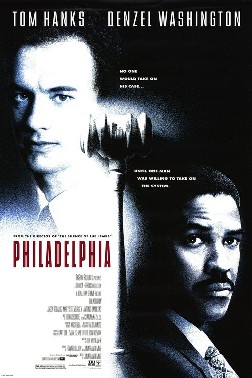
Philadelphia sets a courtroom dispute inside a wider struggle over who is allowed to be seen as fully human. Andrew Beckett has built a career in a prestigious law firm while concealing aspects of his life and illness from its partners. When his employment ends, the firm describes the decision in professional terms; he believes that explanation hides discrimination. Jonathan Demme’s 1993 film, written by Ron Nyswaner, follows his effort to challenge it, with Tom Hanks as Andrew and Denzel Washington as Joe Miller, the lawyer who eventually takes his case. The story gives Andrew a clear objective without reducing his life to a legal complaint. Work is one part of an identity that also includes a partner, a family, personal pleasures and a future increasingly constrained by illness.
Andrew loses his job after an important filing goes missing and is recovered in time. He suspects the incident has been used to disguise the firm’s response to his AIDS and sexuality. Joe initially refuses to represent him, but witnessing discrimination in a law library helps change his decision. The trial exposes the distance between the partners’ account of Andrew’s competence and their previous confidence in his work. As Andrew becomes more ill, Joe’s professional involvement develops into personal regard. The jury finds for Andrew, but the victory does not reverse his decline. Joe visits him in hospital, and the film closes after Andrew’s death with mourners watching childhood home movies.
Joe’s position makes the alliance more difficult than a straightforward meeting between a wronged man and an enlightened defender. His fear and homophobia are obstacles Andrew must navigate even when seeking help. Washington plays a lawyer whose ability to recognise an injustice develops alongside his ability to recognise the person experiencing it. The film does not make those changes identical. Joe can decide that a case deserves representation before he has resolved every prejudice he brings to it. Working together gives those prejudices fewer places to hide, because they have to respond to Andrew’s actual conduct rather than a distant image. Andrew is asking for legal assistance, however, not volunteering to become a lesson for someone else. Their relationship develops within that imbalance as well as through their shared work.
The firm’s language of standards gives the courtroom its central contest. An employer can claim to be measuring performance while choosing what to notice, what to forgive and what to describe as failure. Andrew’s earlier position in the office matters because it reveals how abruptly the explanation of his value has changed. Jason Robards’s Charles Wheeler embodies an authority Andrew once admired, giving the dispute an element of personal betrayal alongside lost employment. Mary Steenburgen’s defence lawyer works within the adversarial form of the trial, where a person’s history can be rearranged to make an accusation seem less credible. The film places the audience beside Andrew as private aspects of his life are exposed to public examination. The right to challenge an injustice arrives with the burden of having to explain himself before strangers.
Outside court, Andrew’s relationships give him a continuity that the employer’s account would erase. Antonio Banderas’s Miguel is his partner, not a detail added to establish a category in the lawsuit. Joanne Woodward’s Sarah belongs to a family willing to stand with Andrew, giving him a place in which he does not have to earn acceptance by keeping parts of himself hidden. Those scenes change the scale of the story. The legal case can ask how an institution treated him; the domestic world can show what companionship, support and affection mean while he pursues it. The distinction keeps the illness from becoming his entire identity. It also prevents the professional stakes from floating above the practical reality of a body whose capacity to continue through each day is changing.
Demme’s attention to faces gives conversations an immediacy that differs from the distance of a case summary. A pause or a look can reveal an adjustment in sympathy before a character is ready to articulate it. Andrew’s response to opera offers Joe access to a part of him that cannot be supplied by employment records or testimony. Music provides a language for feeling without converting the scene into another argument about the case. The courtroom requires statements that can be assessed, disputed and answered; this encounter allows another kind of attention. Joe has to remain with an experience he cannot control through the habits of his profession. The film places that personal encounter alongside the trial rather than treating one as a replacement for the other.
The ending separates public vindication from the possibility of recovery. A favourable verdict matters because it names the wrong done to Andrew, but it cannot give him back the time lost to the dispute or restore his health. Joe’s hospital visit measures a change in their relationship through a small gesture rather than a victory speech. The later home movies take the audience further back than the firm knew him, returning an adult publicly defined by his illness to a child within a family’s memory. Philadelphia is a dramatic story, not a guide to medical treatment or a complete account of discrimination law. Its force comes from the relationship between an institution’s explanation and a person’s life: what can be hidden behind professional language, what must be made visible to challenge it, and what remains when the formal battle has ended.