
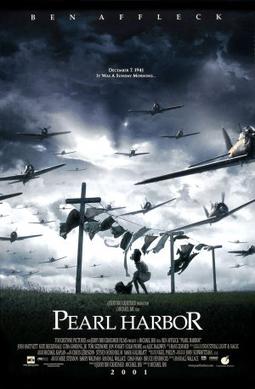
Behind the film
- Year
- 2001
- Director
- Michael Bay
- Writers
- Randall Wallace
- Runtime
- 3h 3m (theatrical version)
- Genres
- War, Romance, Drama
- Production
- Touchstone Pictures, Jerry Bruckheimer Films
- Country
- United States
- Cast
- Ben Affleck, Josh Hartnett, Kate Beckinsale, Cuba Gooding Jr., Tom Sizemore, Jon Voight, Alec Baldwin, Colm Feore
About the film
Contains story spoilers.
Pearl Harbor frames the 1941 attack through the lives of fictional pilots Rafe McCawley and Danny Walker, childhood friends who once played at being aviators in Tennessee. As adults, Ben Affleck’s Rafe and Josh Hartnett’s Danny enter the Army Air Corps and meet nurse Evelyn Johnson, played by Kate Beckinsale. The romantic triangle is invented for the film, and its characters move through a dramatized version of real wartime events. The story follows the friends from training to overseas service, the attack on Hawaii, and a later mission against Japan, with the history serving as both setting and turning point.
Rafe is determined to fly but has dyslexia, which causes him difficulty with written tests. Evelyn signs off his medical examination, and the two begin a relationship. When Rafe volunteers to fly with the British Eagle Squadron before the United States enters the war, he leaves for Europe. His aircraft is shot down over the English Channel and he is presumed dead. Danny and Evelyn grieve together, and their shared loss gradually becomes a relationship of its own. The film lets that intimacy develop while Rafe is absent, so his return will disrupt a real commitment rather than expose a simple betrayal.
Rafe survives the crash and spends months in occupied France before making his way back to Hawaii. On the night before December 7, 1941, he appears at Evelyn’s door, and both discover that the lives they knew have changed. He learns that Danny and Evelyn are together, then goes to a bar where his fellow pilots welcome him. Danny later finds him there; their attempt at reconciliation becomes a fight, and they leave together in Danny’s car to avoid military police. They fall asleep inside it, and the next morning the Japanese attack catches them on the airfield.
The attack is staged as a sudden physical rupture in ordinary life. Aircraft strike the harbor and airfields, ships burn, and the pilots scramble to find operable P-40 fighters. Rafe and Danny get airborne and engage Japanese planes, then return to help rescue sailors from the capsized USS Oklahoma. Evelyn and the other nurses work in the overwhelmed hospital, treating wounded servicemen as the scale of casualties becomes clear. The film also follows Doris “Dorie” Miller, a Black Navy mess attendant who operates an anti-aircraft gun aboard the USS West Virginia. His actions form a thread through the larger assault, though the movie’s central romance remains fictional.
After the attack, the country enters the war and the story brings Rafe and Danny back to duty together. Evelyn tells Rafe that she is pregnant with Danny’s child and has chosen to build a life with Danny, while making clear that her earlier love for Rafe was genuine. The two men are promoted for their actions and volunteer for a secret operation led by Jimmy Doolittle. They and other pilots train to launch B-25 bombers from an aircraft carrier, a task requiring a short takeoff far outside the kind of runway conditions they know.
The film’s Doolittle Raid sequence transforms the intimate rivalry into a shared mission. Rafe and Danny launch from the USS Hornet and take part in the bombing of Tokyo. Their aircraft run out of fuel on the return journey, and they crash in Japanese-occupied China. Danny is mortally wounded in a gunfight with Japanese soldiers. As he dies, Rafe tells him that he will be a father; Danny understands the child is his and entrusts the family to his friend. The scene resolves the two men’s conflict through a final act of loyalty, while keeping the emotional center on Evelyn and the family she will raise.
Rafe and Evelyn marry after the war and bring Evelyn’s son, named Danny after his biological father, to visit Danny Walker’s grave. The final flight in Rafe’s father’s old biplane circles back to the childhood beginning, giving the film a generational close. That ending is a dramatic construction rather than a record of particular real pilots’ lives. The actual attack and raid involved many people whose experiences cannot be reduced to this triangle, so the film’s characters work best as a fictional path into the scale of events rather than substitutes for every historical participant.
Michael Bay’s direction contrasts quiet personal scenes with large, fast-moving set pieces. The attack’s editing shifts rapidly between pilots, ships, nurses and civilians, while a large moving battleship set helps the camera place people inside the damage rather than observing it only from a distance. Hans Zimmer’s score carries the emotional thread through the action, sometimes turning an event into a private crisis for the characters. The film’s three-hour length gives room to establish the friendships and romance before war overwhelms the island; its scale can narrow back to a single choice, such as a nurse treating a stranger or a friend deciding to trust another pilot.