
Behind the film
- Year
- 1970
- Director
- Franklin J. Schaffner
- Writers
- Francis Ford Coppola, Edmund H. North
- Genres
- Biographical, War, Drama
- Production
- 20th Century Studios
- Country
- United States
- Cast
- George C. Scott, Karl Malden, Michael Bates, Karl Michael Vogler, Frank Latimore, Morgan Paull, Siegfried Rauch, Hellmut Lange
About the film
Contains story spoilers.
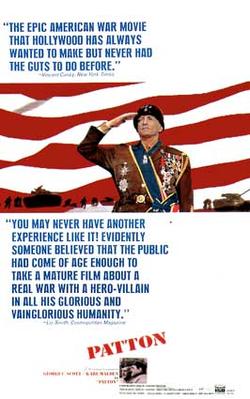
Patton opens with George C. Scott addressing the audience in front of a giant American flag. The general speaks with confidence about military reputation and victory, setting up a character who treats performance as part of command. The first campaign begins at Kasserine Pass, where American II Corps has suffered a severe defeat. Patton arrives to take command, imposes strict discipline and reorganizes the troops. He expects soldiers to embody the army’s standards even under stress, and Scott plays him as a man who can inspire confidence while also making subordinates wary of his temper and certainty.
At El Guettar, the reorganized forces gain a measure of redemption. Patton’s success does not settle his rivalry with British commander Bernard Montgomery, whose troops have pursued Rommel and relieved pressure on the Americans. Both men propose plans for the invasion of Sicily, but Allied leadership chooses a cautious landing at Gela. Patton pushes beyond the supporting role assigned to him, takes Palermo and races toward Messina. The campaign gives him the rapid movement and visible victories he prizes, while making command feel like both battlefield calculation and competition for recognition among allies.
The film also presents the cost of Patton’s theatrical authority. During the Sicilian campaign he visits a field hospital and slaps a shell-shocked soldier whom he accuses of cowardice. The soldier’s condition is not a combat injury visible on the body, and Patton’s contempt turns the encounter into a public scandal. His superiors require an apology, and he later has to visit troops and address the consequences of his conduct. The episode shifts attention from his battlefield record to the people beneath command, showing that a leader’s confidence can become cruelty when he treats fear as disobedience. The North African episodes also establish Patton’s appetite for visible momentum. He wants troops to look prepared as well as be prepared, and his inspections and discipline present the army as an extension of his own public style. The victories at El Guettar give him leverage to argue for a larger role in Sicily, but the film stresses that the Allied campaign is a coalition: British forces, American commands and higher-level planning all determine what Patton can do. His rivalry with Montgomery is therefore more than personal dislike; it becomes a contest over whose strategy and reputation will define the operation.
Patton is sidelined from the Normandy invasion and placed in charge of a fictitious First U.S. Army Group stationed in England, a decoy intended to mislead German intelligence about the location of the assault. He dislikes the inactivity and is frustrated by the performance required for a deception campaign. At a public gathering he makes remarks about postwar Anglo-American dominance that alarm Allied leaders. General George Marshall must decide whether the comments warrant sending Patton home. The film turns his outspoken manner into a strategic liability: the same forceful personality that energizes troops can complicate the coalition he depends on.
After the Normandy landings, Patton takes command of the Third Army and reports to Omar Bradley, his former subordinate. The army advances rapidly across France, but fuel and supplies are diverted to Montgomery’s forces, forcing Patton to halt before Germany. He argues with Bradley, who warns him again about his public statements. The conflict is not simply about who is the better tactician; both generals operate inside a hierarchy that must ration resources and coordinate multiple armies. Patton’s frustration grows as his personal wish to keep advancing collides with the larger structure of Allied command. The film also makes the halt visible as an operational fact rather than a failure of nerve: tanks and infantry can advance only as far as their fuel and supplies permit. Patton has to ask Bradley for resources and accept a decision made for the whole front, even when he believes speed could bring a decisive advantage. Their arguments show how the general’s impatience keeps colliding with a staff system built around competing needs. The scene’s tension comes from the distance between a commander’s confidence and what his army can actually sustain.
During the Battle of the Bulge, Patton’s staff devises a quick operation to relieve the 101st Airborne Division at Bastogne. The film emphasizes the planning and mobility that let him redirect forces under pressure, without presenting the campaign as a solo feat. When Germany capitulates, Patton’s candid comparisons of American politics to Nazism create more trouble. He is relieved of command of the Third Army but retained to help oversee the occupation of Germany. Victory does not remove him from service; it removes the freedom to act as though battlefield success grants authority over every political question.
The final sequence returns Patton to an ordinary walk with his bull terrier. He narrowly avoids a fatal accident, and the voiceover considers the fleeting nature of glory earned through conquest. It lands as a counterpoint to the opening flag and the general’s carefully staged public image. Franklin J. Schaffner’s film moves between large battle tableaux and enclosed confrontations, while Jerry Goldsmith’s score gives the campaigns an imposing forward drive. George C. Scott’s performance keeps Patton’s contradictions visible: vanity and courage, discipline and volatility, strategic skill and social recklessness. The film is a dramatization of wartime episodes, shaped for narrative focus, not a full or neutral record of every historical event.