
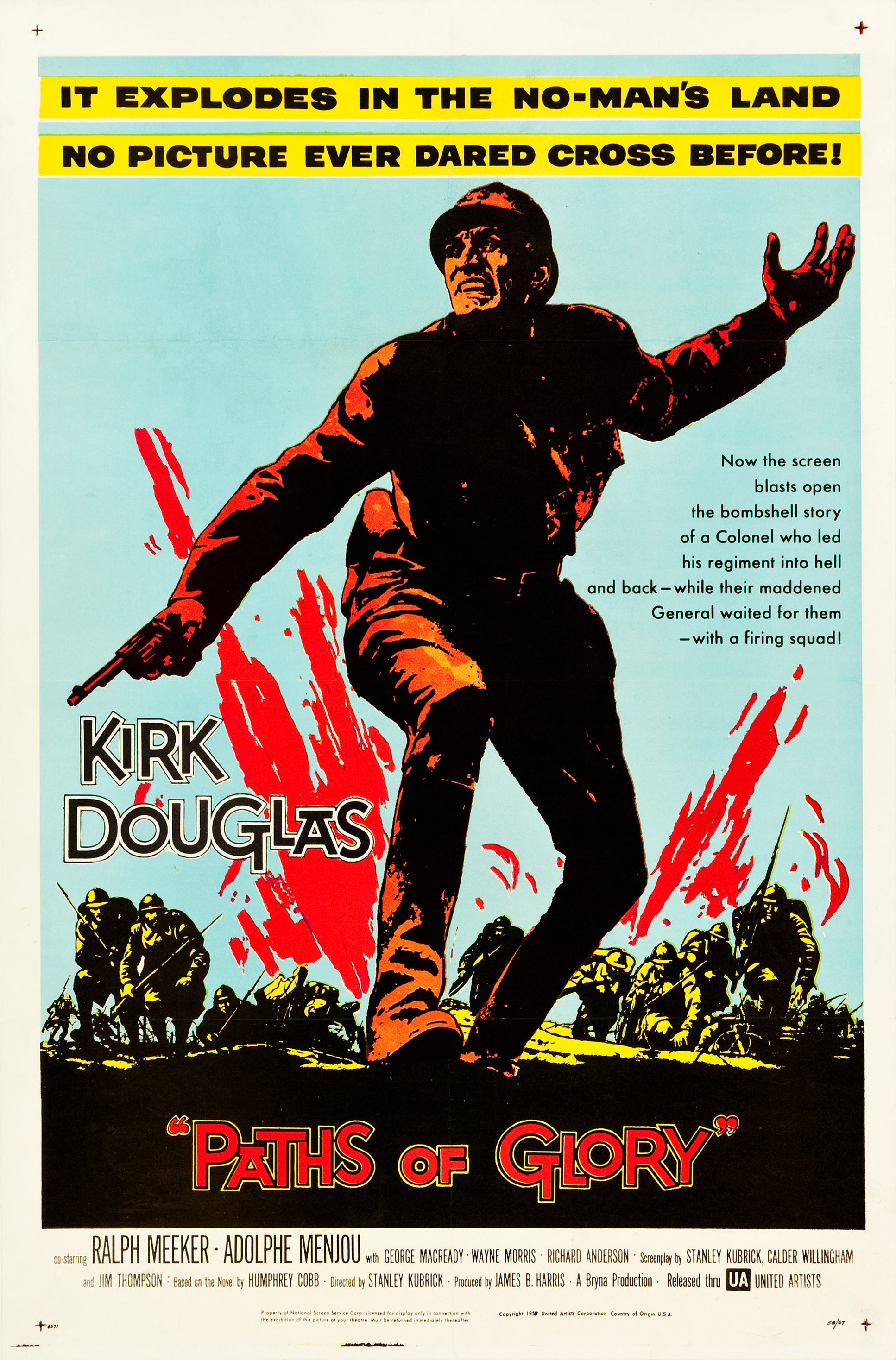
Behind the film
- Year
- 1957
- Director
- Stanley Kubrick
- Writers
- Stanley Kubrick, Calder Willingham, Jim Thompson
- Runtime
- 1h 28m
- Genres
- War, Trial, Anti-war
- Production
- Bryna Productions, Harris-Kubrick Pictures Corporation
- Country
- United States
- Cast
- Kirk Douglas, George Macready, Adolphe Menjou, Ralph Meeker, Wayne Morris, Richard Anderson, Joe Turkel, Timothy Carey
About the film
Contains story spoilers.
Paths of Glory turns the aftermath of a military failure into a confrontation over who has the power to define courage. Stanley Kubrick's 1957 film follows French soldiers during the First World War, but the conflict that gives it its distinctive shape takes place inside their own army. Orders, reputations and disciplinary procedure become instruments through which an impossible demand can be rewritten as someone else's moral weakness. The film keeps the battlefield and the court closely connected: what happens under fire cannot be understood separately from the offices where other men decide which account of it will survive.
General Mireau agrees to an attack on a heavily defended position after a superior raises the possibility of promotion. Colonel Dax leads the assault, which fails. Mireau demands punishment, and three soldiers are selected for a court-martial. Dax defends them, but the proceedings exclude an adequate account of what happened. The men are executed. When Mireau's own conduct becomes vulnerable to investigation, General Broulard offers Dax his command, misunderstanding his defence as a move for advancement. Dax rejects the offer. Later, soldiers jeering at a German singer become quiet as her song reaches them; Dax permits a brief delay before their return to the trenches. The ending allows a moment of feeling without reversing the machinery that surrounds it.
Kirk Douglas's Dax gives the audience a route through that machinery without becoming powerful enough to dismantle it. His determination matters because it is sincere, but sincerity does not secure the result. The character's position is unusually painful: he can recognise the injustice, articulate it forcefully and still be required to watch its consequences. That separation between moral clarity and practical authority prevents the trial from becoming a conventional demonstration that the right speech will eventually win. The film asks what courage looks like when argument fails, rather than using a principled officer as a guarantee that the institution will correct itself.
The contrast between spaces makes authority visible before any judgment is pronounced. Trenches constrain movement and expose bodies to danger; the senior officers' surroundings offer room for conversation, calculation and the management of appearances. This difference is not simply a contrast between ugly and elegant settings. It shows how an order can be issued at a distance from the physical limits that determine whether it can be carried out. Moving between those environments makes the word cowardice unstable. An observer who does not share a soldier's exposure can turn survival under impossible conditions into a defect of character, protecting his own account of command.
The three condemned soldiers make the punishment's supposed precision look hollow. They are presented as individuals rather than as a single representative body, yet the institution needs them to serve a collective explanation. The selection therefore becomes part of the accusation against the procedure itself. A court can look orderly while resting on a decision made elsewhere, and a formal hearing can perform fairness without allowing a defence to change anything. Kubrick's attention to the men's different circumstances gives that abstraction a human cost. The demand for an example does not merely distort a report; it consumes lives that continue to have particular histories and fears.
George Macready's Mireau and Adolphe Menjou's Broulard express different relationships to the same system. One presses a disastrous demand and seeks an explanation that will protect him; the other can accommodate scandal as a matter of rearranging authority. The distinction makes the film's institutional criticism more unsettling than an encounter with one unusually cruel commander. Removing or investigating an officer need not change the assumptions that enabled the original injustice. Broulard's inability to understand Dax's motives is especially revealing: ambition has become so ordinary a measure of conduct that a sincere defence looks to him like a disguised application for a better position.
The execution has weight because the story has withheld the promise of a rescue that can arrive in time. Procedure continues, and its continuation is the horror. The film does not need to claim that every army or every military trial behaves this way to make its fictional case clear. Its argument concerns the moral danger of treating reputation as something worth preserving through other people's punishment. Based on Humphrey Cobb's novel, with a screenplay by Kubrick, Calder Willingham and Jim Thompson, the adaptation makes the institutional conflict concrete enough to follow while leaving room for the audience to confront the logic behind it.
The German singer's scene supplies a final change in the soldiers' attention. Men who initially receive her as another object of entertainment begin to listen, and the shared vulnerability of the moment temporarily interrupts the language of opposition. This is no military solution, and the return to duty remains ahead. Its significance lies in what it lets exist briefly inside a story dominated by classification, orders and judgment. The film ends with the possibility of recognising another person before the next demand arrives. That small pause makes the larger failure harder to absorb, because it shows a human capacity that the preceding proceedings have systematically refused to honour.