
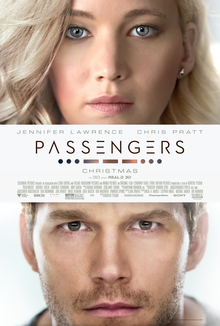
Behind the film
- Year
- 2016
- Director
- Morten Tyldum
- Writers
- Jon Spaihts
- Genres
- Science fiction, Speculative fiction, Melodrama, Thriller
- Production
- Lone Star Funds, Village Roadshow Pictures, Columbia Pictures
- Country
- United States, Australia
- Cast
- Jennifer Lawrence, Chris Pratt, Michael Sheen, Laurence Fishburne, Andy Garcia, Aurora Perrineau, Fred Melamed, Julee Cerda
About the film
Contains story spoilers.
The Avalon is carrying colonists to Homestead II when damage wakes Jim Preston ninety years early. Unable to resume hibernation, he endures isolation before deliberately waking Aurora Lane and pretending that she suffered the same malfunction. They form a relationship until android bartender Arthur reveals the truth. Another awakening brings crew member Gus, whose access allows them to investigate the ship’s worsening failures. Gus dies, and Jim and Aurora work together to prevent a reactor catastrophe. Aurora retrieves Jim from space and revives him. Afterwards, he discovers that the medical system can hibernate one person and offers her that chance; she chooses to remain with him. The crew later find the environment they created. The ending presents a shared life without changing the fact that Jim initially took Aurora’s future without her consent.
The ship’s luxury is central to the premise. Comfortable accommodation, entertainment and automated service seem to provide almost everything a passenger could want, until the absence of other people changes their meaning. A facility designed for a crowd can become unsettling when occupied by one person, because its abundance keeps announcing the life that should be happening there. The environment makes loneliness visible without needing every scene to explain it. Pleasure loses its social setting, and choice becomes oddly limited despite the number of available activities. The film turns the promise of a complete consumer experience into a question about which human needs cannot be met by access alone.
Chris Pratt’s Jim is approachable, but the story requires his approachability to coexist with a grave moral failure. His loneliness can be understood without treating it as permission to decide another person’s life. That distinction is essential to following the relationship. The film places the viewer close to his desperation, then asks that closeness to carry the knowledge of what he has done. Sympathy becomes uncomfortable because familiarity may encourage a generous interpretation before the other person has access to the same facts. Jim’s technical usefulness cannot settle that problem either. Being able to repair a system is a different kind of achievement from being entitled to someone’s trust.
Jennifer Lawrence’s Aurora brings the lost future into view. A journey involves more than reaching a location; it can represent a purpose, an imagined career and the right to decide what a life will contain. Her presence makes the ship’s attractive spaces harder to interpret as adequate compensation. The central relationship is therefore shaped by unequal knowledge as well as isolation. A shared experience can feel intimate while one participant misunderstands its cause. The film’s romance and ethical tension occupy the same setting, and a viewer may find them pulling in different directions. Keeping Aurora’s agency in view is more useful than allowing the survival adventure to answer every question the relationship raises.
Michael Sheen’s Arthur gives the automated world a personable surface. Conversation can feel warm even when the speaker has no ordinary human understanding of what is being concealed. That makes the character useful beyond comic relief. A machine can respond smoothly while failing to recognise which parts of an exchange carry emotional consequences. The contrast exposes how dependent social life is on context, judgement and assumptions about confidentiality. Arthur’s elegance belongs to the ship’s promise that service will remain effortless. The film allows that promise to become unsettling precisely because a polished interaction can appear complete while missing the understanding that the people involved most need.
The visual design combines enormous communal spaces with the small scale of the occupied lives within them. Curving surfaces and clean interiors suggest a controlled journey, while the surrounding emptiness makes that control feel fragile. The ship is both a destination in practice and a vehicle designed never to become one for these travellers. That contradiction gives its spaces emotional ambiguity. A room can offer comfort and still be part of confinement, and a beautiful view can emphasise distance rather than freedom. The science-fiction setting works because those oppositions remain concrete: the characters can move extensively without being able to go where they intended to go.
The mechanical crisis changes the scale of responsibility without erasing the earlier breach of trust. An emergency can make cooperation necessary, but necessity does not by itself determine what forgiveness should mean. That leaves the film open to different responses to its ending. Some viewers may read its shared future as reconciliation; others may remain troubled by the conditions that limited the available choices. The story’s value as a subject for discussion lies partly in that friction. It brings a familiar romantic structure into a situation where isolation and control complicate the meaning of consent, then surrounds that problem with the momentum of a rescue adventure.
Morten Tyldum directs from Jon Spaihts’s screenplay, keeping the central cast small enough for the enormous setting to remain psychologically empty. The film is a fictional thought experiment rather than a prediction about workable interstellar travel. Its most immediate questions concern power over another person’s future, the difference between companionship and access, and what a chosen life can mean after an earlier choice has been taken away. The final image offers a transformed environment, but the relationship’s beginning remains part of how that transformation is understood. The attractive world gives the viewer plenty to look at while the human arrangement inside it remains the harder thing to resolve.