
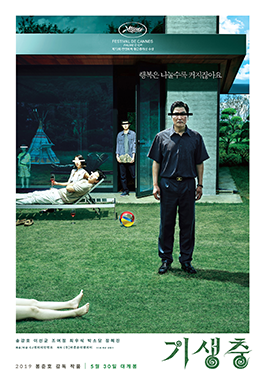
Behind the film
- Year
- 2019
- Director
- Bong Joon-ho
- Writers
- Bong Joon-ho, Han Jin-won
- Runtime
- 2h 12m
- Genres
- Comedy drama, Black comedy, Thriller
- Production
- Barunson E&A, CJ ENM Films & Television
- Country
- South Korea
- Cast
- Song Kang-ho, Lee Sun-kyun, Cho Yeo-jeong, Jang Hye-jin, Choi Woo-shik, Park So-dam, Jung Ji-so, Lee Jung-eun
About the film
Contains story spoilers.
Bong Joon-ho’s Parasite begins in a cramped semi-basement where the Kim family searches for stray Wi-Fi and folds pizza boxes for money. Ki-taek, Chung-sook, Ki-woo and Ki-jung share both the work and the improvisation required to get by. A chance arrives when Ki-woo’s friend Min-hyuk asks him to tutor Da-hye, daughter of the affluent Park family. Ki-woo borrows the credentials and confidence for the job, and the film immediately makes performance part of survival: he is not merely entering a new home but learning how its inhabitants read status, education and trust. The Kims’ small apartment and the Parks’ spacious hillside house are introduced as sharply different environments, with stairs and thresholds linking them. That contrast is concrete; one family lives above ground in ordered rooms, while the other occupies a low-lying home vulnerable to the city around it.
Once Ki-woo is hired, he recommends Ki-jung as an art therapist for the young Da-song, disguising their sibling relationship. Together they devise ways for their parents to enter the household as well: Ki-taek becomes the chauffeur after the Parks believe their previous driver behaved inappropriately, and Chung-sook replaces housekeeper Moon-gwang after the family exploits her peach allergy to make it look like she has tuberculosis. The scheme depends on each Kim knowing what the others are doing and maintaining the fiction under pressure. The Parks, especially Yeon-gyo, interpret polished manners and confident recommendations as signs of reliability. Bong lets the comedy gather from the gap between the Kims’ quick intelligence and the wealthy family’s oblivious trust, while allowing the audience to see that the jobs are also real work. The arrangement is less a single con than a temporary reshaping of an entire household’s routine.
The Kims appear to have secured their position when the Parks leave for a camping trip, but Moon-gwang returns during a storm, asking to retrieve something from the basement. She reveals a concealed bunker beneath the house where her husband Geun-sae has been hiding from creditors. This space makes the film’s vertical design literal: beneath the polished home is another desperate life the owners do not know exists. The Kims’ advantage collapses when Moon-gwang discovers they are related and records them discussing their deception. The two households struggle over the phone and the bunker entrance just as the Parks call to say the weather has forced them home early. A tense scramble to hide the former housekeeper and her husband turns the home into a maze of doors, furniture and sightlines. The comedy becomes suspense because each surface of the house can expose the Kims or conceal the people trapped below it.
The storm also redraws the city outside. The Parks return to a comfortable house after their camping plans are spoiled, while the Kims descend through the rain to find their semi-basement flooded with sewage. They spend the night with displaced neighbours in an emergency gym, then are called back to help with Da-song’s birthday gathering. That movement from waterlogged home to manicured garden makes the film’s class contrast physical: rain is an inconvenience for one family and a disaster for another. Ki-woo clings to the scholar’s rock Min-hyuk gave him, treating it as a possible promise of advancement, even as it becomes a heavy object tied to a chain of violence. Da-song’s birthday party brings the employees and employers into the same space, but the arrangement remains unequal; the Kims are expected to perform cheerful service while carrying the knowledge of what happened underground.
Ki-woo enters the bunker, where Geun-sae attacks him. Geun-sae then emerges into the birthday gathering and stabs Ki-jung. Chung-sook fights him, and the party becomes a scene of panic, blood and competing emergencies. Ki-taek watches Mr. Park recoil from Geun-sae’s smell, an ordinary reaction that lands, in the moment, as one more reminder of the invisible boundary separating the two households. He stabs Park and escapes, leaving the family’s future fractured. Ki-woo later learns that his father is alive in the bunker and studies the pattern of his Morse-code messages. He imagines earning enough to buy the house and free him; the film then returns to Ki-woo in the semi-basement, making clear that the purchase exists as a plan rather than an accomplished rescue. Its ending keeps hope and realism in the same frame: imagining escape can sustain a person, but it does not itself change the conditions that made escape necessary.
The craft reinforces that design without turning every image into an explanatory symbol. The Park residence is arranged in open lines, with a broad glass wall that makes the garden feel like another room; the Kim apartment presses bodies and objects together. The camera follows characters up or down steps, so a trip between floors carries a social consequence. Bong moves among domestic comedy, thriller and sudden violence, and the transitions feel startling because each genre has already been present in the same household. He uses sound and framing to make people’s awareness of one another uneven: the Parks relax in the garden without seeing who is hiding nearby, while the Kims listen for movements that might reveal them. The repeated mention of smell is staged as a sensory class marker the Kims cannot disguise with clothing or speech.
The film’s title refuses to settle on a single household as the one parasite. The Kims depend on the Parks’ money; Moon-gwang and Geun-sae depend on the hidden space; the Parks rely on workers they treat as interchangeable, while remaining insulated from what those workers endure. These relationships are not morally identical, and the film does not erase the harm the Kims cause. Its sharper point is that the beautiful house functions through a hierarchy of unseen lives. After the final party, the surviving characters are separated by more than walls: Ki-taek is beneath the house, and Ki-woo’s dream of buying it is still beyond reach. Parasite makes a family’s clever plan feel plausible, then shows how inherited money and housing determine who can turn a plan into reality.