
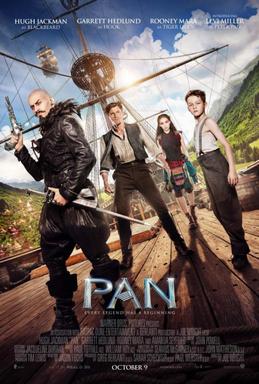
Behind the film
- Year
- 2015
- Director
- Joe Wright
- Writers
- Jason Fuchs
- Genres
- Fantasy, Adventure, Children's, Pirate
- Production
- Warner Bros. Pictures, RatPac-Dune Entertainment, Berlanti Productions
- Country
- United States, United Kingdom, Australia
- Cast
- Levi Miller, Rooney Mara, Amanda Seyfried, Garrett Hedlund, Nonso Anozie, Paul Kaye, Emerald Fennell, Kathy Burke
About the film
Contains story spoilers.
Mary leaves baby Peter at a London orphanage with a pan-flute pendant. Years later, pirates abduct him and take him to Neverland to mine Pixum, the fairy dust that keeps Blackbeard from ageing. Peter discovers he can fly, then escapes with James Hook and Smee. Searching for Mary, he meets Tiger Lily, whose Memory Tree reveals his fairy father's sacrifice. Tiger Lily conceals that Mary has died; Blackbeard exposes the truth. Hook initially leaves, while Blackbeard takes Peter's pendant to enter the Fairy Kingdom. Hook returns to help, and Peter finally masters flight to save him. Peter rallies the fairies, defeats Blackbeard and sees a vision of Mary. He returns to London with Hook and Tiger Lily to rescue Nibs and the orphans, who become the Lost Boys. Peter and Hook remain friends.
Jason Fuchs built this origin story around Peter's search for his mother. He told Creative Screenwriting that the question of how Peter reached Neverland had stayed with him since a Disneyland ride stalled above its miniature London while he was visiting with his father. His late-2012 pitch initially found no buyer. A meeting with Warner Bros. executive Sarah Schechter led to producer Greg Berlanti joining the project, and Fuchs wrote the first draft over ten weeks in summer 2013. Wright read it within two months of its submission. Fuchs pictured Hugh Jackman as Blackbeard while writing and wanted Garrett Hedlund for Hook. Although he planned a large fantasy world with room for action, he described the story's emotional centre as a child trying to find his mum, with a family audience in mind.
Hook's place beside Peter changes the familiar arrangement of J. M. Barrie's characters. In Tim Lammers's interviews, Fuchs named Wicked as an example of revisiting known figures through a different context. His Hook was an unfinished, selfish adventurer, conceived along the lines of Treasure of the Sierra Madre or Indiana Jones, with traces of the later captain. Hedlund recalled Wright imagining someone from a John Ford western, a man who might otherwise have been content riding a horse across a prairie. The actor's Minnesota upbringing also helped determine the character's accent. These ideas gave the young Hook a route into an adventure shared with Peter, before the antagonism associated with their familiar story.
Wright wanted Neverland to carry the texture of objects made by hand. In his interview with Edward Douglas, he connected that wish to his mother's puppet theatre and described photographing small physical models so their surfaces could be mapped onto digital creatures. His sister, a puppeteer, developed the Neverbird model. Foreground sets gave performers something tangible to work with, while digital extensions enlarged the spaces around them; the final Fairy Kingdom was a computer-generated environment. Landscape photography in Vietnam supplied further material. Wright had looked through National Geographic for real places that could be combined in unfamiliar ways. He privately imagined Peter assembling Neverland from fragments of the world, using that idea to guide the design. The imagination concept was a working explanation for Wright rather than an explicit revelation that Peter's adventure had been a dream. Tiger Lily's action role was already in the screenplay, and Wright and Schechter pushed to realise it.
The contrast between London and Neverland also shaped the sets. Reporting from Leavesden before release, Grae Drake described walking through a forest of real greenery and coming upon two large pirate ships in front of green screens. The designs combined references from Mexican crystal caves and Parisian streets with tents and huts. Wright's colourful Neverland stood against the largely monochromatic wartime England of the opening. Hedlund's Hook still had both hands in this earlier adventure.
Framestore divided more than four hundred effects shots between London and Montreal. The journey into Neverland moved through space, clouds and floating balls of water containing fish and ships. A new system for clouds built from volumes let the environment, effects and lighting departments work on the same cloudscape, with individual arrangements for each shot. Montreal created the underground mine entirely digitally, allowing the team to change lighting direction without rebuilding a physical set. Its crowds needed to convey the size of the mine while leaving individual figures readable. London extended the above-ground mine through digital matte painting, dividing the landscape into areas that could be reused across different views. The studio also developed Cara Delevingne's three mermaids after filming, using distinct personalities to guide their appearance and performance despite their shared face.
The mermaid photography required movements to be planned before the underwater illusion was added. Wright told Post that the actress was filmed dry, supported by a Kuka arm, while a motion-controlled camera followed movements worked out in advance. Simulated hair, tails, underwater lighting and diffusion came later. That sequence formed part of what he estimated were about sixteen hundred effects shots. His preparation included learning the vocabulary needed to discuss those shots with visual effects supervisor Chas Jarrett. Post-production stayed in London: Wright edited at home, with the effects department in a nearby office. Paul Tothill worked on set throughout filming, and William Hoy joined during post-production to handle action sequences. The film was photographed in 2D and converted for its 3D release, with stereographer Chris Parks involved in discussions before shooting began.