
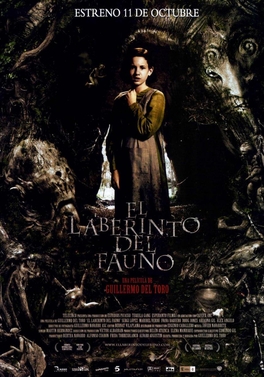
Behind the film
- Year
- 2006
- Director
- Guillermo del Toro
- Writers
- Guillermo del Toro
- Runtime
- 1h 58m
- Genres
- Fantasy, Drama, War, Teen
- Production
- Telecinco Cinema
- Country
- Mexico, Spain
- Cast
- Ivana Baquero, Ariadna Gil, Doug Jones, Sergi López, Maribel Verdú, Álex Angulo, Roger Casamajor, Federico Luppi
About the film
Contains story spoilers.
In 1944, Ofelia travels with her pregnant mother Carmen to a rural military outpost where Captain Vidal, her new stepfather, commands a campaign against anti-Francoist fighters hidden in the surrounding hills. Vidal has brought Carmen there because he wants his son born close to him. He treats the house as a command post, watches the time obsessively, and expects those around him to obey. Ofelia has her own interests: she carries books of fairy tales, studies the landscape, and resists being folded into Vidal’s household. The outpost’s doctor, Ferreiro, and its housekeeper, Mercedes, seem to offer different forms of care, though both are living under Vidal’s control.
A small insect leads Ofelia to an overgrown stone labyrinth near the house. There she meets a faun who says she is Princess Moanna, daughter of an underworld king, and that she can return to her kingdom if she proves her identity through three tasks. The faun gives her a book whose pages reveal instructions when she needs them. Ofelia cannot know whether to trust him: his body looks old and rooted in the earth, his manner shifts between encouraging and severe, and his promises arrive alongside danger. The fantasy plot therefore gives her a second authority to question while Vidal’s military rule tightens around everyone at the outpost.
The first task sends Ofelia beneath a dying fig tree to retrieve a key from a giant toad. She succeeds, but the mission leaves her dirty and frightened, and her concern soon shifts to Carmen’s worsening illness. The faun gives her a mandrake root to place under her mother’s bed and feed with blood. For a while, Carmen seems to improve. Ofelia’s next task takes her through a chalk-drawn doorway into a banquet room where the Pale Man sits motionless before a vast spread of food. She is warned not to eat. Tempted by grapes, she wakes the creature, which devours two fairies as she escapes with the dagger she came to find.
The danger in the fantasy realm is not separate from the violence outside it. Vidal rations food to weaken the villagers and the guerrillas, then uses brutal interrogation to search for resistance members. Mercedes appears to be a quiet servant, but she is carrying supplies to the fighters led by her brother Pedro. Ferreiro also helps the resistance and, when ordered to treat a captured fighter, ends the man’s suffering before Vidal can continue torturing him. Vidal kills the doctor after discovering his allegiance. Ofelia sees enough to understand that the captain’s cruelty is deliberate; the fairy-tale world gives her another language for facing a reality that the adults around her cannot safely challenge.
Carmen’s pregnancy becomes more dangerous as Vidal’s attention shifts to the baby he expects to inherit his name and authority. He discovers Ofelia tending the mandrake root. Carmen rejects her daughter's belief in it and throws it into the fire. Carmen immediately goes into labour and dies after giving birth to a boy. Vidal takes the child and dismisses Ofelia’s belief in magic as delusion. When he later identifies Mercedes as a rebel, she is captured and interrogated, but frees herself by cutting his face and escapes to the resistance. The faun returns to Ofelia with the final task: take her baby brother to the labyrinth. Vidal’s men and the guerrillas are now preparing for a direct confrontation.
Ofelia carries the baby to the centre of the labyrinth, where the faun asks for a small amount of the child’s blood. The task requires the blood of an innocent, but Ofelia refuses to hurt her brother. Vidal, who cannot see the faun, arrives and takes the baby from her. He shoots Ofelia before leaving the labyrinth. At the entrance, the resistance fighters surround him. Vidal passes the baby to Mercedes and asks her to tell his son the time he died, hoping the detail will preserve his family legend. Mercedes tells him the child will not even know his name, and Pedro kills him. The two stories meet in one final act of refusal: Ofelia rejects Vidal’s claim over the child, and Mercedes rejects his claim over the future.
As Ofelia dies, drops of her blood fall onto the labyrinth’s central steps. The film then shows her in a golden underworld court, reunited with the king and queen, who tell her that choosing her own blood rather than her brother’s completed the test. The faun recognizes her as Moanna. Whether the kingdom exists independently or belongs to Ofelia’s way of making sense of terror remains open to interpretation, but the final images present her choice as meaningful in both worlds. The ending does not erase the loss of her mother or the violence of Vidal’s defeat; it gives Ofelia a destination that the military household could never offer.
Guillermo del Toro connects the outpost’s hard surfaces, ration books and watchful routines with a labyrinth filled by handmade creatures and uncanny spaces. The fantasy sequences do not float away from the political story; their trials echo the choices Ofelia makes under Vidal’s authority. Practical makeup and animatronic details give the faun and the Pale Man a tactile presence, while the contrast between an immense feast and Ofelia’s precarious access to food makes the Pale Man’s room feel like another form of power. The film’s images stay close to a child’s view of the world without making the surrounding danger imaginary. Ofelia’s courage is expressed through what she refuses to do, not through a sudden ability to defeat the adults who hold power.