
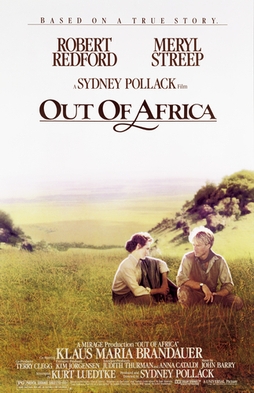
Behind the film
- Year
- 1985
- Director
- Sydney Pollack
- Writers
- Kurt Luedtke
- Genres
- Biographical, Drama, Romance, Adventure
- Production
- Mirage Studios, Universal Pictures
- Country
- United States
- Cast
- Robert Redford, Meryl Streep, Klaus Maria Brandauer, Michael Gough, Suzanna Hamilton, Michael Kitchen, Rachel Kempson, Leslie Phillips
About the film
Contains story spoilers.
Out of Africa is told from the distance between having a place and remembering it. Meryl Streep’s Karen Blixen looks back on a life begun with practical expectations and transformed by experiences that would not obey them. Sydney Pollack’s 1985 film follows her arrival in colonial Kenya, the demands of a coffee farm and a relationship with Denys Finch Hatton, played by Robert Redford. Its expansive landscapes belong to an intimate story about attachment: Karen wants to build and maintain a life, while Denys resists the ownership and permanence she associates with security. The romance develops within that disagreement rather than resolving it as soon as the characters fall in love.
Karen’s marriage to Bror provides her initial route into the new world. Klaus Maria Brandauer gives him charm without making him dependable, and the gap between the partnership she expects and the arrangement she receives becomes increasingly clear. The farm is harder to establish than the early plan suggests, and Bror’s absences leave her with much of its management. Work makes the place real in ways that arrival and social ceremony cannot. Karen has to learn from people already familiar with the land, negotiate practical problems and decide how much she is willing to invest. Her title and family connections give her advantages, but they cannot make the enterprise flourish by themselves.
The colonial setting also governs who is permitted to speak, own, enter or decide. European social circles treat their customs as if they naturally belong in a place whose existing communities have lives and knowledge of their own. Karen’s relationships with the people working on the farm, especially Farah, provide a perspective beyond her dealings with other settlers. The film still centres the experience of a European landowner and uses memory to shape that experience. Its beautiful images do not make the underlying system neutral. A careful understanding of its world has room for both the character’s growing attachment and the unequal arrangements that make her position possible.
War and illness interrupt the project of settling down. Karen undertakes a difficult supply journey during the wartime period, showing a determination that those around her do not always expect. Her marriage brings another kind of damage when she contracts an illness from Bror and returns to Denmark for treatment. Coming back does not restore the partnership she had imagined. Their separation leaves the farm, and the decision to remain, increasingly her own. Streep allows confidence and disappointment to coexist: Karen becomes more capable without ceasing to want companionship, and managing a household or a business does not protect her against the vulnerabilities of an intimate life.
Denys offers a relationship with a different rhythm. His absences are not simply Bror’s neglect repeated under another name; they are connected to an explicit desire to remain free of arrangements he believes would diminish the relationship. Karen finds that freedom attractive and painful. Shared journeys, conversation and flights over the landscape give their connection space to grow, but those pleasures cannot answer her wish for commitment. Pollack allows the aerial sequences to express how the world looks when ordinary boundaries fall away. On the ground, the characters have to face the question those views briefly suspend: whether loving someone means joining their life or accepting that parts of it will remain beyond reach.
The farm’s destruction by fire turns an already difficult enterprise into a loss Karen cannot absorb. Selling her possessions and arranging to leave gives the house a different meaning: objects that once signalled a new life become things to be dispersed. Her concern for the people whose livelihoods have been tied to the farm continues beyond the failure of her own plans. Denys’s later death in an aircraft crash removes the possibility of another meeting or a negotiated future. Karen can organise a funeral and give expression to grief, but she cannot make the relationship complete. The film places those losses together without treating one as a tidy symbol for the other.
David Watkin’s cinematography gives the landscape scale and changing light, while John Barry’s music helps the story move between public grandeur and private recollection. Streep’s measured narration connects those spaces to a person remembering rather than merely showing an attractive destination. Redford’s composed presence suits Denys’s resistance to explanation and possession; Brandauer’s sociability makes Bror’s failings more complicated than simple hostility. Farah’s steadiness gives Karen’s departure another emotional register. Parting from him means losing a voice and relationship embedded in the life she has built, not just surrendering land or leaving the man whose memory will dominate her story.
Kurt Luedtke’s screenplay draws on Karen Blixen’s writing and biographical material, shaping them into a historical romance rather than a complete factual record of every relationship. The pen name Isak Dinesen connects the experience to the writer Karen becomes, and the film’s final sense of distance belongs to that act of recollection. She cannot return the farm, Denys or the younger version of herself to their earlier positions. What remains is a remembered world, full of work, beauty, dependence and contradiction. The ending finds its force in that incompleteness: a life can matter deeply without becoming the permanent arrangement its owner hoped to secure.