
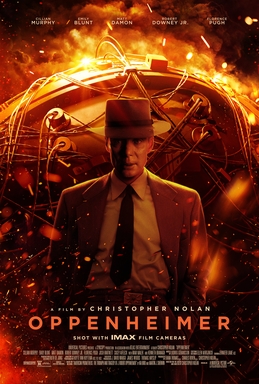
Behind the film
- Year
- 2023
- Director
- Christopher Nolan
- Writers
- Christopher Nolan
- Runtime
- 3h 0m
- Genres
- Historical, Biographical, Thriller, Epic
- Production
- Universal Pictures, Syncopy, Atlas Entertainment
- Country
- United States, United Kingdom
- Cast
- Cillian Murphy, Emily Blunt, Matt Damon, Robert Downey Jr., Florence Pugh, Josh Hartnett, Casey Affleck, Rami Malek
About the film
Contains story spoilers.
Christopher Nolan’s Oppenheimer follows the physicist from his early academic life into the Manhattan Project and the political hearings that reshape his public standing. Cillian Murphy plays a man whose quick mind and appetite for ideas make him an effective scientific leader, while also leaving him drawn to the people and arguments around him. The film does not cover every year evenly. It concentrates on choices that build toward Los Alamos, the first test, and consequences that arrive after the war, when the meaning of Oppenheimer’s achievement is no longer his to define alone. Its shape is closer to a pressure-filled drama than a simple cradle-to-grave biography.
In the earlier strand, Oppenheimer studies in Europe, returns to teach in the United States, and becomes connected to physicists, political activists and friends that include Jean Tatlock. His personal relationships and left-wing associations later become material for investigators. General Leslie Groves recruits him to direct the secret weapons laboratory at Los Alamos, New Mexico. Oppenheimer must bring together scientists more comfortable debating theory than working under military command, while persuading them that the project can be completed before Germany develops a bomb. Matt Damon’s Groves is a blunt partner: he needs Oppenheimer’s scientific authority and confidence, even as he keeps the project inside a strict military structure.
At Los Alamos, the film shifts from individual scientists to the pressure of a collective undertaking. Oppenheimer recruits colleagues, oversees the laboratory community and carries arguments about the bomb’s possible use into a place where practical deadlines dominate. Kitty Oppenheimer, played by Emily Blunt, is not simply outside this world: she navigates its social and political demands while dealing with her husband’s absences and the strains of their marriage. The film gives private domestic details real weight, especially the couple’s wordless way of signalling what Robert cannot discuss openly. Those small exchanges sit beside the immense secrecy surrounding the work, giving the family story its own tension.
The Trinity test is the film’s central turning point. Scientists and military personnel gather in the desert to see whether the device will work, and the sequence stretches anticipation through observation, waiting and sound before the detonation. The event resolves the project’s immediate technical question but opens a much larger one. Oppenheimer’s public role changes as the weapon is used against Japan; a celebratory speech becomes an assault on his senses, with stamping feet and imagined victims overwhelming the room. He can explain the physics, but he cannot control the decisions that follow or make the public celebration fit what he now imagines. Rather than treating the test as a clean finish, the narrative returns to it as a moment whose consequences continue to unfold in rooms far from the desert and among people who cannot discuss the work publicly.
The later material is shaped by two proceedings. Oppenheimer’s 1954 security hearing questions his past associations and judgment on nuclear policy, while Strauss’s Senate confirmation hearing revisits his own relationship with the scientist. Nolan marks most of Oppenheimer’s account in colour and the Strauss strand in black and white, following distinct points of view rather than offering a simple split between truth and falsehood. Strauss, played by Robert Downey Jr., believes Oppenheimer has mocked and diminished him; his recollection gives political conflict a personal edge. Editing lets a remark or decision echo across years, showing how grievance can acquire institutional force.
The film’s argument sharpens as Oppenheimer argues against a rapid expansion of the American arsenal, especially the hydrogen bomb, and the security apparatus treats his contacts as grounds for suspicion. The hearing strips away his access and influence through testimony, cross-examination and records he cannot answer on equal terms. Kitty’s testimony becomes a forceful intervention, but proceedings still leave him publicly damaged. Strauss, meanwhile, expects confirmation to secure a powerful government post, only to find senators examining the vendetta behind his account. The two tracks meet through consequences: one man loses standing in a closed hearing, while the other loses political support in public.
The final return to Oppenheimer’s conversation with Einstein changes the meaning of a scene Strauss has interpreted as a personal slight. Their subject is larger than Strauss: Oppenheimer recalls the fear that an atomic explosion could trigger a world-destroying chain reaction, then connects that fear to what the weapons have set in motion. The film closes on his vision of expanding nuclear arsenals rather than a completed scientific triumph. The conversation is a dramatic scene, not a transcript of a documented exchange. Within the story, it draws together his earlier theoretical anxiety and his later inability to direct the arms race. Particles, waves and flashes of imagined destruction have accompanied his thinking throughout the film; here that private visual language reaches beyond the laboratory. Strauss’s suspicion has helped damage one man’s reputation, but the ending turns back toward the consequences that neither scientist nor politician can contain.