
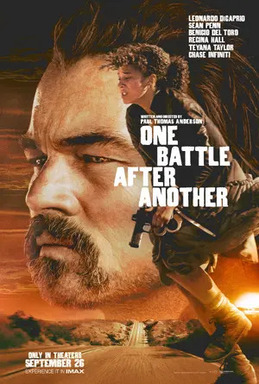
Behind the film
- Year
- 2025
- Director
- Paul Thomas Anderson
- Writers
- Paul Thomas Anderson
- Genres
- Drama, Thriller, Action, Crime
- Production
- Warner Bros. Pictures
- Country
- United States
- Cast
- Leonardo DiCaprio, Sean Penn, Chase Infiniti, Benicio del Toro, Regina Hall, Teyana Taylor, Wood Harris, Alana Haim
About the film
Contains story spoilers.
Paul Thomas Anderson connects an old revolutionary campaign to a family trying to survive its consequences. After French 75 member Perfidia betrays comrades, Pat and their daughter hide as Bob and Willa. Sixteen years later, Colonel Lockjaw hunts Willa to conceal the interracial relationship that threatens his admission to the white-supremacist Christmas Adventurers Club. Willa learns her mother's betrayal; Bob depends on community allies to find her. A DNA test confirms Lockjaw is her biological father. Willa escapes militia custody, kills her pursuer Tim after a car chase, and reunites with Bob. Lockjaw survives Tim's earlier attack, but the club later gases and cremates him. Bob gives Willa Perfidia's apologetic letter and eventually supports her departure for a protest. Survival changes their relationship without erasing the older generation's damage.
The title suggests a sequence of confrontations, but the film’s larger subject is how political struggle changes when people age, hide and raise children. The French 75 belongs to an earlier period of direct action; in Baktan Cross, the community’s resistance is woven into practical support, escape routes and local relationships. Bob’s old identity has not vanished so much as become a burden he carries without a clear language for explaining it. Willa inherits the consequences without inheriting the same memory. Her frustration is not a rejection of every cause her parents served; she is responding to the specific life Bob has built around secrecy. Their disagreement gives the film an intimate scale inside its broad, unstable political landscape.
Lockjaw turns private shame into a reason to exercise public power. The contradiction is particularly ugly because a man's anxiety about belonging becomes a danger imposed on a child. An institution's approval can encourage someone to deny the relationships that make up his own history. Within that logic, respectability means eliminating inconvenient evidence rather than behaving responsibly. The film's racial hierarchy is therefore also a machinery of personal cowardice. It creates a standard that cannot be satisfied through honesty, then gives its adherents reasons to become more violent in pursuit of acceptance. Lockjaw's authority looks formidable, but the need beneath it is humiliatingly dependent. His pursuit makes domination and insecurity appear as partners, rather than as opposite qualities.
Bob’s role as a parent is framed through mismatched forms of care. He wants to protect Willa, yet his secrecy and uneven attention make protection feel like surveillance. His memories of the French 75 are difficult to separate from the danger they pose, so he gives his daughter a simplified account that leaves her without the tools to understand the present. Willa’s discovery does not magically supply a complete history, but it allows her to judge the adults around her with more agency. The film’s emotional turning point is not simply that Bob finds her; it is that she tests him with the movement’s countersign and he meets that demand through recognition rather than force. Their embrace follows a moment when she could have treated him as another unknown threat.
Perfidia remains a powerful absence. The early scenes present her as charismatic, daring and capable of alarming choices, but the later family story cannot reduce her to either a revolutionary icon or a cautionary mother. Her betrayal harms the people who trusted her, while her later letter admits responsibility without demanding that Willa forgive her. The distance between her memory, Bob’s account and Willa’s own knowledge gives the film a useful tension: history arrives through testimony, but no single version can repair the years of absence. The film does not require Perfidia’s apology to settle the family’s future. Willa can carry the letter as information and still choose a path that belongs to her.
Anderson’s rapid shifts in pace, tone and scale make the world feel difficult to stabilize. A pursuit can veer into absurdity, and a comic exchange does not cancel the danger around it. The California settings move between community spaces, institutional corridors, hidden passages and open roads; each changes what protection looks like. Sergio’s karate teaching and neighborhood leadership connect Willa’s ordinary routine to a network capable of acting when official systems become hostile. The film’s movement is not merely a succession of chases: it places the body under pressure, then pauses to show who can offer shelter, information or a way out. Its ending grants no clean victory over the structures that produced Lockjaw, but it lets Willa leave for a protest with Bob’s blessing, carrying a choice rather than an inherited script.
The different meanings of concealment are worth keeping in view. For a threatened family, hiding can preserve the possibility of an ordinary life. For a powerful persecutor, hiding can preserve the ability to hurt others. Those motives can produce similar outward behavior while having completely different stakes. The distinction matters because the story refuses to make openness an effortless virtue: being known can be dangerous. What Bob owes Willa is not unrestricted disclosure to the world, but a more honest relationship with the person who lives with his precautions. She needs enough knowledge to exercise judgment herself. That makes independence something more difficult than rejecting a parent's politics or repeating them. It means deciding which responsibilities belong to her, with a clearer account of the history she has inherited.